
In the push for AI adoption, the gap between a promising prototype and a core business process is where most enterprises fail. While three-quarters of employees in Singapore use AI tools individually, only 15% of SMEs have managed to integrate AI at an enterprise level. The challenge, as Singapore’s Minister for Digital Development and Information Josephine Teo recently articulated, is not one of technology, but of capacity.
“The staff must have the ability to bring what was just a prototype, something more likely to be at the fringe, to the core of the company… So bringing things from the fringe to the core is not a capacity that gets built overnight. You need to invest in growing it.” – from Josephine Teo’s Opening Remarks at the Launch of Microsoft’s AI QuickStart Programme
Complicating this gap is also the reality that enterprise AI adoption is more complex than regular usage of chat-based interfaces for workflow automation. Aspects like security, data quality, and clear ROI need to be factored in to beat the odds (referring to the well-circulated MIT study on 95% of enterprise AI pilots not achieving ROI).
This “capacity gap” is precisely where the venture opportunity in enterprise AI lies. As Singapore commits over S$1 billion to its National AI R&D Plan for 2025-2030, focusing on Fundamental AI, Applied AI, and Talent Development, a new generation of startups have been developing this capacity for enterprise, turning Singapore’s vision into market reality.
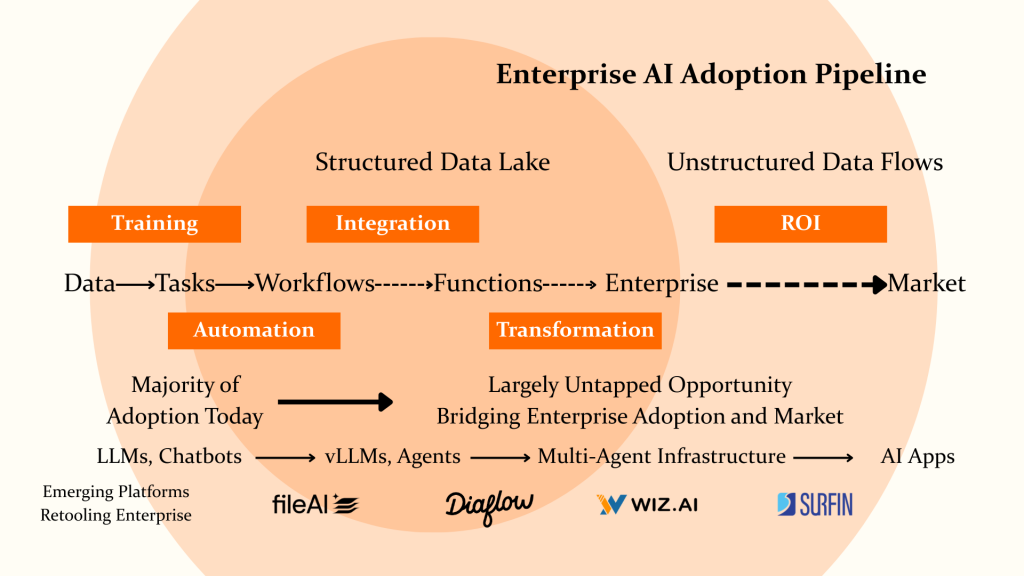
(1) Building Capacity through a Holistic Approach: For seven years, WIZ.AI has been at the forefront of bringing AI to the core of enterprise customer engagement. At the heart of their approach is a combination of patented technology and meaningful partnership with their customers, not just a use case or project level, but at an organizational level.
(2) Building Capacity at the Long Tail: True adoption is not just about the “sexy” use cases but transformation even in the most mundane ones. Eezee, for example, recently raised funding on top of the evolution of their platform from long-tail procurement marketplace and integration into procurement workflow automation.
(3) Building Capacity for Complexity: The real challenge for enterprise AI is automating not just individual tasks, but entire complex workflows at scale and with governance. This is the mission of Diaflow, an AI agentic automation platform we recently partnered with. The company combines no-code user experience with enterprise grade security to close the gap between non-technical users and highly customized enterprise needs.
(4) Building Capacity through Scale: Surfin‘s experience delivering AI-powered financial services to over 10 markets globally has helped the company develop AI-as-a-Service solutions for fintech leaders and financial service institutions, as is the case with their recent partnership with a leading Mongolia fintech group.
(5) Building Capacity through Data: fileAI‘s data preparation platform does not supercharge enterprise’s ability to develop internal automation independent of horizontal LLMs but also create a more sustainable approach to workflow automation, where the long-term fidelity of data sources often poses a risk in the “supply chain” of automation.
For Southeast Asia’s enterprises, the journey from AI curiosity to core competency is a defining challenge of this decade. The venture opportunity lies with the startups that are not just selling AI as a feature, but delivering it as a fundamental capacity-builder, aligning perfectly with the region’s national innovation priorities.
Follow us on LinkedIn for more insights and updates from our team and portfolio.

Paulo Joquiño is a writer and content producer for tech companies, and co-author of the book Navigating ASEANnovation. He is currently Editor of Insignia Business Review, the official publication of Insignia Ventures Partners, and senior content strategist for the venture capital firm, where he started right after graduation. As a university student, he took up multiple work opportunities in content and marketing for startups in Asia. These included interning as an associate at G3 Partners, a Seoul-based marketing agency for tech startups, running tech community engagements at coworking space and business community, ASPACE Philippines, and interning at workspace marketplace FlySpaces. He graduated with a BS Management Engineering at Ateneo de Manila University in 2019.




 Home
Home

 Publications
 Podcasts
  Search