
Visa, Amazon Web Services, Stripe, and TSMC all built their industries’ plumbing without giving up the customer they started with. Three Southeast Asian fintechs are attempting the same move. Their odds look better once you know what happened the last four times.
Visa began in 1958 as BankAmericard, a single credit card program run by Bank of America out of Fresno, California [1]. A rival scheme, Master Charge, started gaining ground in the mid-1960s, so in 1966 Bank of America began licensing its card to other banks. By 1970 the bank had given up direct control entirely: the issuing banks formed a cooperative, National BankAmericard Inc., to run the network themselves [1]. Renamed Visa in 1976, it became the standard nearly every bank plugged into. It got there by sharing ownership, not by outspending its rivals.
Amazon Web Services has an equally unglamorous origin. In 2006, Amazon’s engineers were losing too much time provisioning servers for the retail business, so the company built S3 and EC2 to fix that internally, then decided to rent the same infrastructure to anyone who wanted it [2]. Amazon’s own framing of the ambition was that a kid in a college dorm room should be able to access the same computing power as a Fortune 500 company [2]. Raw servers were about as commoditized a product as software gets. AWS kept its lead by constantly building new services on top of them: managed databases, machine learning tools, industry-specific offerings, one after another, faster than rivals could catch up on the last one.
Stripe launched into an already crowded payments market in 2010, competing against PayPal, the major banks, and Braintree. Instead of fighting harder on processing fees, it built outward: Issuing for card programs, Capital for lending, Atlas for business formation, Treasury for embedded banking, and half a dozen more product lines, each one large enough, by one analyst’s estimate, to be its own billion-dollar business [3]. A basic payments API is a commodity. A dozen of them wired together, with a developer experience competitors spent years trying to match, is not.
TSMC took a different route to a similar place. Founded in 1987 as the semiconductor industry’s first pure-play foundry, it manufactured chips designed by other companies rather than designing its own [4]. Apple started making chips there around 2010; Nvidia followed. By 2024, Apple alone accounted for roughly a quarter of TSMC’s revenue, and TSMC held 64% of the global foundry market [4]. Apple and Nvidia are each worth several times what TSMC is worth. Neither has built a competing fab. Nearly four decades of accumulated manufacturing expertise turned out to be the one thing a bigger balance sheet couldn’t simply buy.
None of these four companies left its original customer behind on the way to becoming infrastructure. Visa still exists to serve cardholders, just reached through banks instead of directly. AWS still runs Amazon’s own retail systems alongside everyone else’s. Stripe and TSMC both kept the direct relationships that taught them what to build next. Three Southeast Asian fintechs are running an early version of the same play, serving the same kind of end user twice over: once directly, once through whoever they’ve quietly become infrastructure for.
Reaching the Same Customer Twice
Flip runs Flip Globe, a consumer remittance app that now reaches more than 60 countries, and Flip for Business, an API that lets other remittance companies move money through Flip’s Indonesia-licensed rails [5][6]. StraitsX has no consumer app of its own, and still reaches millions of everyday spenders through RedotPay, the crypto card platform that ran $2.95 billion in volume in 2025 on StraitsX’s infrastructure [7]. Surfin lends directly to more than 90 million people while licensing its credit-scoring models and voice agents to banks and government agencies, including the Philippine Social Security System, which uses Surfin’s technology to serve Filipino overseas workers [8].
Framed as a choice between winning consumers and becoming infrastructure, this can look like a trade each company made. It isn’t one. All three reach the same kind of end user through two channels running at the same time, which is much closer to what Visa, AWS, Stripe, and TSMC actually did than it is to picking a side.
The Same Pressure, Right on Schedule
Each company is running into a real version of the pressure that hit its predecessors. StraitsX’s stablecoins were already live on Ethereum, Polygon, Avalanche, and Arbitrum before they extended to Solana in early 2026 with native support for x402, the protocol that lets AI agents pay each other without a person approving the transaction. That bet now competes in a market where Tether and Circle controlled roughly 87% combined as of April 2026, and where Stripe, Visa, BlackRock, American Express, Google, and more than 140 other companies have since formed a rival consortium coin called Open USD [9]. Flip’s Business API is pitching cheaper, faster transfers into corridors Xendit already serves, competing too against Wise Platform, the company whose rails power Flip Globe itself [5][6][10]. And Surfin’s CEO, Dr. Yanan Wu, has named the limit on its AI licensing plainly: the large models “are owned by the mega companies,” leaving Surfin to compete on vertical depth rather than raw scale [8].
None of this is a new kind of problem. It’s the one every infrastructure business runs into once its early advantage starts looking replicable: a bigger, richer player notices the layer is valuable and decides to occupy it too.
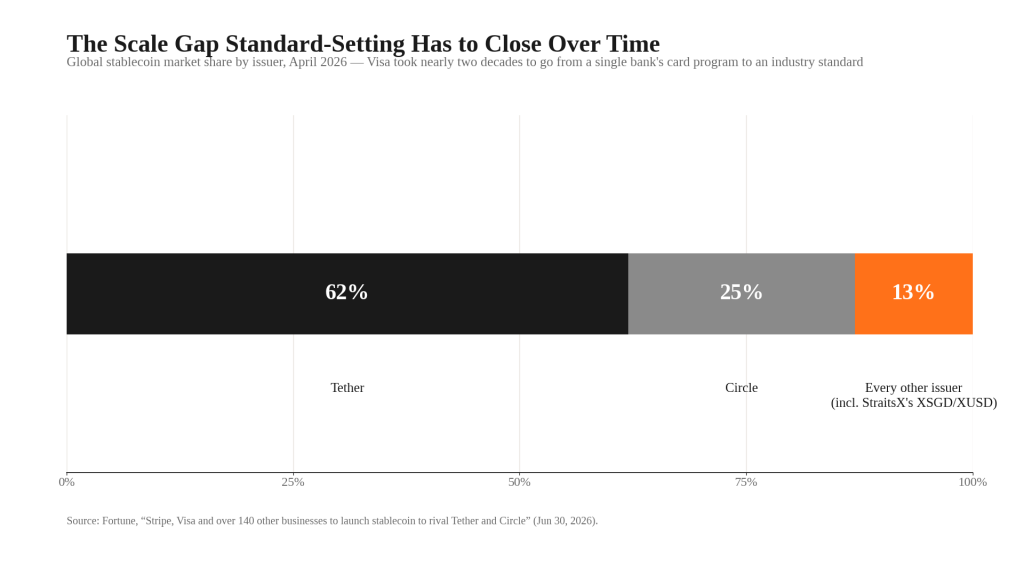
Global stablecoin market share by issuer, April 2026. Source: Fortune.
What Separates the Winners From the Commoditized
Sharing the standard. Visa’s cooperative structure worked because Bank of America gave up something first, exclusive ownership, in exchange for a network no single rival bank could match on its own. StraitsX holds a comparable position without having had to give up much of anything yet. Its founding seat at Singapore’s BLOOM settlement initiative sits it alongside Circle, Coinbase, DBS, Stripe, and, since August 2026, Visa itself [11][12]. That kind of seat took Visa nearly two decades to earn. StraitsX has a version of it years ahead of what its raw stablecoin market share would suggest it deserves.
2025 annualized card volume across three infrastructure models. Source: CoinDesk.
Building past the base layer. Stripe and AWS both faced the same trap Flip is in now: a thin, price-competitive layer that any well-funded rival could match. Both got out of it by adding higher-value services faster than competitors could copy the last one, until the base layer became an entry point rather than the whole business. Flip’s API, six corridors deep against Flip Globe’s 60-plus, is closer to where Stripe and AWS started than to where they ended up. What happens on top of that base layer over the next few years will decide whether it becomes a floor to build from or stays a thin, price-competitive product indefinitely.
Depth that compounds. TSMC shows what a moat looks like when capital alone can’t buy it. Surfin’s 600,000 behavioral features modeled across ten markets, drawn from nine years of underwriting first-time borrowers through multiple economic cycles, works the same way [8]. It has to be built one market, one credit cycle, one dataset at a time. Wu’s own admission that general-purpose AI belongs to the mega-cap labs is really an argument for staying in the lane where depth compounds, vertical, regulated, emerging-market data, instead of trying to compete where it doesn’t.
What to Watch
Whether Flip, StraitsX, and Surfin pull this off will come down to specifics, not the strategy itself. Watch whether StraitsX’s BLOOM seat converts into settled transaction volume before Open USD gets meaningful distribution in Southeast Asia. Watch whether Flip adds services on top of its Business API, the way Stripe added Issuing and Capital, rather than competing on price alone. Watch whether Surfin’s behavioral dataset keeps growing faster than a foundation-model company’s ability to approximate it.
The pattern is unlikely to stay limited to these three. Southeast Asia has plenty of fintechs built around a single consumer product in markets where acquiring the next customer keeps getting more expensive, and the B2B2C route out isn’t specific to remittances, stablecoin cards, or lending. Watch which other regional players start licensing their compliance stack, their rails, or their data rather than just their app. Watch how the banks and card networks already operating in the region respond: building competing infrastructure, buying into it the way Visa joined BLOOM, or ceding the layer altogether. Watch whether regulators treat this as worth standardizing the way Singapore’s MAS has with BLOOM, or leave each company to negotiate its own path market by market. Visa, AWS, Stripe, and TSMC each found their own version of that combination, at their own pace, under their own pressure. There’s no reason to assume Flip, StraitsX, and Surfin, or the fintechs that follow them, can’t find theirs too.
References
- Wikipedia — “Visa Inc.”
- Amazon Web Services — “Our Origins”
- technically.dev — “What does Stripe do?”
- Encyclopaedia Britannica — “Taiwan Semiconductor Manufacturing Co.”
- Flip Tech Blog — “Helping Our Flip for Business Customers Go Global”
- Indoconnect Singapore — “Flip Expands International Remittance Service to Over 60 Countries”
- CoinDesk — “Stablecoin payments go ‘invisible’ in Southeast Asia as crypto card business surges” (March 29, 2026)
- Insignia Business Review — “Dr Yanan Wu on why Surfin cannot remain a consumer fintech as it grows beyond 100M users across 12 markets” (June 22, 2026); “Surfin CEO and founder Yanan Wu on Building a Global Financial Inclusion Platform with Agentic AI” (February 12, 2026)
- Fortune — “Stripe, Visa and over 140 other businesses to launch stablecoin to rival Tether and Circle” (June 30, 2026)
- Wise Newsroom — “Flip partners with Wise Platform to Power Faster, Cheaper International Payments for Millions of Indonesians”
- Hubbis — “MAS Launches BLOOM Initiative to Extend Settlement Capabilities” (October 17, 2025)
- Tech Times — “Visa Becomes First Card Network in MAS-Supervised Stablecoin Settlement” (August 25, 2026)

Paulo Joquiño is a writer and content producer for tech companies, and co-author of the book Navigating ASEANnovation. He is currently Editor of Insignia Business Review, the official publication of Insignia Ventures Partners, and senior content strategist for the venture capital firm, where he started right after graduation. As a university student, he took up multiple work opportunities in content and marketing for startups in Asia. These included interning as an associate at G3 Partners, a Seoul-based marketing agency for tech startups, running tech community engagements at coworking space and business community, ASPACE Philippines, and interning at workspace marketplace FlySpaces. He graduated with a BS Management Engineering at Ateneo de Manila University in 2019.



 Home
Home

 Publications
 Podcasts
  Search