
As Wall Street megabanks and global asset managers scramble to tokenize trillions in bank deposits, a quiet structural revolution is unfolding across modern commerce: money movement is detaching from the balance sheets that once monopolized it. From JPMorgan’s deposit token initiatives in New York to StraitsX’s multi-currency settlement rails in Singapore, the competitive battleground for global trade is no longer fought on proprietary banking stacks—it is fought on open, interoperable settlement platforms. In this feature, Insignia Business Review analyzes why open platform rails are outpacing closed bank silos and how licensed regional gateways are setting the operational blueprint for international money movement.
Key Takeaways
-
The Wall Street Tokenization Push: U.S. G-SIBs (JPMorgan Chase, Bank of America, Citi, Wells Fargo) and asset servicing leader BNY are moving live funds onto blockchain rails, attempting to defend balance-sheet deposits against a surging $226 billion B2B stablecoin market.
-
The Platform Imperative: Proprietary bank tokens create isolated balance-sheet silos. In contrast, platform models—led globally by Circle and Open USD, and regionally in Asia-Pacific by StraitsX—offer shared, open settlement infrastructure that financial institutions plug into directly.
-
StraitsX as Asia’s Regional Benchmark: Holding MAS Major Payment Institution licenses across six regulated categories, StraitsX demonstrates how local currency stablecoins (XSGD/XUSD) power $18B+ in onchain volume, 40x card volume growth via Visa BIN sponsorship, and cross-border corridors under MAS’s Project BLOOM.
-
The AI & Interoperability Frontier: As StraitsX deploys native Solana rails supporting the x402 protocol for machine-to-machine AI payments, open regional platforms are establishing the blueprint for multi-jurisdictional financial infrastructure.
1. The Tokenization Crossroads: Wall Street Deposit Silos vs. Open Settlement Platforms
The world’s largest financial institutions are executing an aggressive pivot toward blockchain infrastructure. U.S. global systemically important banks (G-SIBs)—including JPMorgan Chase, Bank of America, Citi, and Wells Fargo—recently confirmed plans to launch a shared tokenized deposit network through The Clearing House [1]. Simultaneously, BNY announced the migration of its $8.6 trillion transfer agency business onto distributed ledger rails to establish a single digital ownership record for tokenized funds [3].
These Wall Street announcements signal monumental institutional validation. However, they also reflect a fundamental structural constraint: closed banking consortia building proprietary technology in the hope that external market participants will adapt to their proprietary ledgers.
Against these bank-owned initiatives stands a more disruptive, fast-scaling paradigm: the payments rail itself is becoming the standalone platform product.
This platform shift is defined by three distinct architecture models operating at scale today:
-
Circle’s USDC Network: An issuer-driven global network with 55 enrolled financial institutions and 74 under review, processing $5.7 billion in annualized transaction volume across neutral infrastructure [6].
-
Open USD: A multi-corporate stablecoin consortium launched on July 1 with over 140 enterprise co-owners—including Visa, Mastercard, Stripe, Coinbase, and BNY itself [1].
-
StraitsX: Singapore’s premier Monetary Authority of Singapore (MAS) licensed settlement layer, which has moved over $18 billion in combined onchain volume while serving as the primary regional card-issuing gateway for Asia-Pacific platforms [4].
Together, Wall Street’s tokenization offensive and StraitsX’s regional expansion point to a unified structural reality: money movement is unbundling from legacy banking stacks, and open platforms—not bank silos—are becoming the default infrastructure for global trade.
2. Live Banking Deployments: JPMorgan Kinexys, BNY, and the Deposit Token Defensive
Wall Street’s move toward tokenized money is driven by measurable market displacement. B2B stablecoin settlement volume reached $226 billion in 2025, expanding from a monthly run rate under 6 trillion in commercial bank deposits** could eventually migrate into stablecoin alternatives [1].
In response, major institutions are bringing live blockchain products into production:
-
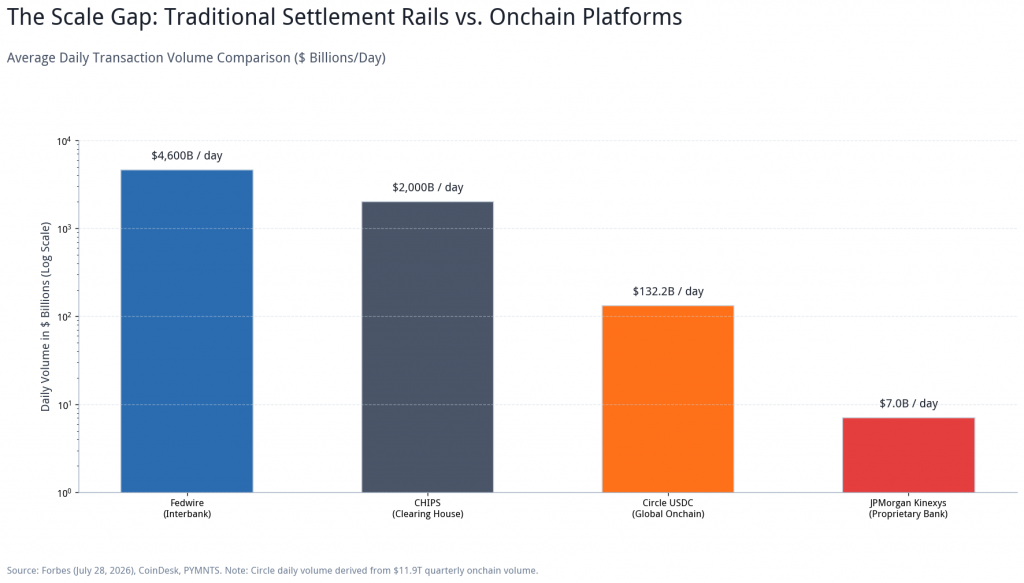
JPMorgan’s Kinexys Platform: Averages over $7 billion in daily transaction volume and has cleared more than $4 trillion in cumulative value. Its proprietary JPMD deposit token achieved general availability on the Base network in November 2025 [1].
-
Citi Token Services: Runs live commercial liquidity and trade finance management across the U.S., U.K., Singapore, and Hong Kong [1].
-
BNY Transfer Agency Infrastructure: Powers Baillie Gifford’s management of $261 billion in assets on the U.K.’s first fully regulated tokenized fund, with BlackRock and BNY’s Dreyfus unit preparing subsequent product rollouts [3].
“We think of BNY as modernizing a function that sits behind every single fund transaction by bringing the books and records onchain,” noted Carolyn Weinberg, Chief Product and Innovation Officer at BNY [3].
However, bank leadership acknowledges that tokenized deposit rails operate alongside legacy rails rather than replacing them. “We fully recognize you’ve got trillions and trillions of dollars’ worth of funds that… will continue to exist on traditional rails,” stated Emily Portney, Global Head of Asset Servicing at BNY [3].
To protect bank balance sheets, U.S. lawmakers enacted the GENIUS Act, which specifically excludes bank deposit tokens from the statutory definition of payment stablecoins [1]. This regulatory framing allows banks to issue tokenized deposits without separate stablecoin licensing, ensuring deposit assets remain on bank balance sheets to fund commercial lending rather than sitting as segregated reserves.
3. The Three Platform Models: Circle, Open USD, and StraitsX
While Wall Street megabanks establish deposit token frameworks, platform-first infrastructure providers have deployed battle-tested rails that third-party institutions plug into directly.
1. The Global Issuer Platform: Circle’s USDC Network
Circle demonstrates the global issuer model. USDC circulating market capitalization reached $75.3 billion at year-end 2025 (+72% YoY), while quarterly onchain transaction volume surged 247% to $11.9 trillion [6].
Through the Circle Payments Network (CPN), Circle has onboarded 55 financial institutions with 74 additional applications under review, offering turnkey real-time settlement, foreign exchange execution (StableFX), and tokenized treasury liquidity (USYC) [6]. Enterprise adopters include Visa (direct USDC settlement for acquirers) and Intuit (embedded B2B invoice settlement) [6].
2. The Multi-Corporate Consortium: Open USD
Open USD provides a multi-entity alternative: over 140 corporate members co-own the economic yield and reserve backing of a unified stablecoin framework [1].
Launched on July 1, Open USD’s members include BNY, Visa, Mastercard, Stripe, and Coinbase [1]. Notably, BNY and Visa simultaneously participate in bank-led deposit token initiatives—underlining how institutional leaders diversify risk across consortium platforms and bank networks alike.
3. The MAS-Licensed Regional Gateway: StraitsX
Formed in 2020 through the combination of Singapore payment provider Xfers and Indonesian fintech Payfazz, StraitsX holds Major Payment Institution (MPI) licenses from the Monetary Authority of Singapore (MAS) across six distinct payment service categories. Its flagship regional stablecoins—XSGD and XUSD—have executed over $18 billion in cumulative onchain volume [4].
Rather than competing for direct consumer wallet downloads, StraitsX operates as a wholesale infrastructure layer. It serves as the Visa BIN Sponsor for prominent digital asset card programs, including RedotPay, OKX, Pionex, and Tapeeze [4]. Between Q4 2024 and Q4 2025, StraitsX’s sponsored card business recorded a 40-fold surge in transaction volume and an 83-fold increase in active cards issued [4].
“No user cares about whether a payment runs on stablecoins or fiat; they only care if the payment goes through,” emphasized Tianwei Liu, Co-Founder and CEO of StraitsX [4].
4. Why Proprietary Bank Token Networks Face Governance Bottlenecks
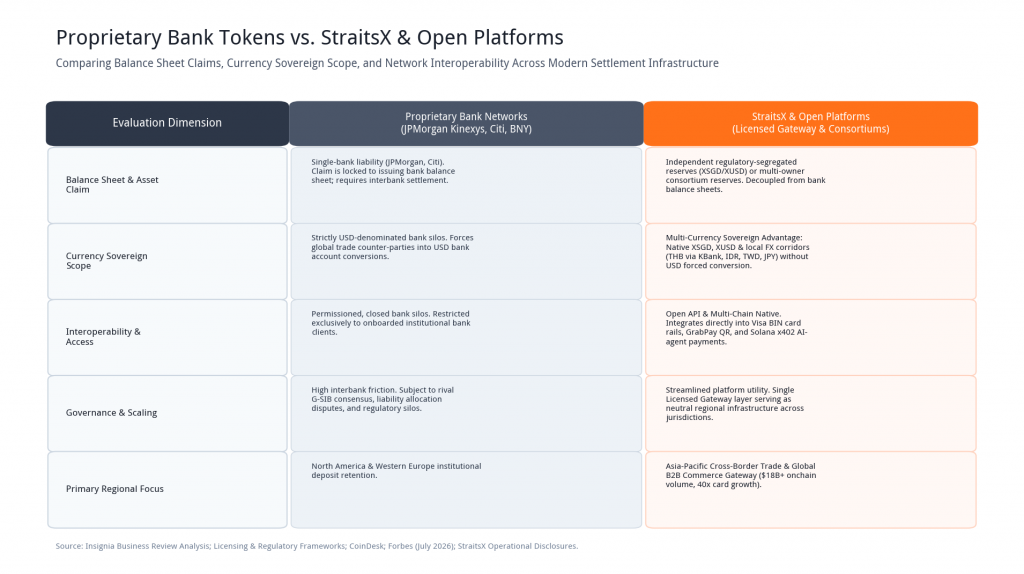
The primary operational hurdle facing Wall Street deposit token networks is balance-sheet isolation: a proprietary bank token represents an exclusive liability of its issuing institution.
A JPMorgan deposit token is a claim on JPMorgan Chase, redeemable only by JPMorgan account holders. If a corporate treasurer attempts to settle a payment with a vendor banking at Citi or Bank of America, the proprietary token cannot clear natively across bank balance sheets without a centralized interbank intermediary.
As former Treasury Under Secretary Nellie Liang highlighted in a Brookings Institution analysis, true interbank settlement of deposit tokens across private permissioned blockchains “does not exist in production today” [1].
The volume gap reinforces this structural challenge:
-
CHIPS clears $2 trillion daily [1].
-
Fedwire processes $4.6 trillion daily [1].
-
JPMorgan’s Kinexys clears $7 billion daily [1].
Historically, banking consortia have struggled with shared governance. While Zelle succeeded in processing $1.2 trillion in 2025 under direct competitive pressure from Venmo, trade finance consortia—including we.trade, Marco Polo, and Contour—all shut down between 2022 and 2023 due to alignment disputes [1]. Resolving shared balance-sheet exposure between competing G-SIBs remains a formidable governance challenge.
5. Asia-Pacific Execution: StraitsX, Project BLOOM, and Solana x402 AI Settlement
StraitsX’s regional execution illustrates how licensed, single-regulator platforms scale frictionlessly across international borders without requiring interbank balance-sheet mergers.
While XSGD holds over 70% of the non-USD stablecoin market share in Southeast Asia, StraitsX is expanding its footprint by deploying both XSGD and XUSD natively on Solana to support the x402 protocol—an open standard tailored for automated machine-to-machine and AI-agent micropayments [4].
Under MAS’s Project BLOOM initiative, StraitsX activated a live cross-border payment corridor linking KBank’s Q Wallet in Thailand directly to XSGD settlement in Singapore, with active expansion corridors launching across Taiwan, Japan, and Hong Kong [4][5].
“By embedding XSGD into established consumer rails like GrabPay and Q Wallet by KBank, we’re showing how trusted digital assets can deliver real-time settlement, transparent FX conversion, and interoperability at scale,” stated Tianwei Liu [5].
By combining MAS-compliant regulatory licensing with open API card rails and merchant QR integration, StraitsX delivers high-velocity cross-border settlement across key Asia-Pacific growth corridors.
6. Strategic Outlook: Why Open Settlement Platforms Are Winning Global Money Movement
The simultaneous deployment of bank deposit tokens on Wall Street alongside the rapid scaling of Circle globally and StraitsX across Asia points to a decisive structural transition: money movement is unbundling from legacy institutional stacks.
Global financial leaders face a clear choice:
-
The Closed Bank Approach: Building isolated, bank-owned token networks that require complex interbank governance and custom bilateral connectors.
-
The Open Platform Approach: Plugging into licensed, purpose-built settlement layers designed from day one to function as shared, multi-jurisdictional utility infrastructure.
While Wall Street megabanks will continue tokenizing internal deposit balances to optimize liquidity, the future of global B2B payments belongs to open platform rails. In modern financial architecture, the rail is no longer just back-office piping—the rail is the business itself.
References
-
Zennon Kapron, “America’s Biggest Banks Are Building One Deposit Token. History Is The Hard Part.,” Forbes, July 28, 2026. Forbes Article Link
-
Omkar Godbole, “JPMorgan, Bank of America, Citi to start blockchain offensive with shared tokenized network,” CoinDesk, June 5, 2026. CoinDesk Article Link
-
Olivier Acuna, “BNY targets $8.6 trillion transfer agency market on blockchain rails,” CoinDesk, July 29, 2026. CoinDesk Article Link
-
Francisco Rodrigues, “Stablecoin payments go ‘invisible’ in Southeast Asia as crypto card business surges,” CoinDesk, March 29, 2026 (updated March 30, 2026). CoinDesk Article Link
-
StraitsX Editorial Team, “StraitsX to Extend Payment Network Across Asia, Advancing Stablecoin-Native Cross Border Settlement,” StraitsX Blog, November 4, 2025. StraitsX Blog Link
-
PYMNTS Editorial, “Circle Bets on 2026 Growth After Stablecoin Transactions Skyrocket 247%,” PYMNTS.com, February 25, 2026. PYMNTS Article Link

Paulo Joquiño is a writer and content producer for tech companies, and co-author of the book Navigating ASEANnovation. He is currently Editor of Insignia Business Review, the official publication of Insignia Ventures Partners, and senior content strategist for the venture capital firm, where he started right after graduation. As a university student, he took up multiple work opportunities in content and marketing for startups in Asia. These included interning as an associate at G3 Partners, a Seoul-based marketing agency for tech startups, running tech community engagements at coworking space and business community, ASPACE Philippines, and interning at workspace marketplace FlySpaces. He graduated with a BS Management Engineering at Ateneo de Manila University in 2019.



 Home
Home

 Publications
 Podcasts
  Search