
In March 2023, Yang Zhilin, a Carnegie Mellon-trained researcher who had worked at Meta and Google, co-founded Moonshot AI in Beijing. Twenty-nine months later, the company is closing in on a $50 billion valuation, dismantling its own corporate structure to qualify for a Hong Kong listing it hopes to complete before the year is out, and answering for a model that has become both a geopolitical flashpoint and, increasingly, part of the infrastructure US companies quietly run on (CryptoBriefing; Briefs.co; Nikkei Asia). Few company timelines compress that much distance, that fast.
Moonshot’s rise is not an isolated anomaly; it sits at the epicenter of a high-stakes, hyper-capital-intensive global arms race. Across Silicon Valley and Beijing, frontier labs are locked in a relentless treadmill where maintaining parity requires exponential spending per model generation. In the US, OpenAI, Anthropic, and Google commit tens of billions annually to cluster scale, specialized silicon, and data acquisition. In China, challenger labs like DeepSeek, Qwen, and Moonshot push open-weight capability boundaries while navigating tight export controls and constrained compute access. For foundation model builders, valuation surges are not merely milestones of success—they are the minimum entry stakes required to remain in the training race.
Yet, as frontier labs push the limits of scale, the cost structure of staying at the cutting edge is reshaping the entire software landscape. For enterprise AI adoption, every leap in foundation model capability introduces new dependencies, volatile API cost dynamics, and rapid model obsolescence. But for companies deciding not to enter the frontier training race at all, Moonshot’s surge and its accompanying friction carry a clear lesson. A cluster of Southeast Asia-headquartered AI companies—fileAI, Diaflow, WIZ.AI, Gani.ai, and Surfin—all based in Singapore, is built on the opposite bet: that the more durable business in AI right now is not the one racing to own the foundation model, but the one that owns the workflow sitting on top of it, regardless of whose model is underneath.
What the Climb Actually Cost
Moonshot released its Kimi chatbot to the public in November 2023, notable mainly for accepting 128,000 tokens of context, more than any model on the market at the time (Wikipedia). Growth followed the model’s ability to read long documents and search the web, and by early 2024 Alibaba had led a 2.5 billion (Gulf News). Tencent joined as an investor the following year. By early 2026, back-to-back funding rounds had pushed Moonshot from a 4.8 billion in a matter of weeks, then toward 2 billion round that valued the company at $20 billion, with state-backed China Mobile among the participants (CNBC).
Then came Kimi K3. Released July 17, 2026, days before the World Artificial Intelligence Conference in Shanghai, K3 is a 2.8 trillion-parameter open-weight model with native vision, a one-million-token context window, and benchmark scores that put it ahead of GPT-5.6 Sol and Claude Fable 5 on several coding evaluations, including a first-place finish on the independent Frontend Code Arena leaderboard (VentureBeat; Wan 2.7). Full open weights followed on Hugging Face on July 27 under a modified MIT license. Annual recurring revenue jumped from 300 million by July, with API sales now accounting for more than 70% of that revenue (Bloomberg).
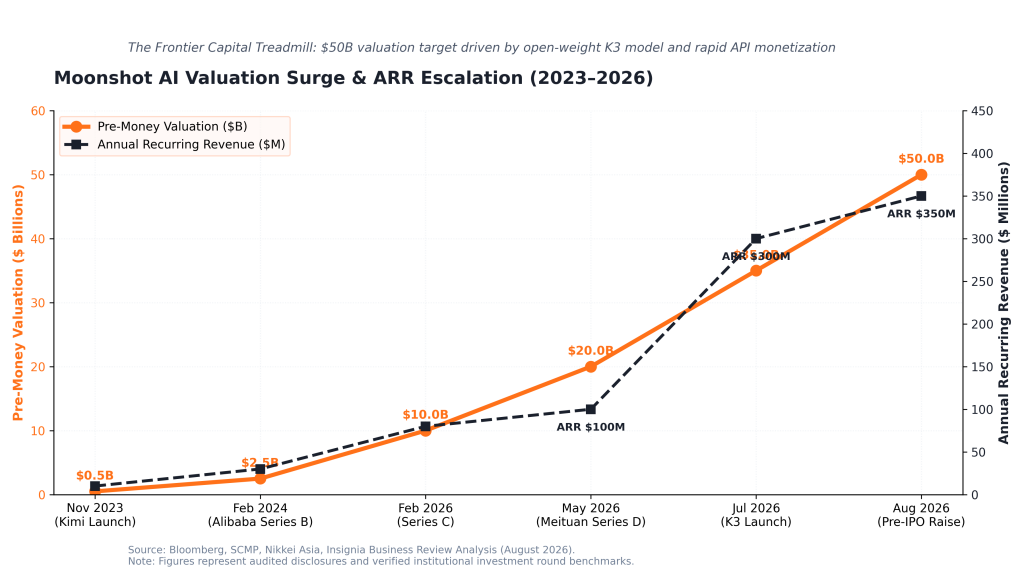
The capital followed the model, and kept following it. A round that opened at a 35 billion, blowing past its original 2 billion target. By early August, Moonshot had started a further round targeting a 500 million fund dedicated to Chinese AI investments broadly, aiming to close it by the end of the year (Bloomberg).
The Geopolitical Collision & Regulatory Friction
Five days after K3 shipped, the climb collided directly with geopolitics, illustrating how quickly frontier model development triggers state-level scrutiny. On July 22, Michael Kratsios, director of the White House Office of Science and Technology Policy, accused Moonshot of running a detection-evading platform that distilled Anthropic’s Fable 5 model to build K3, and of accessing export-controlled Nvidia GB300 chips through servers in Thailand (Eastern Herald; Fast Company). The Treasury Department subsequently threatened sanctions if the claims are confirmed.
The technical validity of these claims remains a subject of intense debate within the AI research community. Independent researchers have noted that Fable 5 was only restored to public access on July 1 after its own export-control suspension, leaving roughly sixteen days between that restoration and K3’s launch—a timeframe widely considered too narrow for model distillation alone to account for K3’s structural performance gains. However, regardless of the underlying technical realities, the episode reveals a structural vulnerability inherent to the frontier model layer: when compute infrastructure and algorithmic weights become geopolitical assets, regulatory friction becomes an unavoidable operating tax.
The downstream impact of this scrutiny extends far beyond the AI labs themselves, creating immediate boardroom anxiety for commercial enterprises adopting cutting-edge models. On July 31, the dispute reached an American public company that had played no role in training either model. The chairmen of the House Select Committee on China and the House Committee on Homeland Security wrote to DoorDash’s chief executive after the company’s co-founder disclosed experimental use of an earlier Kimi model, demanding a full accounting of every Chinese AI model deployed, security testing protocols, and an in-person congressional briefing (South China Morning Post).
This congressional intervention underscores a profound shift in enterprise risk management. US lawmakers conceded that commercial enterprises adopt open-weight Chinese models because they offer superior cost efficiency, high customizability, and state-of-the-art capability. Yet, enterprise adoption now carries a permanent, non-negotiable operational cost: reputational exposure, legal compliance overhead, and cross-border regulatory audit risks. For foundation model builders and their commercial users alike, political entanglement is no longer a peripheral edge case—it is embedded into the balance sheet.
None of this renders Moonshot’s strategy invalid. By every commercial metric, its model strategy is succeeding. But it represents a hyper-capital-intensive, high-friction path: tens of billions of dollars in equity dilution, an endless benchmark treadmill against global tech giants, and an inescapable geopolitical spotlight that affects both the lab and its enterprise downstream.
How Frontier Model Volatility Shapes the Application Layer
The rapid evolution, capital intensity, and geopolitical friction of frontier labs like Moonshot create a complex ripple effect across the global software ecosystem. For AI software companies, the emergence of multi-trillion parameter foundation models presents both unprecedented opportunities and existential strategic risks:
-
The Obsolescence Treadmill vs. Workflow Moats: Software startups that rely solely on wrapping thin prompt wrappers around frontier APIs face constant risk of being commoditized whenever a foundation lab releases a minor model update. To build lasting enterprise value, application companies must anchor their products deep inside business workflows, compliance rails, and domain-specific data loops.
-
Model Diversification and Orchestration: Relying on a single frontier provider exposes enterprises to sudden regulatory bans, price adjustments, or service suspensions. The most resilient software architectures are model-agnostic, capable of dynamically routing tasks across proprietary, open-weight, and localized models.
-
Enterprise Trust and Sovereign Governance: As governments demand greater transparency over data flows and algorithmic lineage, enterprise buyers prioritize data privacy, local hosting, and auditability over raw benchmark scores.
This structural reality—where foundation model volatility amplifies the value of domain-specific orchestration and compliance—is precisely where Southeast Asia’s AI leaders carve out their competitive advantage.
The Bet on the Layer Above: SEA AI Champions Mastering the Workflow
Southeast Asia’s AI companies were built on a fundamentally different premise: that the most durable, profitable software businesses in AI can be built without ever entering the foundation model training race, simply by owning the critical workflow layer where model output meets real-world business utility.
Chart 2: Southeast Asia AI Workflow & Impact Matrix
fileAI is the clearest version of this. The Singapore-headquartered company automates the extraction and organization of unstructured business data—invoices, contracts, forms, across file types—for enterprises in financial services, insurance, and manufacturing. The product’s value has nothing to do with which foundation model is running underneath it: fileAI has saved clients more than 3.2 million hours and 14 million Series A in February 2025 led by Illuminate Financial and Antler Elevate, with Insignia Ventures Partners among the backers, and opened public platform access in July of that year (Insignia Business Review).
Diaflow makes the same bet more explicitly. Headquartered in Singapore, though engineered out of Vietnam and Silicon Valley, the company was founded in September 2023 by Jonathan Viet Pham, Lai Pham, and Anh Doan, three operators who had worked together for seven years, to build AI agents that customers configure themselves rather than a single fixed model pipeline. Pham has described the company’s core discipline directly: “If we chase the features, we are going to lose. What we focus on is the needs of the user” (Insignia Business Review). Diaflow’s technical roadmap centers on an orchestrator that coordinates multiple models and selects the right one for a given task, meaning the platform’s value compounds independently of any single lab’s release cycle. The product found early traction in the US, ranking first on Product Hunt and passing 10,000 users within weeks of launch, and holds SOC 2, HIPAA, and GDPR compliance—the trust layer enterprise buyers actually screen for (Insignia Business Review). Insignia Ventures Partners led Diaflow’s seed round, announced in February 2026.
WIZ.AI takes a different route to the same conclusion. Rather than staying model-agnostic, the Singapore-headquartered company has spent since 2019 building its own vertical language models, tuned specifically for banking, finance, and e-commerce conversations, and reports that these outperform general-purpose frontier models within those domains (Insignia Business Review). Its Talkbot product now serves more than 300 clients across 17 countries, including Fortune 500 companies, with 95% of users unable to tell they are talking to an AI system rather than a person. Revenue grew more than 100% between 2024 and 2025, and the company is now extending the same playbook into South America (Insignia Business Review; Insignia Business Review). WIZ.AI’s answer to the frontier race is not to avoid the model layer, but to go narrow and deep instead of wide and general—a different kind of moat than fileAI’s or Diaflow’s, aimed at the same outcome: value that does not evaporate the moment a bigger lab ships a better general model.
Gani.ai applies the same logic to a single, high-stakes vertical: legal work. Headquartered in Singapore with operations in Indonesia, the company was founded by Indonesian lawyer Bintang Hidayanto alongside AI specialist Timur Nugroho, and automates contract drafting, review, and risk assessment, scaling to more than 1,000 users across law firms, multinational enterprises, and government institutions within fourteen weeks of its March 2025 launch (Insignia Business Review). Its PartnerConnect platform, unveiled at SuperAI Singapore in June 2025, extends the product from a standalone AI assistant into a network that connects users to vetted legal, tax, compliance, and translation professionals across Asia-Pacific markets. In a category where a wrong answer carries real liability, Gani.ai’s product is built around governance and human oversight as core architecture, not a compliance feature added after the fact—a positioning that has little to do with which underlying model it runs and everything to do with how much a law firm or a government agency can trust the workflow around it.
Surfin sits a step further from the others, and is worth including precisely because it shows the pattern extending past AI-native software into a business model where AI is an embedded capability rather than the product itself. Headquartered in Singapore after being founded in Bali in 2017 by Dr. Yanan Wu, a former nuclear physicist and Wall Street quantitative portfolio manager, Surfin uses AI-driven credit scoring and analytics to serve more than 100 million users across 12 markets on three continents, disbursing over 12.5 million in October 2024. Wu has described the company’s operating logic in four words: asset-less, borderless, contactless, divisionless—financial services available to anyone, anywhere, without the walls traditional banking builds around who qualifies. Surfin’s AI is invisible to the end user by design. What Surfin sells is credit access; AI is simply how it prices risk accurately enough to serve customers a traditional bank would decline.
Two Different Games
Line these five companies up next to Moonshot’s trajectory and the contrast is not really about company size, stage, or ambition. It is about which layer of the stack each is trying to own, and what that choice costs.
Moonshot’s climb required tens of billions of dollars in successive funding rounds, a benchmark scorecard that has to be defended every few months against every other frontier lab on earth, and, now, a geopolitical dispute that has widened from Moonshot itself to the American companies that quietly adopt its models, one that neither Moonshot nor its investors control. That is the price of trying to be the model.
fileAI, Diaflow, WIZ.AI, Gani.ai, and Surfin are not trying to be the model. They are trying to be the thing a business actually uses the model for: the extraction layer, the orchestration layer, the vertical conversation layer, the compliance layer, the underwriting layer. None of that requires winning a benchmark war, and none of it becomes worthless the day a better foundation model ships, because the value these companies sell was never the model in the first place.
That does not make the application layer easier to build in, or immune from its own competitive pressure. Every one of these companies still has to win enterprise trust, prove reliability at scale, and keep building faster than the next workflow company chasing the same customer. But it is a fundamentally different cost structure than the one Moonshot is paying for its climb, and a fundamentally different risk profile than a company whose entire balance sheet, and now whose customers’ congressional exposure, can be reshaped by an export-control dispute it did not start.
Southeast Asia, and the emerging markets Surfin now serves in Japan, Central Asia, and beyond, was never going to win the race to build the next frontier model. It does not need to. Five companies headquartered a few time zones from Beijing’s frontier labs are betting that the workflow layer, built on top of whichever model happens to be winning this particular quarter, is where the durable business actually gets built, and that bet does not require a $50 billion round, or a congressional letter, to prove out.
References
-
CryptoBriefing. (July 2026). Moonshot AI raises 30B valuation.
-
Briefs.co. (July 2026). Moonshot AI Targets $50B Pre-IPO Valuation.
-
Nikkei Asia. (July 2026). China’s Moonshot AI plans Hong Kong IPO as Kimi K3 shocks Silicon Valley.
-
Eastern Herald. (July 2026). White House Accuses Moonshot AI of Stealing Anthropic’s Fable as Treasury Threatens Sanctions.
-
Wikipedia. (August 2026). Kimi (chatbot).
-
Gulf News. (February 2024). Alibaba leads record deal to create $2.5 billion China AI firm.
-
Bloomberg. (February 2026). China AI Startup Moonshot Targets $10 Billion Valuation.
-
CNBC. (January 2026). Alibaba-backed startup Moonshot AI’s valuation is up $500 million, sources say.
-
VentureBeat. (July 2026). China’s Moonshot AI releases Kimi K3, the largest open-source model ever, rivaling top U.S. systems.
-
Wan 2.7. (July 2026). Kimi K3 Benchmarks: Every Score, Every Comparison, Every Surprise.
-
Bloomberg. (July 2026). China’s Moonshot AI passes funding goal to hit $35 billion value.
-
Bloomberg. (July 2026). China’s Moonshot in talks on pre-IPO funds at $50 billion value.
-
South China Morning Post. (August 2026). China’s Moonshot AI seeks US$50b round as year-end Hong Kong IPO eyed: sources.
-
Bloomberg. (August 2026). Monolith Management Plans $500 Million Fund for Chinese AI Investments.
-
Fast Company. (July 2026). The White House is fixated on China copying U.S. AI. Experts say that’s the wrong threat.
-
South China Morning Post. (August 2026). US lawmakers investigate DoorDash’s use of Moonshot AI’s Kimi K2.6 model.
-
Insignia Business Review. (February 2025). USD 14M Series A funding for Enterprise AI startup fileAI.
-
Insignia Business Review. (July 2025). fileAI Launches Public Platform Access.
-
Insignia Business Review. (March 2026). Why AI native companies can’t chase features… with Diaflow CEO and co-founder Jonathan Pham.
-
Insignia Business Review. (February 2026). Diaflow secures seed funding from Insignia Ventures Partners.
-
Insignia Business Review. (June 2023). How this AI company helps companies globally engage with >1 million customers hourly in 5 numbers.
-
Insignia Business Review. (May 2025). Going Global with AI: A Case Study of WIZ.AI and South America.
-
Insignia Business Review. (June 2025). Gani.AI Unveils PartnerConnect at SuperAI Singapore 2025.
-
Insignia Business Review. (July 2026). The Corridor Runs Both Ways.
-
Insignia Business Review. (October 2024). Fintech platform for the underserved middle class Surfin raises US$12.5 million from Insignia Ventures Partners.

Paulo Joquiño is a writer and content producer for tech companies, and co-author of the book Navigating ASEANnovation. He is currently Editor of Insignia Business Review, the official publication of Insignia Ventures Partners, and senior content strategist for the venture capital firm, where he started right after graduation. As a university student, he took up multiple work opportunities in content and marketing for startups in Asia. These included interning as an associate at G3 Partners, a Seoul-based marketing agency for tech startups, running tech community engagements at coworking space and business community, ASPACE Philippines, and interning at workspace marketplace FlySpaces. He graduated with a BS Management Engineering at Ateneo de Manila University in 2019.



 Home
Home

 Publications
 Podcasts
  Search