
When Asia-Pacific automotive platform Carro finalized its acquisition of Australian marketplace CarPlace, it provided a live demonstration of the tech giant’s international scaling playbook. Expanding into Australia—its eighth regional market—gives Carro a direct foothold in a major developed automotive economy, serving as a catalyst for a deeper strategic transformation across the region.
In a recent candid interview on The Business Times Transport BT podcast, Carro Chief Executive Officer Aaron Tan shed light on the operational and economic mechanics driving this expansion down under. Beyond geographical reach, the Australian integration illustrates Carro’s core thesis: that the pre-owned automotive industry’s most entrenched bottleneck—a systemic, global “trust deficit” marked by odometer tampering, undisclosed accidents, and opaque pricing—is best solved by deploying artificial intelligence, computer vision, and modular data infrastructure.
1. Converting the Industry’s Trust Deficit into a Tech-Driven Growth Engine
Across global pre-owned vehicle markets, buyer hesitation has long been rooted in severe information asymmetry. Vehicle histories were frequently incomplete, pricing lacked objective standards, and buyers routinely faced hidden mechanical defects or altered mileage records. In both emerging and developed economies, traditional un-digitized dealerships operate with limited transparency, creating an environment where consumer friction is high and trust is difficult to establish.
Where traditional operators treat this opacity as an unavoidable cost of doing business, Carro views the industry’s trust deficit as its single largest competitive opportunity. Addressing issues like odometer fraud—which Tan noted “happens frequently” even in developed markets like Australia—Carro positions artificial intelligence as an objective, automated verification engine to transform vehicle inspection and valuation into data-backed science:
- Automated Anomaly & Fraud Detection: Machine learning algorithms continuously parse historical service records, registry data, and title histories. Discrepancies in mileage or registration history are automatically flagged before a vehicle reaches the platform.
- Computer Vision Physical Checks: AI-assisted computer vision tools evaluate body panel alignments, paint consistency, and chassis condition, catching unrecorded collision repairs that human inspectors might miss.
- Algorithmic Pricing Engines: Dynamic pricing models process thousands of regional transactions daily, setting fair, transparent market values that eliminate arbitrary dealer markups.
- Immutable Condition Scoring: Inspection findings are converted into standardized, transparent digital condition scores accessible directly by prospective buyers.
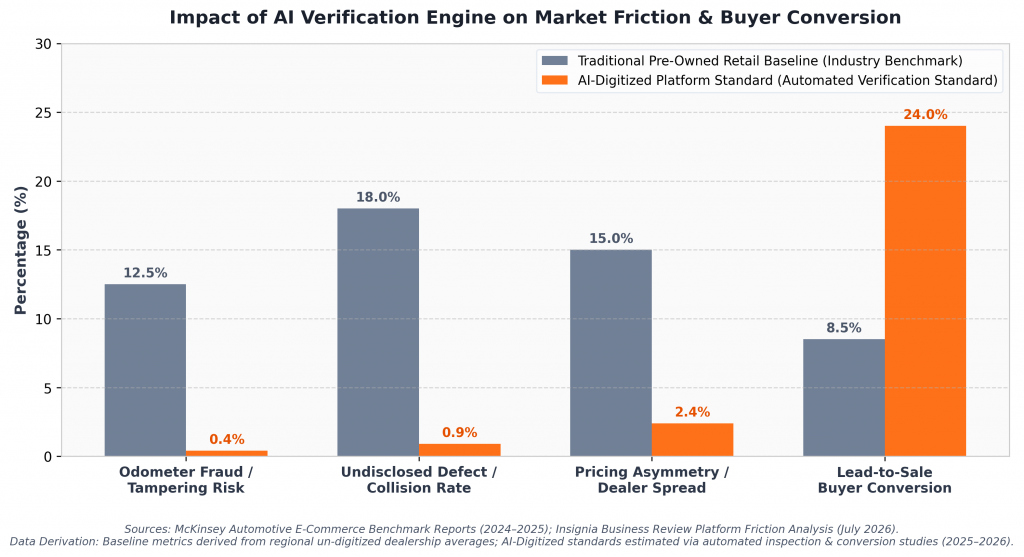
By replacing manual guesswork with algorithmic verification, Carro elevates used car purchasing to match the confidence and transparency traditionally associated with brand-new vehicles.
2. Monetizing Trust: The High-Margin Ecosystem Revenue Flywheel
Establishing trust through AI verification does more than reassure buyers; it serves as the essential gateway to Carro’s high-margin recurring ecosystem. Once consumers have complete confidence in the platform’s vehicle condition reports, they naturally adopt Carro’s integrated automotive financial and protection services.
In describing Carro’s financial model, CEO Aaron Tan highlighted that “more than 70% of our gross profit is recurring”, driven by high-margin ancillary products rather than traditional one-off vehicle trading markups (as noted on The Business Times Transport BT podcast and in Carro’s FY2025 financial disclosures in The Manila Times):
- In-House Financial Services & Underwriting (32% of GP): Proprietary credit scoring enables algorithmically underwritten auto loans, floor-plan financing, and flexible subscriptions.
- Extended Warranties & Maintenance Subscriptions (22% of GP): Multi-year service packages backed by Carro’s certified regional workshop network.
- Digital Automotive Insurance & Ancillary (18% of GP): Seamlessly embedded digital insurance policies underwritten at the exact point of sale.
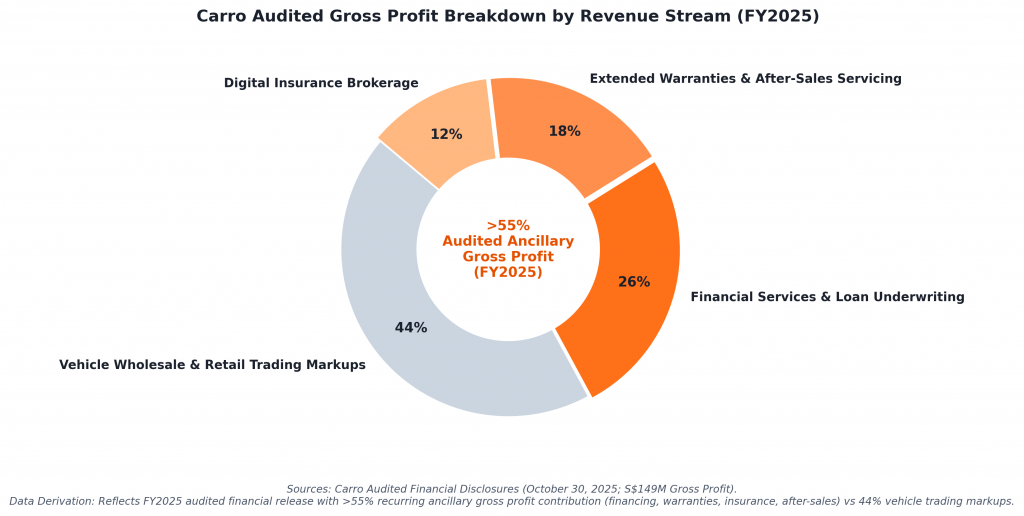
This self-reinforcing flywheel turns consumer trust into long-term lifetime value, proving that solving information asymmetry directly maximizes unit-level profitability.
3. The Australia Case Study: Modular Architecture & Developed Market Economics
The Australian acquisition provides a real-world case study of how Carro scales its technological infrastructure into new territories, detailed in PR Newswire’s coverage of Carro’s Australia market entry. Built on a modular, decoupled microservices OS, Carro digitized CarPlace’s entire backend within days of deal closing.
Rapid Digitalization & Predictive Inventory Routing
- Instant Backend Integration: By spinning up a new instance of its proprietary enterprise OS, Carro gained instant operational visibility into inventory aging, reconditioning pipelines, and unit economics down under.
- Predictive Regional Arbitrage: Using real-time supply-demand analytics, Carro routes high-demand vehicles from eastern hubs (Sydney, Melbourne) to high-value western markets like Perth—a major mining center where vehicle demand commands premium pricing.
Unpacking GPU Economics: Industry Benchmarks & CEO Estimates
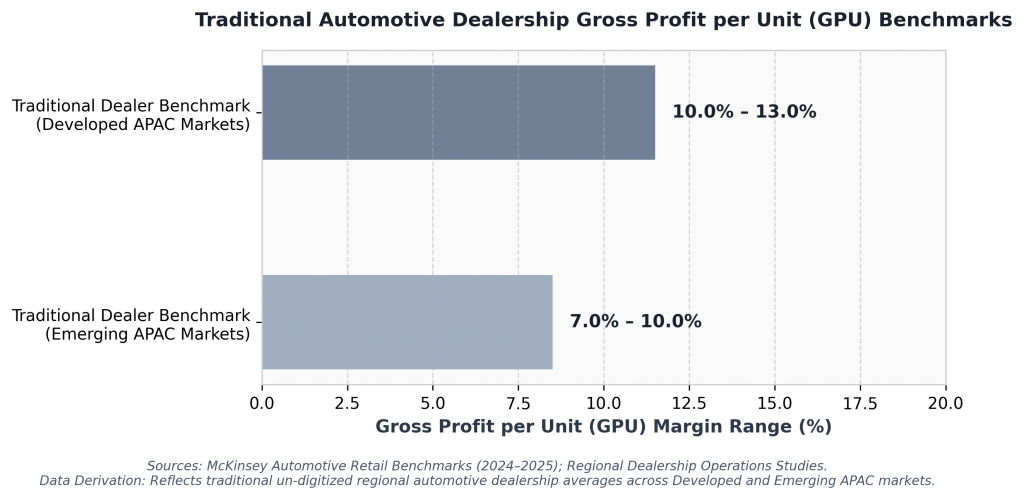
Gross Profit per Unit (GPU) is the foundational profitability metric in automotive retail. While traditional pre-owned car dealers typically realize 8% to 12% GPU due to heavy offline overhead and lack of ancillary attachments, Carro’s tech-driven model achieves substantially thicker margins.
Rather than citing rigid accounting formulas, CEO Aaron Tan provided general operational estimates for GPU performance across regional markets on The Business Times Transport BT podcast, stating: “In places like Australia, for instance, we can do margins of anywhere from 15 to 20 something percent per car. But if you look at it from closer to home in Thailand and Indonesia, those margins tends to be lesser than 15%.”
- Developed APAC Economies (Australia, Japan, HK, Singapore): Higher average vehicle transaction values, mature financial infrastructure, and strong financing adoption enable what Tan estimated as “anywhere from 15 to 20 something percent per car” GPU margins.
- Emerging APAC Economies (Thailand, Indonesia, Malaysia): Highly fragmented agent networks and un-audited mom-and-pop dealer competition keep GPU margins estimated as “lesser than 15%”.
4. Enterprise Efficiency & The Strategic Horizon
Carro’s AI capabilities extend beyond retail into enterprise-wide operational efficiency. Discussing company productivity, Tan noted that AI automation and natural attrition have “led to 15% reduction in headcount across the last couple of years”, emphasizing that “it’s not because we did any massive termination exercise… but it’s honestly just natural attrition and optimization of the business units.”
Multi-Brand EV Distribution Operating System
Rather than competing as a traditional franchise dealer, Carro is leveraging its digital infrastructure to act as a regional platform partner for leading Electric Vehicle (EV) manufacturers—including BYD, Zeekr, and Exeed. Tan remarked that EV brand owners “tend to be more liberal in terms of appointment of dealerships”, expressing expectations to partner with “more than 10 brands” globally by the end of 2026.
Strategic Roadmap: Depth Over Width
Looking ahead over the next 6 to 12 months, Tan emphasized that Carro is intentionally focusing on operational density rather than opening new regional territories, stating: “The next six to 12 months, I probably would still prefer to go deep rather than go abroad.” As highlighted in the Insignia Business Review 2026 strategic commentary, deepening market share and AI integration in its eight active APAC markets remains Carro’s primary strategic vector for sustainable growth.
Read more into the last 10 years of Carro in our Insignia Press case study on the company.
Article generated with Diaflow.
References
-
The Business Times, Carro’s APAC Car Market Expansion Conversation, Transport BT podcast interview with Aaron Tan hosted by Darren Wong, July 26, 2026. Listen on The Business Times
-
PR Newswire, Carro Enters Australia With CarPlace Acquisition to Bring Better, Transparent Car Buying and Selling Experience to Australians, June 18, 2026. Read on PR Newswire
-
McKinsey & Company, Clone or Create: A Conversation With Aaron Tan, CEO of Carro, The Venture podcast, May 19, 2020. Read on McKinsey Insights
-
The Manila Times / PR Newswire, Carro Posts Record Revenues and Gross Profit for FY2025, Closes US$60m Strategic Investment Led by Cool Japan Fund, October 30, 2025. Read on The Manila Times
-
Insignia Business Review, How the Carro Approach to Going Global Lines Up With Its Profitability, Growth, and IPO Readiness, March 15, 2024. Read on Insignia Business Review
-
Insignia Business Review, Building an Enduring Company in Southeast Asia Is Not Always About Being First or Fastest, but Running the Right Race, July 6, 2026. Read on Insignia Business Review

Paulo Joquiño is a writer and content producer for tech companies, and co-author of the book Navigating ASEANnovation. He is currently Editor of Insignia Business Review, the official publication of Insignia Ventures Partners, and senior content strategist for the venture capital firm, where he started right after graduation. As a university student, he took up multiple work opportunities in content and marketing for startups in Asia. These included interning as an associate at G3 Partners, a Seoul-based marketing agency for tech startups, running tech community engagements at coworking space and business community, ASPACE Philippines, and interning at workspace marketplace FlySpaces. He graduated with a BS Management Engineering at Ateneo de Manila University in 2019.



 Home
Home

 Publications
 Podcasts
  Search