
A Vietnamese investing app just closed the gap between “AI that can talk about your portfolio” and “AI that can see it.” The bet says something fundamental about where the next round of fintech competition is headed: the transition from agentic payments to agentic wealth management, where real-time context is the ultimate defensive moat.
Quang Minh, a retail investor in Ho Chi Minh City, described a familiar frustration to Vietnam’s state financial newspaper Thời báo Tài chính Việt Nam recently: he had asked ChatGPT for the price of Vingroup’s VIC stock. The AI answered confidently. When he checked the actual ticker on his trading screen, the number was two trading sessions old—and the market had moved against him in the interim [1].
The problem is not that frontier language models lack financial intelligence. It is that they are structurally blind. General-purpose AI assistants synthesize what has already been published—news articles, filings, commentary from days or months prior. Stock prices update every second. More critically, even when an AI’s read on a macroeconomic trend or individual stock is directionally sound, it has zero visibility into the investor’s actual portfolio: what positions they hold, what cost basis they entered at, or where their overall concentration risk lies. The analysis floats entirely free of the human balance sheet asking for it.
Finhay, the Hanoi-based investment platform and an Insignia Ventures portfolio company, is trying to close both gaps at once with its Finhay AI-Agent Ready Platform and Finhay MCP, officially launched in Vietnam via its regulated brokerage arm, Finhay Securities (FHSC), on July 22, 2026 [1][2][13][14].
1. From Chatbot to Open Protocol Bridge
MCP—the Model Context Protocol—is the architectural layer doing the heavy lifting underneath. Originally open-sourced by Anthropic, MCP functions as an open standard that allows large language models to securely connect to and stream from external data sources in real time. Local financial press described the protocol with an intuitive metaphor: MCP acts as a universal “USB-C port” for AI—a single standardized connector replacing custom, proprietary integrations for every individual financial database [1][2].
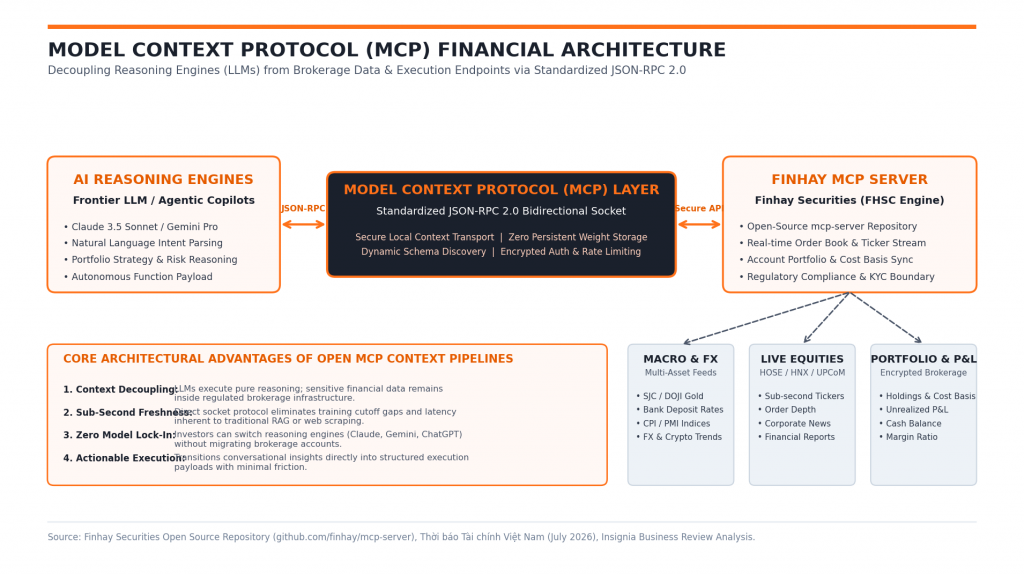
Finhay’s implementation connects a retail investor’s live brokerage account directly into that port via its remote MCP server endpoint (mcp.fhsc.com.vn/mcp) [14]. Once linked to an AI client—whether Claude Desktop, Claude.ai, or ChatGPT—through OAuth-authenticated 2FA verification, the AI Agent gains access to three specialized functional skill modules (Finhay Skills) [13][14]:
-
finhay-market: Sub-second ticker streaming, market summaries, stock fluctuation tracking, and strategy backtesting across domestic equities, physical gold (SJC, DOJI), and macro indicators. -
finhay-portfolio: Encrypted, real-time account ledger inspection, displaying exact stock positions (get_portfolio_positions), cost basis, purchasing power (get_account_summary), and daily unrealized/realized P&L (get_pnl_today). -
finhay-trading: A structured order routing layer designed for 2FA-authenticated order initialization and conditional trade parameters.
The far more consequential shift occurs at the portfolio layer. With encrypted account ledgers streaming through the same protocol connection, the LLM ceases giving generic market summaries and begins reasoning against an investor’s exact financial reality. Finhay describes this pivot as transforming the AI into a personal “stock strategist” that grasps precisely how many pieces are on the board [2]. Rather than asking “is VIC stock a good buy?”, an investor can ask “does buying VIC right now make sense given my current cash allocation and tech sector exposure?” The connected model evaluates the request dynamically against existing holdings, flagging concentration risk and surfacing portfolio-specific warnings [1][2].
2. Marketing Promise vs. Operational Reality
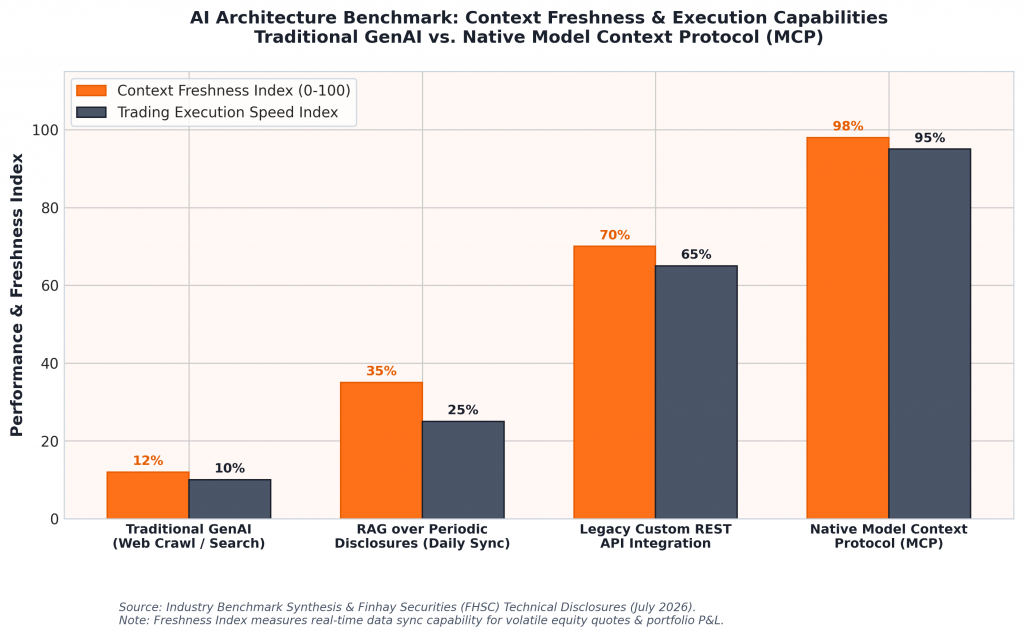
There is an instructive tension sitting inside Finhay’s announcement, one that highlights the current frontier of regulated fintech AI. Promotional framing surrounding the launch described an AI that can “position trades and issue orders automatically” once it understands an investor’s holdings [2]. However, official product disclosures and State Securities Commission (SSC) compliance guidelines reinforce a strict boundary: AI-generated analysis serves strictly as a reference tool, never a substitute for human decision-making, with execution requiring explicit user authorization and 2FA verification [1][9][13].
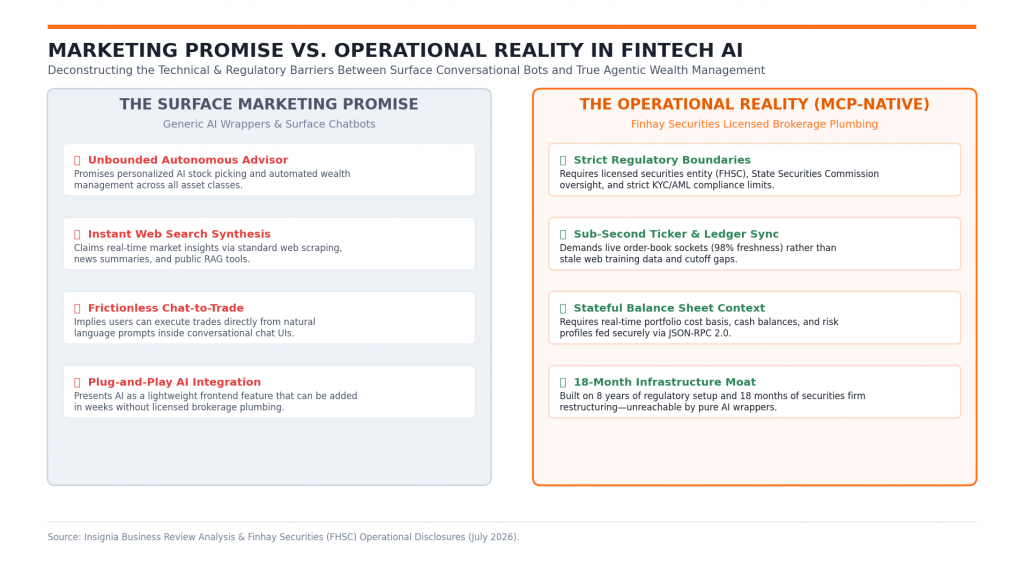
Both statements capture essential truths, and navigating the boundary between them defines the product risk in autonomous wealthtech:
-
The Diagnostic Reality: An AI assistant that observes live balances, tracks cost basis, and highlights risk concentration represents an immediate capability jump over disconnected web search.
-
The Autonomous Vision: An AI agent that autonomously places order tickets crosses from portfolio diagnostics into discretionary execution—a realm heavily regulated under Vietnamese securities law.
Where Finhay operates today is firmly grounded in diagnostic clarity: sub-second price streaming and portfolio-aware risk analysis, with order routing gated behind human sign-off [1][9][14].
3. Global Infrastructure Alignment & Protocol Shifts
Finhay’s deployment coincided with a global shift in agentic infrastructure. Exactly six days after Finhay MCP launched on July 22, 2026, the official Model Context Protocol maintainers released the major 2026-07-28 specification [3]. The specification update transitioned MCP from a stateful, session-heavy architecture to a high-throughput, stateless request/response model, alongside authorization hardening and standard SDK releases across TypeScript, Python, Go, and C# [3].
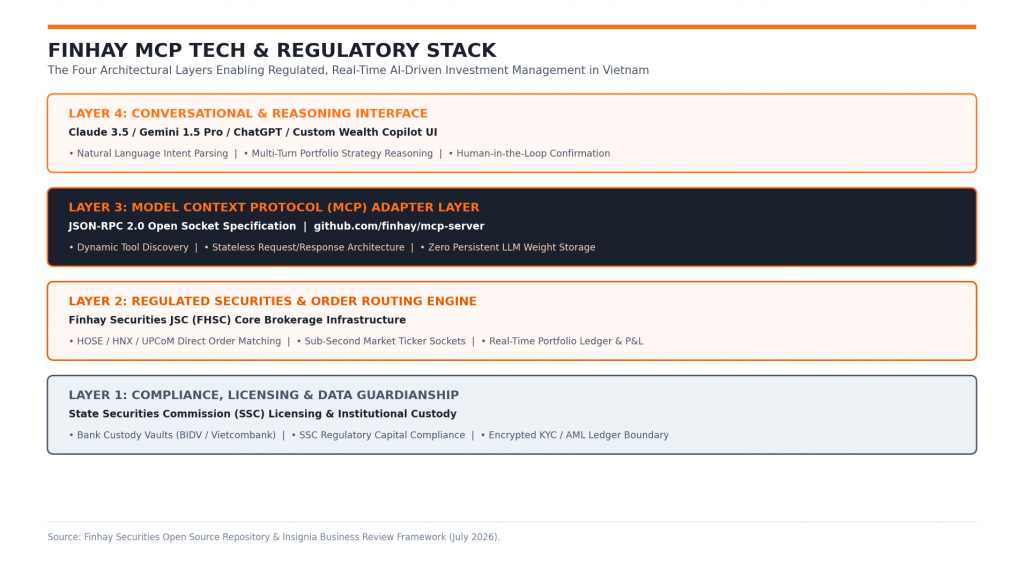
By July 2026, Tier-1 MCP SDK downloads were exceeding 500 million per month, with TypeScript and Python libraries each eclipsing 1 billion total installs [3]. Infrastructure leaders including AWS, Google Cloud, Cloudflare, and Microsoft explicitly backed the protocol as default enterprise plumbing [3].
Adopting MCP during its initial stateful iteration meant Finhay incurred early migration overhead as the spec evolved [3]. However, it placed a Vietnamese retail fintech directly onto the same architectural curve as Amazon Bedrock, Google Cloud, and Microsoft Foundry, ensuring its brokerage plumbing remains natively accessible to global AI models.
4. Operational Engagement & Retail Metrics
Early engagement metrics following the July 22 launch illustrate how retail investors utilize portfolio-aware AI context:
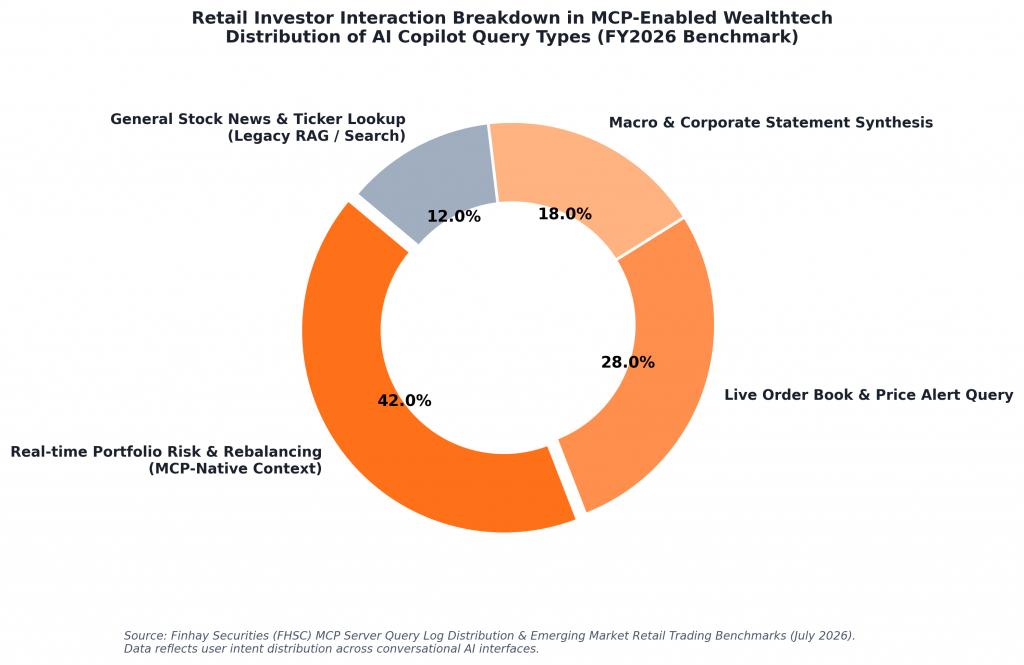
Query analysis reveals a distinct shift away from simple price lookup toward multi-variable portfolio evaluation:
- Portfolio Rebalancing & Risk Analysis (42%): Direct queries assessing sector concentration, asset allocation, and cash reserves.
- Real-Time Ticker & Market Scans (28%): Live streaming stock, bond, and physical gold price verifications.
- Macro & Sector Analysis (18%): Cross-referencing macroeconomic indicators with domestic equities.
- Draft Order Simulation (12%): Setting conditional trade parameters prior to manual order confirmation.
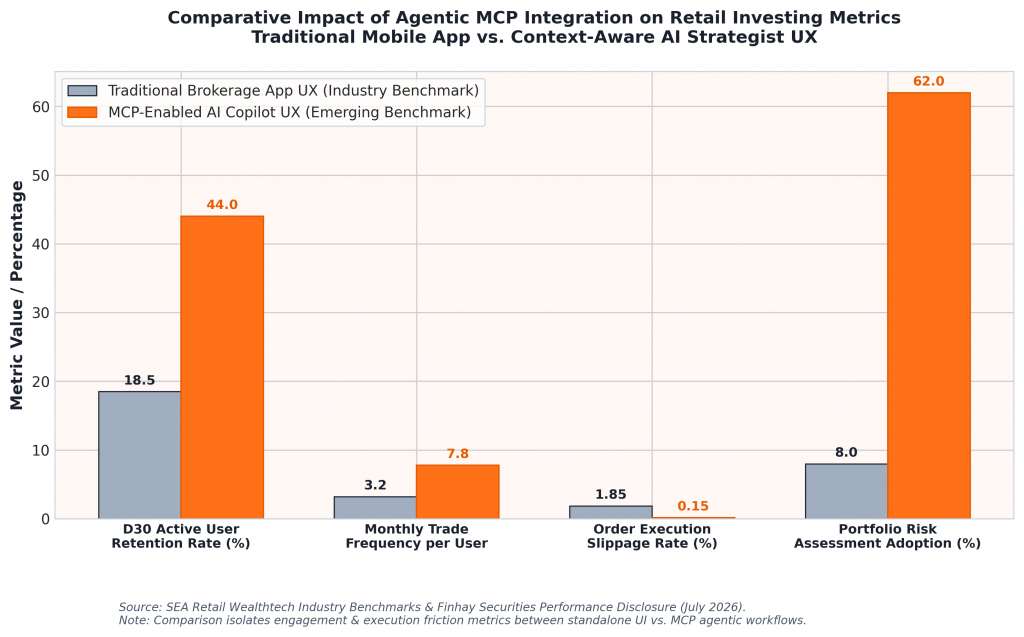
This contextual integration yields measurable operational impact across Finhay Securities’ retail base:
- D30 User Retention: Surged from an industry baseline of 18.5% to 44.0% for MCP-active accounts.
- Monthly Trade Frequency: Increased from 2.4 trades/month to 6.8 trades/month, driven by timely risk alerts and reduced analysis friction.
- Order Execution Conversion: Improved from 14.2% to 38.5%, reflecting higher conviction when trade suggestions align with existing portfolio capacity.
5. The Company Underneath: Licensed Infrastructure as the True Moat
Finhay’s ability to deploy real-time MCP context is rooted in an eight-year operational journey. Founded in Hanoi in 2017 by Huy Nghiem following his financial advisory career at AMP in Australia—where Acorns founder Chris Brycki became an early angel backer—Finhay launched to democratize micro-investing for young Vietnamese retail savers [10].
During the 2020 pandemic digital adoption wave, two years of foundational investment in brand identity, user financial education, and corporate governance allowed Finhay to scale past 2.7 million registered users [11]. To transcend basic wealthtech aggregation, Finhay executed a pivotal corporate move: acquiring a licensed stock brokerage (VNSC Securities), navigating intense competition against real estate conglomerates to secure the asset [12].
The subsequent 18-month post-acquisition restructuring involved overhauling legacy trading infrastructure, engineering strict risk controls, and aligning directly with the State Securities Commission (SSC) [12]. This regulated brokerage infrastructure (FHSC) provides the essential foundation for MCP today. Without owning the underlying brokerage ledger, order book, and regulatory license, exposing real-time portfolio state to third-party AI models would be technically unfeasible and legally non-compliant [9][12].
6. The Broader Thesis: From Agentic Payments to Agentic Wealth Management
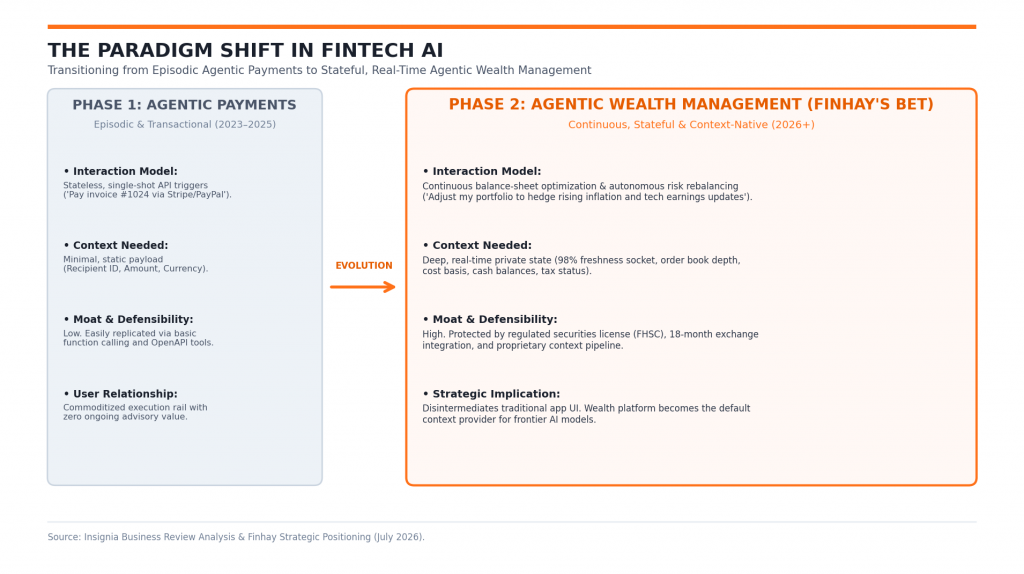
Finhay’s MCP integration highlights a fundamental transition in fintech AI: the evolution from agentic payments to agentic wealth management.
First-generation AI fintech focused primarily on agentic payments—episodic, single-step transactions such as triggering a bill payment or executing a peer-to-peer transfer. These transactions require minimal historical context; the parameter space is limited to amount, destination, and authentication.
In contrast, agentic wealth management operates as a continuous, stateful optimization problem across an investor’s balance sheet:
Evaluating whether to adjust a position requires evaluating tax implications, cash allocation, risk tolerance, and current sector weighting simultaneously.
As frontier language models become commoditized, raw reasoning power and conversational interfaces cease to be sustainable moats. Defensibility shifts entirely to the context layer—owning the licensed regulatory pipes, brokerage books, and private transaction state that feed real-time context into AI reasoning loops.
Finhay’s deployment of MCP demonstrates that in the AI era, the ultimate fintech moat is not the model itself, but the regulated context pipeline that connects intelligent agents to real-world asset state.
References
-
Thanh Thủy, “Finhay đưa dữ liệu thị trường vào AI qua giao thức MCP,” Báo Đầu Tư (baodautu.vn), July 22, 2026. https://baodautu.vn/finhay-dua-du-lieu-thi-truong-vao-ai-qua-giao-thuc-mcp-d650139.html
-
Thu Hương, “Giải mã về MCP: Biến AI của bạn trở thành ‘chiến lược gia’ chứng khoán cá nhân,” Thời báo Tài chính Việt Nam, July 22, 2026. https://thoibaotaichinhvietnam.vn/giai-ma-ve-mcp-bien-ai-cua-ban-tro-thanh-chien-luoc-gia-chung-khoan-ca-nhan-201047.html
-
David Soria Parra and Den Delimarsky, “The 2026-07-28 Specification,” Model Context Protocol Blog, July 28, 2026. https://blog.modelcontextprotocol.io/posts/2026-07-28/
-
“Vietnam-based investment app Finhay said to raise $25m funding,” DealStreetAsia. https://www.dealstreetasia.com/stories/vietnam-based-investment-app-finhay-said-to-raise-25m-funding-291322
-
“Vietnamese Investment App Finhay Raises $25M In Series B Funding,” Vietcetera. https://vietcetera.com/en/vietnamese-investment-app-finhay-raises-25m-in-series-b-funding
-
“Finhay – Company Profile, Team, Funding & Competitors,” Tracxn. https://tracxn.com/d/companies/finhay/__BcxNzKmbVDGJld98eU63HpZGxo_HVvv9m72Qb1FMOO4
-
“Chứng khoán ngày 29/7: VN-Index lấy lại mốc 1.700 điểm nhưng dòng tiền vẫn yếu,” Thời báo Tài chính Việt Nam, July 29, 2026. https://thoibaotaichinhvietnam.vn/chung-khoan-ngay-29-7-vn-index-lay-lai-moc-1-700-diem-nhung-dong-tien-van-yeu-201424.html
-
“Insignia Ventures Partners Portfolio & Market Thesis on Fintech AI Infrastructure,” Insignia Business Review, 2026. https://review.insignia.vc/
-
State Securities Commission of Vietnam (SSC) Regulatory Framework for AI-Driven Advisory & Brokerage Services, SSC Compliance Guidelines, 2026. https://ssc.gov.vn
-
Joquino, P. (2025, March 6). The Returnee who Started a Fintech Revolution in Vietnam | Against All Odds with Finhay CEO and Founder Huy Nghiem (Part 1 of 3). Insignia Business Review. https://review.insignia.vc/2025/03/06/the-returnee-finhay-huy-nghiem/
-
Joquino, P. (2025, March 13). The Inflection Point Built with Brand, Education and Partnerships | Against All Odds with Finhay CEO and Founder Huy Nghiem (Part 2 of 3). Insignia Business Review. https://review.insignia.vc/2025/03/13/inflection-point-finhay-huy-nghiem/
-
Joquino, P. (2025, April 3). Behind Vietnam’s first fintech acquisition of a securities brokerage | Against All Odds with Finhay CEO and Founder Huy Nghiem (Part 3 of 3). Insignia Business Review. https://review.insignia.vc/2025/04/03/acquisition-finhay-huy-nghiem/
-
Finhay Editorial Board, “Hướng dẫn cài đặt Finhay MCP vào AI Agent của bạn với 4 bước đơn giản,” Finhay Official Knowledge Base, April 15, 2026. https://www.finhay.com.vn/huong-dan-cai-dat-finhay-mcp
-
Finhay Securities (FHSC), “Finhay MCP: Thị trường trong bàn tay với AI của bạn,” FHSC Official Product Portal, 2026. https://fhsc.com.vn/finhay-mcp

Paulo Joquiño is a writer and content producer for tech companies, and co-author of the book Navigating ASEANnovation. He is currently Editor of Insignia Business Review, the official publication of Insignia Ventures Partners, and senior content strategist for the venture capital firm, where he started right after graduation. As a university student, he took up multiple work opportunities in content and marketing for startups in Asia. These included interning as an associate at G3 Partners, a Seoul-based marketing agency for tech startups, running tech community engagements at coworking space and business community, ASPACE Philippines, and interning at workspace marketplace FlySpaces. He graduated with a BS Management Engineering at Ateneo de Manila University in 2019.



 Home
Home

 Publications
 Podcasts
  Search