
SMBC Asia Rising Fund and Singtel Innov8’s investment in the Singapore-based enterprise AI-native data workflow platform reveals how corporate capital is reshaping enterprise AI funding across Asia, and turning Japan into the next proving ground.
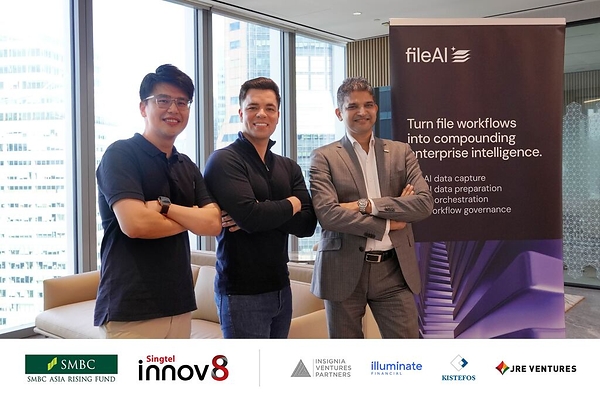
L-R: Alex Neo, Director (Investments), Singtel Innov8; Christian Schneider, CEO, fileAI; Mayoran Rajendra, Managing Director — AI Transformation Department, SMBC
Singapore-based enterprise data startup fileAI has landed backing from SMBC Asia Rising Fund and Singtel Innov8 — a round whose size wasn’t disclosed, but whose backers matter more than the number would. On the surface, this looks like routine funding news: another Singapore AI startup adding names to its cap table. It shouldn’t be skimmed past that easily. It’s a useful window into who is actually financing Asia’s enterprise AI buildout, and it isn’t quite who financed the region’s last tech boom [SMBC Asia Rising Fund and Singtel Innov8 Back fileAI].
The names on this term sheet are not generalist growth investors chasing the next AI multiple. They are a Japanese banking group’s corporate venture arm and a Southeast Asian telecom giant’s strategic fund — institutions that are, in a very real sense, also prospective customers, channel partners, and reference-case providers for the company they just funded. That dynamic is becoming one of the defining features of enterprise AI investing in Asia, and fileAI is now one of its clearest examples.
The Deal: fileScout, Japan, and a Billion Files
fileAI, the company behind enterprise automation platform fileForge, announced the investment alongside the launch of fileScout, a new AI-native tool designed to map and structure unstructured enterprise data while sharply cutting the token costs of processing it. fileScout is paired with what the company calls “agentified” data capture, validation, matching, and reconciliation — a pipeline that publishes clean, verified, audit-ready records directly into the systems that run modern enterprises [SMBC Asia Rising Fund and Singtel Innov8 Back fileAI].
That product framing matters because it targets the single biggest bottleneck in enterprise AI deployment today: most organizations don’t have an AI model problem, they have a data problem. Contracts, invoices, claims forms, KYC documents, and operational records sit in messy, semi-structured, and unstructured formats that large language models still struggle to reliably parse and govern at scale. fileAI’s pitch — reliability, traceability, and auditability “by design” — is explicitly built for regulated industries where an AI system that’s 95% accurate isn’t good enough if the other 5% triggers a compliance failure.
The capital is earmarked to fund fileAI’s expansion in Japan — building a local Tokyo team across sales, engineering, and customer success — and to deepen its financial-services capabilities as enterprises move from AI pilots into production workflows [SMBC Asia Rising Fund and Singtel Innov8 Back fileAI]. This builds directly on a June 2026 strategic investment and partnership with JRE Ventures, the corporate venture arm of the JR East Group, which gave fileAI its initial foothold in Japan, centered on digitizing JR East’s legacy contracts and operational documents.
fileAI’s existing client roster includes MS&AD, Toshiba, PwC, KPMG, Nippon Paint, and Keppel, and the company says it has processed over 1 billion files across finance, insurance, supply chain, healthcare, and core operations [SMBC Asia Rising Fund and Singtel Innov8 Back fileAI]. It’s also not a stranger to institutional capital: fileAI previously raised a $14 million Series A in early 2025, led by financial-services-focused investors including Illuminate Financial, alongside Antler Elevate and Heinemann Group — capital that helped establish the fileForge platform before this latest strategic round layered on top of it.
CEO Christian Schneider framed the raise in explicitly regional-ambition terms: “AI will become an operating layer for every major enterprise, but that future cannot be built on fragmented data, unreliable outputs or endlessly expanding computing costs… Backed by some of Asia’s most influential corporate ecosystems, fileAI’s ambition is to build a global enterprise AI leader from Asia and to help the region’s businesses become the most AI-enabled organisations in the world” [SMBC Asia Rising Fund and Singtel Innov8 Back fileAI].
On its face, this is a solid but unremarkable follow-on round for a growing startup. The more interesting story is who wrote the checks — and why.
The Investors Are Also the Customers
SMBC Asia Rising Fund is not a generalist VC. It’s a corporate venture fund co-established in 2023 by Sumitomo Mitsui Banking Corporation — one of Japan’s largest banking groups — and Incubate Fund, one of Japan’s leading early-stage venture firms. The fund’s explicit mandate is to accelerate SMBC’s own business development and strategic partnerships by investing in high-potential startups across India, Southeast Asia, and global markets [Tracxn — SMBC Asia Rising Fund; VC Sheet — SMBC Asia Rising Fund]. Industry trackers describe the fund’s team as openly framing its mission as helping Japanese financial institutions “catch up” on partnering with Indian and Southeast Asian startups — a space where Japanese corporates have historically lagged US, European, Korean, and Chinese counterparts [VC Sheet — SMBC Asia Rising Fund].
That mandate shows up in SMBC’s portfolio. In November 2025, SMBC Asia Rising Fund led the Series B round for Wiz.ai, a Singapore-based enterprise AGI company focused on customer engagement — a round that also saw participation from Singtel Innov8 and Granite Asia, alongside new strategic investors Beacon Venture Capital (the CVC of Thailand’s Kasikorn Bank) and SMIC SG Holdings [Wiz.ai Series B; TechNode Global]. More recently, in mid-2026, SMBC Asia Rising Fund joined a $40 million Series C-III round for Whale, another Singapore-based enterprise AI company, again alongside Singtel Innov8 [CB Insights — Singtel Innov8].
That’s the real pattern here: SMBC Asia Rising Fund and Singtel Innov8 keep showing up together — on Wiz.ai, on Whale, and now on fileAI. That’s not coincidence. It suggests the two funds have developed a shared thesis, and possibly a co-investment rhythm, around Singapore-originated enterprise AI companies with financial-services and large-enterprise applications. For fileAI, landing both in the same round places it squarely inside that emerging cluster.
Singtel Innov8’s mandate makes the underlying logic even more explicit. Established in 2010, Innov8 has made more than 120 investments globally, including past bets like Arista Networks, Carro, Endowus, and ShopBack [TechCoffeeHouse — Innov8 AI Growth Fund]. But in March 2026, the fund sharpened its focus considerably, launching a dedicated $250 million AI Growth Fund on top of its existing $250 million evergreen fund — bringing total managed capital to roughly $500 million [Yahoo Finance / The Edge Singapore — Innov8 AI fund]. The new fund targets growth-stage AI companies relevant to Singtel’s own operations: customer engagement, network operations, cybersecurity, IT automation, horizontal enterprise AI platforms, and vertical-specific AI solutions [Asia Tech Daily — Singtel AI fund].
Crucially, Innov8’s CEO Edgar Hardless has been explicit that this isn’t capital deployed for financial return alone. “Our AI Growth Fund gives Singtel Group strategic access to transformative AI technologies at a pivotal stage of growth,” he said at launch. “It also enables us to test, integrate and scale AI innovations across our networks, platforms and digital infrastructure” [Yahoo Finance — Innov8 AI fund]. Portfolio companies get access to live deployment environments — Singtel’s own Singapore operations and Optus in Australia, Digital InfraCo’s data centres and RE:AI cloud platform, and NCS’s enterprise integration capabilities [TechCoffeeHouse — Innov8 AI Growth Fund]. In other words: Innov8 doesn’t just want upside on an AI startup’s valuation. It wants a working pipeline of deployable AI technology it can run through its own telecom and enterprise-services business, and then resell or integrate for its corporate and government clients.
For fileAI specifically, Innov8’s Managing Director Boon Ping Chua framed the investment around exactly that need: “We believe there is a significant and growing need to turn complex, unstructured information into clean, structured data that enterprises can trust and use at scale… We see strong potential for fileAI as enterprises increasingly seek reliable data foundations to support AI adoption” [SMBC Asia Rising Fund and Singtel Innov8 Back fileAI]. SMBC’s Mayoran Rajendra, Managing Director of the bank’s AI Transformation Department, went further, describing an intent to actively collaborate: “We look forward to collaborating with fileAI and leading organisations to explore practical AI use cases and drive innovation across industries” [SMBC Asia Rising Fund and Singtel Innov8 Back fileAI].
Put together, fileAI’s cap table isn’t just a source of capital — it’s a distribution and credibility mechanism. SMBC’s involvement makes fileAI a more plausible vendor to other large regulated financial institutions across Asia. JRE Ventures already delivered a live reference case inside JR East. This is capital that arrives pre-loaded with warm introductions to exactly the enterprise buyers a document-AI startup needs — and, in Innov8’s case, potential deployment inside a telecom operator’s own million-customer-scale infrastructure.
A Different Funding Logic Than the Last SEA Boom
It’s worth contrasting this with the capital that built Southeast Asia’s last generation of tech giants. Grab, GoTo, and Sea Group were built substantially on consumer growth capital — SoftBank, Tiger Global, and sovereign wealth funds betting on scale and network effects, with monetization to follow later. The underlying logic was straightforward: subsidize user acquisition, win the market, and figure out margins once dominant position was secured.
Enterprise AI doesn’t have that flywheel, and fileAI’s target customers make the difference stark. Its clients — MS&AD, Toshiba, PwC, KPMG, Nippon Paint, Keppel — are banks, insurers, professional services firms, and industrial operators with long sales cycles, strict compliance requirements, and low tolerance for unproven vendors. A discount or a viral feature doesn’t close an enterprise procurement cycle at a Japanese insurer. A warm introduction from a trusted counterparty often does.
That’s the gap corporate and strategic VCs are filling, and fileAI is a clean example of a startup deliberately built to take advantage of it. SMBC, Singtel, and JR East aren’t only deploying capital opportunistically; their CVC arms are getting early access to infrastructure they may eventually need to buy, deploy, or benchmark against internally. For fileAI, it’s a trade: some independence and potentially narrower strategic optionality, in exchange for trusted distribution into risk-averse enterprise buyers that would otherwise take years to court through cold enterprise sales.
This is also a broader signal about how mature the enterprise AI narrative has become in Asia. A few years ago, the region’s most closely watched AI stories were largely about consumer-facing chat and generative tools. Today, some of the most consequential capital flows are going into the unglamorous plumbing — document parsing, data governance, workflow orchestration — precisely because that’s where regulated industries are actually spending budget as they move AI from pilot programs into production systems.
Why Japan, Specifically
fileAI’s Japan push — JRE Ventures first, then SMBC — fits a broader pattern that Insignia has been tracking across the region: Japan is emerging as a genuine expansion frontier for Southeast Asia-born enterprise AI startups, arguably ahead of the US or China as a next logical market.
The reasons are structural. Japan has a well-documented enterprise digitization gap: an enormous base of legacy paper-based and siloed digital records across rail, banking, manufacturing, and insurance, combined with acute labor shortages that make automation an operational necessity rather than a nice-to-have. Japan’s demographic trajectory — a shrinking working-age population and rising labor costs — has turned “we need fewer people doing manual document processing” from a cost-optimization talking point into a board-level strategic priority at many large Japanese corporates.
At the same time, Japanese corporates have built out CVC arms specifically to source innovation externally rather than build everything in-house on slower internal R&D timelines. SMBC Asia Rising Fund’s own stated mission — helping Japanese institutions “catch up” on partnering with Indian and Southeast Asian startups [VC Sheet — SMBC Asia Rising Fund] — is a direct acknowledgment that Japan’s largest financial institutions see themselves as playing catch-up on AI-native vendor relationships that US, European, Korean, and Chinese firms already have. JRE Ventures, similarly, exists to plug JR East — one of the world’s largest rail operators, sitting on decades of legacy contracts and operational paperwork — into external AI innovation rather than building document-AI capabilities from scratch internally.
For fileAI, that’s a compelling entry path: a large, underserved enterprise market, paired with local corporate investors who can fund localization and deliver the first reference customers, rather than a multi-year cold-start into Japanese enterprise procurement cycles alone — cycles that are notoriously difficult for foreign vendors without a trusted local sponsor to break into.
The Widening Corporate VC Playbook
fileAI’s round also illustrates something bigger than one company’s fundraising strategy: a template that’s likely to recur across Southeast Asia’s enterprise AI sector.
Look at the pattern across SMBC Asia Rising Fund and Singtel Innov8’s shared portfolio. Wiz.ai, backed by both funds, sells enterprise AGI for customer engagement — a category directly relevant to Singtel’s own contact-center and customer-experience operations, and to SMBC’s retail banking customer touchpoints. Whale, also backed by both, operates in enterprise AI infrastructure. fileAI, the newest addition, sells document intelligence and unstructured data governance — directly relevant to both a bank’s compliance operations and a telco’s own back-office automation needs.
In each case, the strategic logic is nearly identical: fund a Singapore-headquartered enterprise AI company whose product maps onto a real operational need inside the investor’s own business, then use that investment as a bridge to pilot the technology internally while also opening doors to the investor’s broader corporate network. It’s venture capital that doubles as a build-versus-buy decision deferred, not abandoned — the corporate gets optionality on internal deployment without committing to building the capability from zero.
This is meaningfully different from how corporate venture arms have historically operated in Southeast Asia, where CVC money often trailed traditional VC rounds as a later, more passive addition. Here, corporate and strategic investors are showing up as anchor or co-lead participants at earlier stages, specifically because enterprise AI’s value proposition is inseparable from deployment access and customer trust — assets that a generalist fund simply cannot offer.
What to Watch
Several threads are worth tracking as this plays out over the next 12 to 18 months:
- Whether fileAI becomes the third confirmed leg of a recognizable SMBC–Innov8 cluster. Wiz.ai, Whale, and now fileAI form a small but visible pattern of joint backing. If a fourth or fifth Singapore-origin enterprise AI company receives capital from both funds together, that stops being a coincidence and starts looking like a deliberate, repeatable co-investment thesis — worth a dedicated look at what unifies the pattern across sector, stage, and founder profile.
- How fast fileAI’s Tokyo build-out moves, and whether the JRE Ventures and SMBC relationships translate into named enterprise customers beyond JR East within the next year. Japan’s enterprise sales cycles are long even with a trusted local sponsor; the real test of this capital’s value will be visible in customer logos, not funding announcements.
- How Singtel’s $250 million AI Growth Fund deploys over the next year, and whether its picks continue to skew toward companies — like fileAI — that plug directly into regulated, document-heavy verticals versus more horizontal infrastructure plays closer to Singtel’s core telecom stack.
- The strategic-investor trade-off for fileAI specifically. Corporate VC money is sticky and useful, but it can narrow a startup’s roadmap toward its backers’ interests, or complicate later fundraising if new investors perceive conflicts with existing strategics already embedded in the customer base. fileAI’s next raise, and who is, and isn’t, in the room, will be a good signal of how the company is managing that balance as it scales.
The Bigger Picture
fileAI’s round is modest on the numbers, deliberately light on disclosure. But it is a clean, well-documented example of a broader shift already under way: enterprise AI startups in Asia are increasingly being financed by the very institutions they are built to transform. Banks are funding the vendors that will digitize their compliance workflows. Telcos are funding the platforms that will run inside their own network operations and customer service stacks. Rail operators are funding the AI agents that will parse their legacy contracts.
For founders, this represents a genuine strategic opportunity — a faster, more credible path into risk-averse enterprise buyers than traditional venture capital alone can offer. For the region’s venture ecosystem, it suggests that the next wave of Southeast Asian tech champions may look less like the consumer super-apps that defined the 2010s and more like fileAI: quieter, B2B, deeply embedded in regulated industries, and financed by strategic partners who are also, eventually, its biggest customers.
And for fileAI itself, the message from this round is unambiguous: the company is no longer just building a Singapore-based document intelligence platform. It’s positioning itself, with a Japanese bank and a Singapore telco now on its cap table, to become the enterprise AI layer that “Asia” builds and “Asia” — and the rest of the world — eventually adopts.
References
- PR Newswire / Manila Times, “SMBC Asia Rising Fund and Singtel Innov8 Back fileAI as Enterprise AI Adoption Accelerates Across Asia,” August 27, 2026.
- The Straits Times, Paid Press Release, “SMBC Asia Rising Fund and Singtel Innov8 Back fileAI as Enterprise AI Adoption Accelerates Across Asia,” August 27, 2026.
- Wiz.ai, “Enterprise AGI Solutions Pioneer WIZ.AI Raises Series B Funding.”
- TechNode Global, “Singapore’s WIZ.AI raises tens of millions in Series B to scale enterprise AGI Solution globally,” November 2025.
- The SaaS News, “WIZ.AI Secures Series B Funding.”
- CB Insights, “SingTel Innov8 Portfolio Investments” profile.
- Tracxn, “SMBC Asia Rising Fund – 2026 Investor Profile, Portfolio, Team.”
- VC Sheet, “SMBC Asia Rising Fund – VC Fund Breakdown.”
- TechCoffeeHouse, “Singtel Innov8 Launches US$250M AI Growth Fund,” March 13, 2026.
- The Edge Singapore / Yahoo Finance, “Singtel Innov8 launches US$250 mil AI fund to back growth-stage start-ups globally,” March 12, 2026.
- Asia Tech Daily, “Singtel Uses $250M AI Fund to Build Deployment Pipeline Across Its Network.”
- Asia Business Outlook, “Singtel’s Innov8 Launches $250M AI Growth Fund.”

Paulo Joquiño is a writer and content producer for tech companies, and co-author of the book Navigating ASEANnovation. He is currently Editor of Insignia Business Review, the official publication of Insignia Ventures Partners, and senior content strategist for the venture capital firm, where he started right after graduation. As a university student, he took up multiple work opportunities in content and marketing for startups in Asia. These included interning as an associate at G3 Partners, a Seoul-based marketing agency for tech startups, running tech community engagements at coworking space and business community, ASPACE Philippines, and interning at workspace marketplace FlySpaces. He graduated with a BS Management Engineering at Ateneo de Manila University in 2019.



 Home
Home

 Publications
 Podcasts
  Search