
A whitepaper co-published by our portfolio company StraitsX with the Singapore FinTech Association and Visa, drawing on roundtable input from Grab, Stripe, AWS, Aave, Google Cloud and a dozen other builders, lays out what it will actually take for AI agents to spend money safely. Here’s what stood out to us, and where StraitsX fits into it.
A growing list of large platforms now has an AI agent that can browse, compare and add to cart, Amazon’s Rufus, Perplexity’s in-chat checkout, Google’s AI Mode among them. Far fewer have solved what happens after: how that agent proves who it is acting for, how it stays inside a spending limit, and who is on the hook when it doesn’t.
That’s the gap a new whitepaper sets out to map: The Autonomous Economy: How AI Agents, Stablecoins and Payment Infrastructure Are Shaping the Next Generation of Commerce, published this month by the Singapore FinTech Association with Visa and StraitsX, drawing on a July 29 roundtable in Singapore that pulled in payments, banking, custody and AI infrastructure players, including StraitsX, Visa, Grab, Stripe, AWS, Google Cloud, Aave, Monad, OKX, Tazapay and Cyber Sierra [1][2]. We read it closely both because StraitsX helped write it and because the questions it raises, about identity, authority and accountability, are ones every payments-adjacent company in our portfolio will eventually have to answer. SFA President Holly Fang frames the exercise in explicitly regional terms: encouraging “dialogue and collaboration on how Singapore and the wider region can responsibly prepare for an increasingly agent-driven economy” [1].
Here’s what stood out to us.
1. Agentic commerce has four stages, and most companies are only at the first
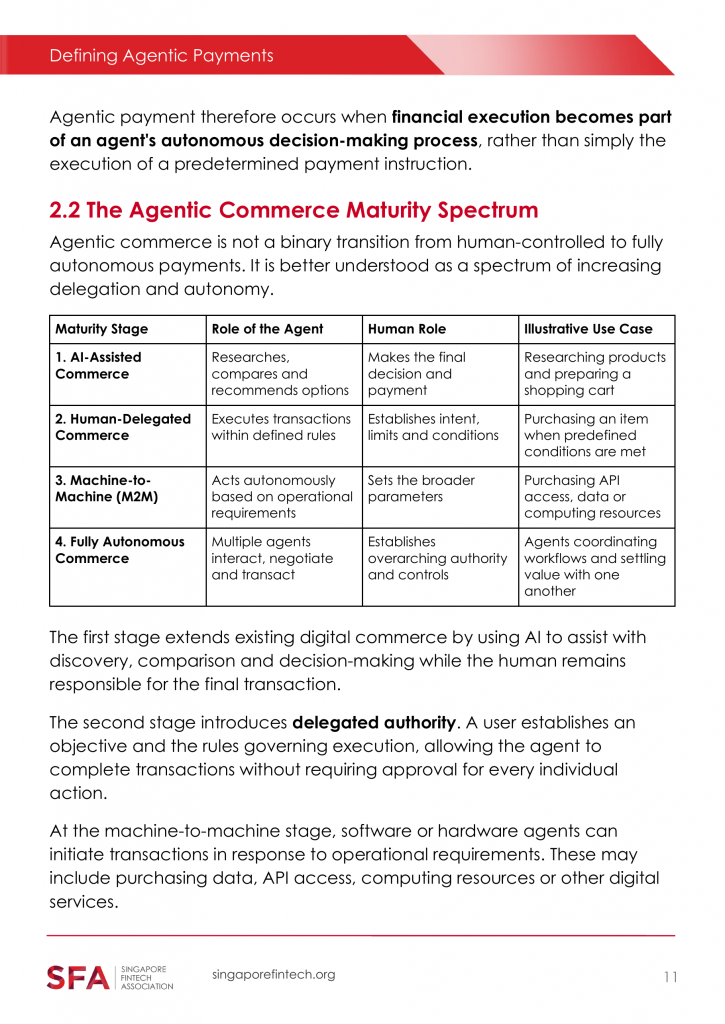
Agentic commerce isn’t a binary between “humans pay” and “agents pay.” It runs across four stages: AI-assisted commerce, where an agent researches and recommends but a human still clicks pay; human-delegated commerce, where a human sets the rules and the agent executes within them; machine-to-machine transactions, where an agent buys API access, data or compute against operational triggers; and fully autonomous commerce, where multiple agents negotiate and settle with each other directly [1].
Most of what looks like “agentic commerce” today, a shopping assistant with a human still approving checkout, sits at stage one. Visa’s Adeline Kim told the roundtable that early adoption will concentrate in transactions that are high-frequency and low-risk, rather than spreading evenly across all four stages at once [1]. Grab’s Karthikeyan Janakiraman, head of product for payments at the Southeast Asian super-app, described where things actually stand: “Current agentic payment activity spans consumer-delegated purchases and machine-to-machine payments initiated on behalf of consumers. Wider adoption will require alignment across merchants, consumers and payment rails” [1].
2. Buying is shifting from approving a purchase to authorizing an outcome
In conventional commerce, a person picks the product, picks the payment method and clicks confirm. Agentic commerce compresses that into a single instruction: “purchase the best available option within this budget.” The agent decides how to get there [1].
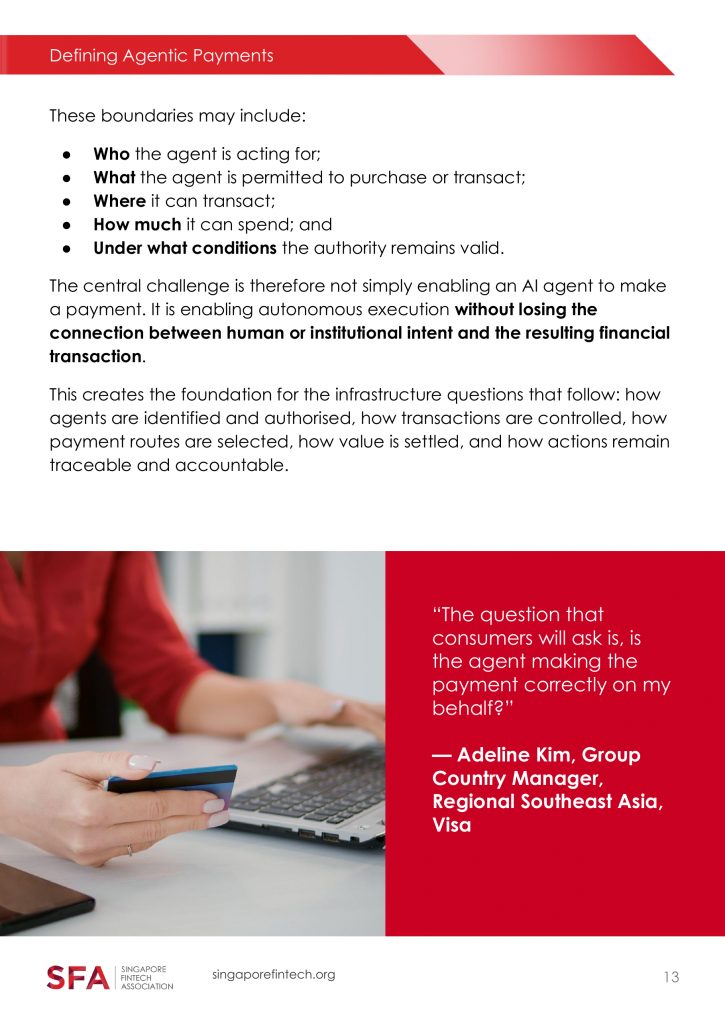
That handoff only works if the system can tell the difference between what the user meant, what the agent was authorized to do, and what the agent actually did. That authority runs along five axes: who the agent is acting for, what it can buy, where it can transact, how much it can spend, and under what conditions that authority stays valid [1].
StraitsX’s own product answer to that question, closest to home for us, is a single-use virtual card: a credential scoped to one transaction rather than access to a full card number or account balance [3]. It’s the “how much can it spend, and under what conditions does that authority remain valid” question, answered as a product feature rather than a policy document.
3. There’s no single payment rail for AI agents, only an orchestration layer
Card networks, bank rails and stablecoin settlement are not competing for the same job. A consumer purchase still needs to reach a merchant through an existing card or bank network; a machine-to-machine transaction has different requirements for size, frequency and settlement speed; a cross-border payment adds currency and liquidity considerations on top [1].
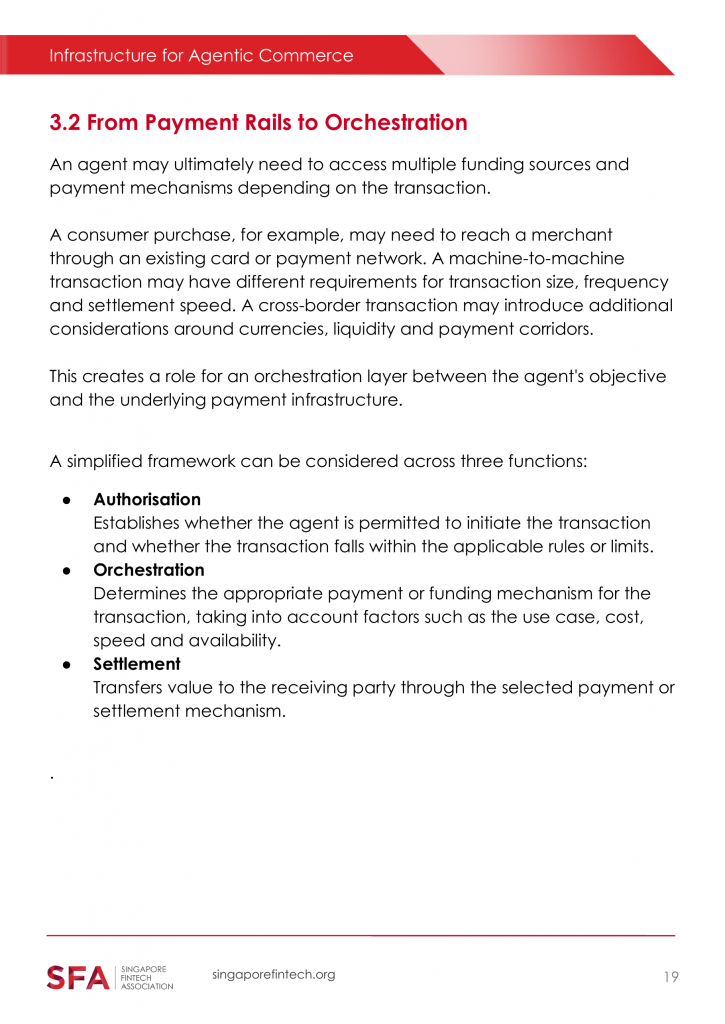
A three-function orchestration model sits between an agent’s intent and the underlying rails: authorization (is this agent allowed to transact), orchestration (which mechanism fits this transaction, given cost, speed and availability) and settlement (moving the value) [1]. Aave’s John Teo framed it almost identically from the crypto-lending side: “Agentic commerce can be viewed across three layers: authorisation, settlement and liquidity. Agents need defined mandates, the ability to choose the most efficient payment method, and access to liquidity when required” [1]. Monad’s Edwin Lau, the foundation’s Southeast Asia lead, put the practical version more bluntly: “Reaching merchants will always mean cards and bank rails – but agents at machine speed can benefit from onchain, where mandate, guardrails and settlement execute together instantly” [1].
4. Stablecoins get a narrow, real job in agentic payments, not a starring one
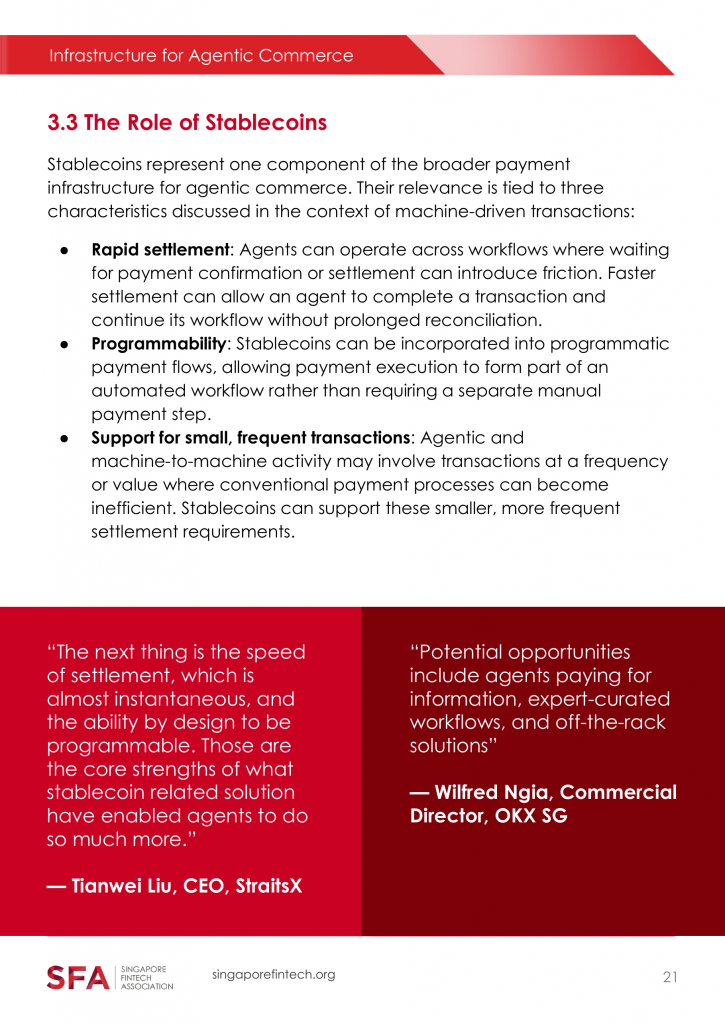
Stablecoins aren’t being oversold here as the payment rail for agentic commerce. Their advantage for machine-driven transactions comes down to three things: settlement fast enough that an agent isn’t left waiting mid-workflow, programmability that lets payment execution sit inside an automated flow rather than as a separate manual step, and suitability for the smaller, more frequent transactions that conventional payment processes handle inefficiently [1]. Stablecoin settlement alone doesn’t solve acceptance, though: agents still need to reach merchants and services that run on cards, wallets, bank transfers or local payment networks [1].
StraitsX CEO Tianwei Liu, whose firm builds exactly this settlement layer, drew the boundary clearly: “The next thing is the speed of settlement, which is almost instantaneous, and the ability by design to be programmable. Those are the core strengths of what stablecoin related solution have enabled agents to do so much more” [1].
We’ve heard versions of this argument before, from guests well outside our own portfolio. Coinbase Singapore’s Hassan Ahmed told our podcast in April that the logic runs both ways: “If agents are internet-native and digital-native, then they need a digitally native form of money. That is where we see this symbiotic relationship between AI agents and crypto wallets funded by stablecoins” [4]. Circle’s Yam Ki Chan made a related point about why that money needs to be programmable in the first place, describing smart contracts that execute “if this happens, then this happens” once the cost of moving money approaches zero [5]. That same case now carries the weight of a roundtable that also included Visa, Grab, AWS and Google Cloud, arriving months after Ahmed and Yam Ki Chan made it to us directly.
5. Guardrails now have to run during the transaction, not only after it clears
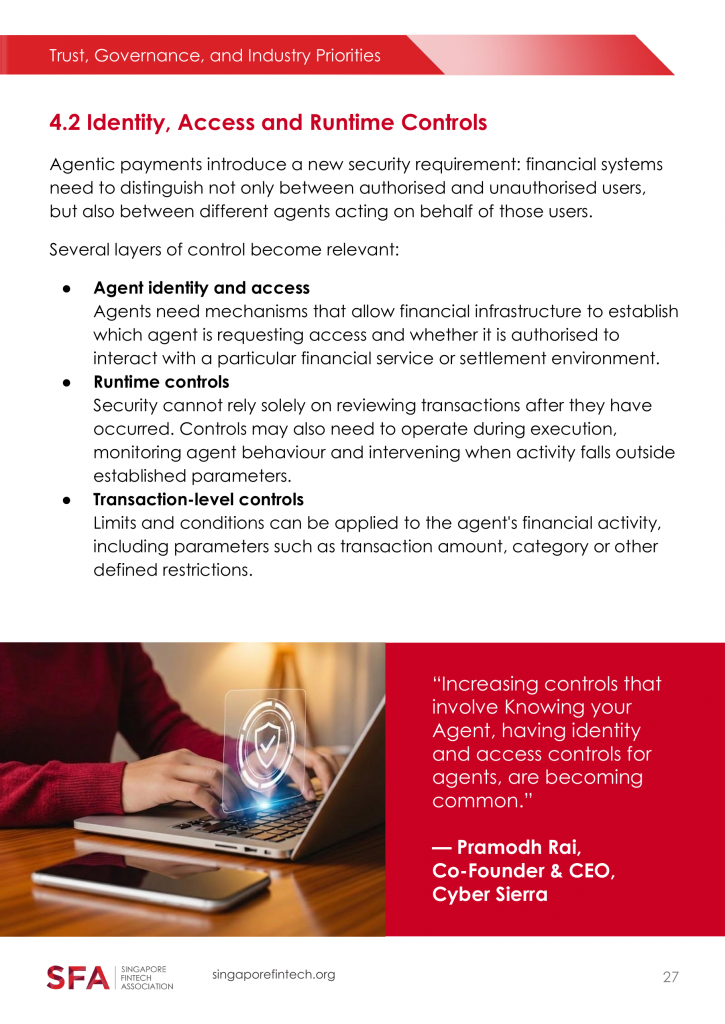
The most useful insight here has almost nothing to do with payments technology and everything to do with governance: when an agent acts outside its authorised intent, how should responsibility be determined across the parties involved in the transaction? [1]
Stripe’s Akhil Sadarangani put the underlying logic simply: “For an agent to act on your behalf, you need trust. For there to be trust, you need very controlled guardrails” [1]. That trust breaks down into three concrete layers: agent identity and access controls that establish which agent is requesting what; runtime controls that monitor behavior during execution rather than only reviewing it afterward; and transaction-level limits on amount, category and other parameters [1]. Cyber Sierra’s Pramodh Rai was the most pointed voice on how unfinished this still is: “None of the existing frameworks comprehensively address the current AI environment. Either a new framework has to develop, or the existing ones will have to evolve pretty fast. Otherwise, we’re all going to be blocked in pilot environments” [1].
StraitsX’s Tianwei Liu was making a version of this same argument on our podcast well before this roundtable convened. Discussing how StraitsX builds trust as it scales globally, he put it plainly: “Blockchain gives us the rails, but trust is still built by the people and systems behind the scenes” [6]. It’s the same distinction now sitting at the center of this whitepaper’s governance chapter: the technology moves the money; the guardrails around who’s allowed to move it are still built and maintained by people.
What this means for us
Much of the agentic-commerce commentary this year has argued about market size: how many trillions of dollars will flow through AI agents by the end of the decade. That question mostly stays out of the picture here. The payments executives, custody providers and infrastructure builders behind this roundtable are working through a narrower one first: how does a financial system prove who an agent is acting for, keep it inside its mandate, and know who to call when it isn’t?
That question doesn’t get answered by a bigger model. It gets answered by the same unglamorous work that has built every payment system before this one: identity, authorization, settlement and accountability, now being rebuilt by the people behind this whitepaper, StraitsX included, for a counterparty that never sleeps and never asks twice. It’s a useful reminder for the rest of our portfolio, too: the payments-adjacent companies among them will be asking these same questions before long.
References
- Singapore FinTech Association, StraitsX and Visa, The Autonomous Economy: How AI Agents, Stablecoins and Payment Infrastructure Are Shaping the Next Generation of Commerce (September 2026).
- Singapore FinTech Association, “Stablecoin-linked Agentic Commerce and Payments (Industry Roundtable),” event page, 29 July 2026. https://singaporefintech.org/event/stablecoin-linked-agentic-commerce-and-payments-industry-roundtable-series/
- StraitsX, “The Road to Mainstream Agentic Payments,” StraitsX Blog, 3 September 2026. https://www.straitsx.com/blog-post/the-road-to-mainstream-agentic-payments
- “Why Venture Scale Builders Should Take Stablecoins Seriously, with Coinbase Singapore Country Director Hassan Ahmed,” On Call with Insignia / Insignia Business Review, 13 April 2026. https://review.insignia.vc/2026/04/13/coinbase-hassan-ahmed/
- “On Call with Yam Ki Chan, Managing Director, Asia Pacific at Circle, on Stablecoin’s Journey to Trillions in Asia,” On Call with Insignia / Insignia Business Review, 2 June 2026. https://review.insignia.vc/2026/06/02/yam-ki-chan-circle/
- “Join Us on Call with Tianwei Liu and Hendra Kwik of StraitsX, a CNBC World’s Top Fintech Company,” On Call with Insignia / Insignia Business Review, 23 July 2025. https://review.insignia.vc/2025/07/23/straitsx-ep-186/

Paulo Joquiño is a writer and content producer for tech companies, and co-author of the book Navigating ASEANnovation. He is currently Editor of Insignia Business Review, the official publication of Insignia Ventures Partners, and senior content strategist for the venture capital firm, where he started right after graduation. As a university student, he took up multiple work opportunities in content and marketing for startups in Asia. These included interning as an associate at G3 Partners, a Seoul-based marketing agency for tech startups, running tech community engagements at coworking space and business community, ASPACE Philippines, and interning at workspace marketplace FlySpaces. He graduated with a BS Management Engineering at Ateneo de Manila University in 2019.



 Home
Home

 Publications
 Podcasts
  Search