
Five years ago, Ajaib led Indonesia’s retail-investing market by removing friction the incumbents wouldn’t touch, becoming Indonesia’s first fully digital stock brokerage and Southeast Asia’s first and fastest fintech investment unicorn. Insignia Business Review revisits its portfolio company for a sequel case study: from a Stanford coffee meeting to Indonesia’s fastest unicorn to a Japanese conglomerate’s $270 million bet, as the market Ajaib built turns crowded, competitive, and interesting enough for capital from Tokyo to buy a piece of it.
Before there was a company, there was a car ride. Six years before Ajaib existed, Anderson Sumarli was a Stanford student with no idea how to build one, catching up over coffee in Silicon Valley with a friend who had just raised a seed round of his own. That friend introduced him, that same week, to Yinglan Tan, the investor behind it, at a house gathering in Santa Clara. Small talk turned, by the end of the night, into an hour-long ride to the airport that Anderson has since described simply: “the whole ride to the airport ended up becoming a barrage of questions after questions.” By the time the car reached the terminal, he had his first offer, before he had incorporated a company or built a product [1].
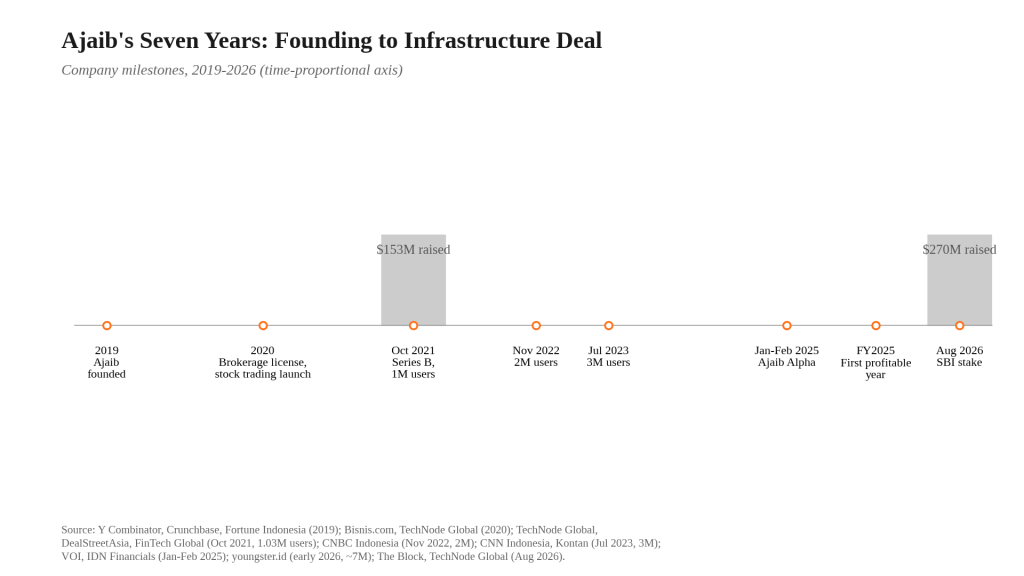
Fast-forward to the days after August 28, 2026, and the same company found itself, in Anderson’s words, “congratulated on the most famous trading floor in the world.” Japan’s SBI Holdings had just agreed to put $270 million into Ajaib Group for a 20% stake, at an implied valuation of roughly $1.35 billion, Indonesia’s largest technology fundraising since 2022 [2][3]. Word of the deal reached the New York Stock Exchange itself. “A company from Jakarta built for first-time investors, congratulated on the most famous trading floor in the world,” Anderson wrote. “Thank you NYSE for your kind words” [4].
That earlier offer, made in a car on the way to the airport, sits between those two moments and roughly where Insignia Business Review’s original case study on Ajaib picked up: a company that turned a 20-page, three-week brokerage account opening into a same-day sign-up, rode that friction removal to a $153 million Series B led by DST Global in October 2021, and became not only Southeast Asia’s first investment-app unicorn but, by most contemporary accounts, Indonesia’s fastest one, reaching the milestone in roughly two and a half years [5][6][7][15]. The thesis then was that product, not marketing spend, creates markets. Indonesia had roughly 1% investor penetration; Ajaib’s job was to make investing simple enough that the other 99% would show up.
They did (and penetration today is at around 7%). What Part 1 could not have shown is what happens once they show up in numbers large enough to draw international capital in twice: once onto the exchange itself, in Robinhood’s case, and once into the company, in SBI’s. Here are five lessons from the five years between that first unicorn round and this one.
1. The market you create will come back crowded, but first mover advantage still matters
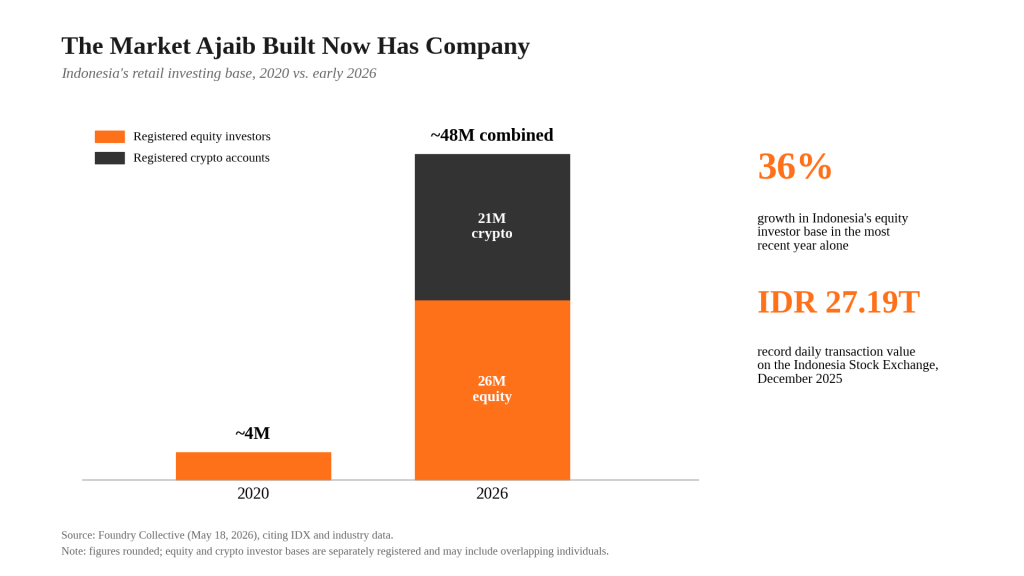
Indonesia’s registered stock-market investor base grew from fewer than 4 million in 2020 to roughly 26 million by early 2026, adding 36% in the most recent year alone; counting the country’s 21 million registered crypto accounts, the combined retail investing base runs close to 48 million people [8]. This is, in other words, the generational wave Part 1 described, now arrived, and arriving with company: domestic competition for that base intensified as the market matured, and Robinhood announced its acquisition of Buana Capital Sekuritas and associated crypto assets in 2025, aiming to close in the first half of 2026 and become the first marquee American broker to commit to the Indonesian retail market [8].
That is the least surprising part of the story. A founder who proves a market exists, and that a population’s investing behavior can actually be changed at scale, has also just handed every well-capitalized competitor, domestic and international, a validated business case and a cheaper way in: the expensive work of proving demand has already been done by someone else. Ajaib’s five-year head start bought it distribution and brand recognition, not exclusivity. Being first to create a market is a temporary advantage on its own; it has to be converted into something structural before the market notices there’s a reason to show up.
Against that backdrop, Ajaib’s own 2025 numbers show discipline more than raw growth: net revenue of IDR 474 billion, up 152% year on year, and roughly $1.4 million in net profit, its first profitable year, alongside a user base that had crossed 7 million and platform transaction value of $13.4 billion, up 131% [8][9]. The margin came less from trading commissions, the metric competitors were pricing most aggressively for share on, and more from turning an existing base into a lending book: margin facilities layered onto accounts the company had already paid to acquire [8]. Product-led growth got Ajaib into the market first; it did not, on its own, keep the market from getting competitive. What it bought was time to build a harder-to-copy margin structure before the crowding fully arrived.
2. Leveraging AI cuts the cost of trust, it doesn’t replace it
Ask founders across different Southeast Asian consumer categories how they use AI, and the same tension shows up in different clothes. Several have arrived, independently, at close to the same conclusion Anderson had: AI’s main job is not to build a smarter product, it’s to make the expensive parts of earning a customer’s trust cheap enough to offer at scale.
At Carro, the used-car marketplace, Aaron Tan described the limits of letting a model set a price on its own: “While machine learning can be extremely accurate, the truth is that the consumers will never agree with your prices” [10]. At Pinhome, the property platform, Dayu Dara Permata put the same idea in unit economics: AI valuation tools took the cost of appraising a roughly $100,000 property from about $130 a transaction down to $20 to $30, “if external factors are all constant and it’s not behaving erratically” [10]. At Super, Steven Wongsoredjo framed the risk of skipping straight to sophistication in rural markets bluntly: “If you’re being too innovative in the rural areas, then no one’s gonna use it. Your AI is just gonna become a trophy in the cabinet. You need a solid foundation before you get there” [10].
Anderson has made the same point in his own words: “One of our challenges running a stock brokerage or crypto exchange or even the bank is that we gotta find a way to serve the customers in a low-cost way. This is where we found opportunities using AI” [10]. Ajaib was already using generative AI for content at scale, more than half of it AI-generated by his account, but he drew a firm line: “I think that we have held ourselves back from going to recommendations… It has to be paired with our human registered wealth advisors,” partly because Indonesia’s market resists the shortcut that might otherwise replace that judgment: “in the Indonesian stock market, it’s not a perfect market. So even if you go and look at fundamentals… it just doesn’t work” [10].
Two years on, Ajaib has scaled that same instinct rather than replaced it: thousands of AI agents trained to the depth of a CFA Level III curriculum answer customer questions across its forums, and licensed AI avatars produce thousands of short-form video lessons in place of one-off influencer contracts [1]. Educating a generation about to control more money than it knows how to manage is, in Anderson’s words, “a huge responsibility on our shoulders” [1]. Four founders, four industries, the same arithmetic: AI’s value is in the trust it buys cheaply, not in how impressive the model behind it looks.
3. One account, every asset class
The product surface Ajaib has built looks less like a traditional Indonesian brokerage experience and more like a single account meant to hold whatever its customers want to own. In January 2025, the company rebranded its crypto app from Ajaib Kripto to Ajaib Alpha and added perpetual futures with leverage up to 25x on assets like bitcoin and ether [11]. The following month, Ajaib Alpha added direct access to more than 600 US-listed companies, including Nvidia, Tesla and Google, with a $1 minimum and a promotional zero-commission structure, giving Indonesian retail investors a fourth asset class, after domestic equities, mutual funds and crypto, without leaving the app [12]. “This aligns with Ajaib’s mission to welcome the new generation into modern financial services,” Anderson said of the launch, a line that could as easily have opened Part 1 [12].
That range is deliberate, and it is also now the company’s profit engine: the margin lending layered onto that wider shelf, not commissions, is what carried Ajaib to its first profitable year in 2025 [8]. Friction removal, in other words, stopped being only about how fast an account opens. It became about how much of a customer’s financial life can stay inside one.
4. The best kind of product-market fit is actually found but evolves across customer lifecycles and generations
Part 1 credited Ajaib’s founders with an early read on an underserved market. Anderson’s account of the company today suggests that read never stopped updating. Indonesia, in his telling, is home to roughly 286 million people with a median age of 30 and still the world’s third-largest unbanked population, around 100 million people, inside a broader Southeast Asian pool of some 700 million people sitting on an estimated $56 trillion in household wealth [1]. “It is pretty clear to us that there’s about to be a generation that’s about to discover more money than they know how to spend, and the current financial institutions either doesn’t know how to serve them or does not want to serve them,” he has said [1].
What that generation does with money, in his account, does not follow the order his own generation assumed. Customers who arrive through crypto often become the company’s most complete users, cycling profits into equities and then into mutual funds rather than climbing a fixed risk ladder from savings upward: “They don’t start with savings, deposits, bonds, mutual funds… and then go to crypto. No. They’ll go wherever they can follow global opportunities,” Anderson has said. By his account, roughly 80% of new customers adopt more than one asset class or use case immediately, and, in a detail that grounds the same point at home, roughly the same share of Ajaib’s own customer base comes from tier two and tier three cities rather than Jakarta [1].
That figure would be familiar to Insignia’s other consumer-fintech bets. In a separate case study on Groww, India’s largest investing app, Insignia Business Review has traced the same thesis forward: “This thesis has guided our investments in companies like Ajaib in Indonesia and Finhay in Vietnam. The success of Groww has provided a clear playbook, and we see these companies executing on the same fundamental principles” [13]. The playbook in question, building a platform for the “next billion users,” a mass market that is “mobile-first and value-conscious,” describes Groww’s customers in India, but it reads just as accurately as a description of Ajaib’s tier two and tier three base in Indonesia [13]. Founder-market fit, on this evidence, is not a one-time insight about a home market. It behaves more like a pattern an investor can recognize and back again: an underserved mass market discovering formal finance for the first time keeps showing up in different countries, wearing a different flag each time.
5. For fintechs, the endgame is becoming an institution, not just a superapp
Read against that backdrop, the SBI stake buys distribution and infrastructure, not growth capital, and the NYSE’s attention, in its own way, is a signal of the same shift. Anderson’s own explanation of why, in his words, “the world suddenly care[s] about an Indonesian company” gets at what SBI is actually buying: “Because Ajaib sits exactly where finance is being rebuilt: the intersection of traditional markets and digital assets. We run a regulated stock brokerage and one of Indonesia’s largest digital asset exchanges under one brand, with stablecoin infrastructure underneath. Over the next decade, real-world assets, financial assets, media, compute, will increasingly trade as tokens, and stablecoins will become how it all settles. Someone has to build that for 280 million people. We intend to be the ones” [4].
SBI’s own rationale lines up with that pitch. Chairman and CEO Yoshitaka Kitao described the investment as advancing SBI’s “APAC Digital Economic Zone” strategy, a plan to knit together digital-asset exchanges across Southeast Asia the way SBI has already done with SBI VC Trade in Japan, Coinhako in Singapore, and its B2C2 market-making unit in the UK [2][3]. The partnership is expected to route SBI’s yen-denominated stablecoin, JPYSC, to Indonesian customers through Ajaib, and to plug Ajaib’s existing OTC stablecoin desk, which already serves institutional clients moving value across borders, into SBI’s broader network [2][3].
Anderson has described this shift in finance’s plumbing as already underway, not speculative: “Already we see the first modernization is around Swift on cross-border payments using stablecoin. But the fact of it is that’s just the beginning. Finance is more and more gonna move on-chain” [1]. It is not an abstraction inside the company either. Ajaib’s OTC stablecoin desk has, in Anderson’s account, drawn real demand from small operators moving money across borders at spreads no bank branch can match, because the pricing is set by global liquidity rather than a fixed margin [1].
Insignia Business Review has previously argued that Japanese financial institutions are treating Southeast Asian fintech less as a speculative bet than as long-term infrastructure, building governance-grade positions that double as bridges to Tokyo’s capital markets: Mizuho’s stake in the Philippines’ Tonik, MS&AD’s in Singapore’s Intellect, Kiraboshi Bank’s partnership with Surfin [14]. The SBI-Ajaib deal adds a distinct piece to that pattern: where the other deals lean on wholesale funding and governance credibility, SBI is buying distribution for a stablecoin product into the most heavily banked-out large population in the region, a market Ajaib had already spent five years teaching to invest. An app earns downloads. An institution earns a call like this one, and, a few days later, a note of congratulations from an exchange most companies only reach by going public on it.
The wave, still early
Set against Southeast Asia’s roughly 700 million people and the trillions of dollars in household wealth expected to change hands or come online over the next decade, a combined Indonesian investor base of 48 million, however fast it has grown, is still a fraction of the addressable population Part 1 described. What has changed is the competitive shape of that opportunity. Ajaib no longer wins simply by being the first app willing to open an account in a day. It wins, if it wins, by being the widest shelf, in equities, crypto, US stocks and margin lending alike, and increasingly by being the rail a global institution plugs into rather than a category leader chasing commission share in an increasingly crowded market.
That is a narrower kind of advantage than “we made investing possible for people locked out of it,” and a harder one to sustain. It is also, on the evidence of the last five years, still the same founder who once talked his way into a car ride to the airport, reading the same generation, one asset class and one border-crossing rail at a time, only now with the New York Stock Exchange taking notice.
References
- Anderson Sumarli, remarks shared with Insignia’s own community, October 2025.
- “SBI Holdings invests $270 million in Ajaib, taking 20% stake amid Asia digital asset push,” The Block, August 28, 2026. https://www.theblock.co/news/deals/2026-08-28-sbi-holdings-invests-270-million-in-ajaib-taking-20-stake-amid-asia-digital-asset-push-413023
- “Japan’s SBI takes 20% stake in Indonesia’s multi-asset investment platform Ajaib,” TechNode Global, August 28, 2026. https://technode.global/2026/08/28/japans-sbi-takes-20-stake-in-indonesias-multi-asset-investment-platform-ajaib/
- Anderson Sumarli, LinkedIn post, September 2026. https://www.linkedin.com/posts/andersonsumarli_a-company-from-jakarta-built-for-first-time-ugcPost-7500021275340390400-PnmK/
- “Ajaib becomes Indonesia’s newest unicorn, raises $153m Series B led by DST Global,” DealStreetAsia, October 4, 2021. https://www.dealstreetasia.com/stories/ajaib-series-b-unicorn-263362
- “Ajaib becomes Indonesia’s fastest unicorn,” FinTech Global, October 5, 2021. https://fintech.global/2021/10/05/ajaib-becomes-indonesias-fastest-unicorn-wealthtech/
- “Ajaib becomes first investment app unicorn in SEA,” The Jakarta Post, October 6, 2021. https://www.thejakartapost.com/paper/2021/10/05/ajaib-becomes-first-investment-app-unicorn-in-sea.html
- “Stockbit Up 544%. Ajaib Profitable. Robinhood Is Buying In. Indonesia’s Wealthtech Sector Is on Fire.,” Foundry Collective, May 18, 2026. https://digest.foundrycollective.id/p/stockbit-up-544-ajaib-profitable
- “Ajaib revenue surges 152% to $22M as Indonesia’s trading boom fuels growth,” Dealroom.co, May 2026. https://app.dealroom.co/news/feed/ajaib-revenue-surges-152-to-22m-as-indonesia-s-trading-boom-fuels-growth
- “Call 146 | The Reality of Leveraging AI in Southeast Asia’s Leading Consumer Platforms,” Insignia Business Review, November 28, 2023. https://review.insignia.vc/2023/11/28/season-5-episode-35-call-146-ai-in-consumer-experiences/
- “Ajaib Kripto Rebranding Jadi Ajaib Alpha, Hadirkan Perpetual Futures Kripto,” VOI, January 23, 2025. https://voi.id/en/technology/453929
- “After IDX stocks and crypto, Ajaib offers US stock investments,” IDN Financials, February 2025. https://www.idnfinancials.com/news/52300/after-idx-stocks-and-crypto-ajaib-offers-us-stock-investments
- “Case Study: Groww,” Insignia Business Review, November 25, 2025. https://review.insignia.vc/2025/11/25/groww/
- “Why Japanese Capital Keeps Finding Southeast Asian Fintech,” Insignia Business Review, August 28, 2026. https://review.insignia.vc/2026/08/28/japan-sea-fintech/
- “Case Study: Product-Driven Growth: 5 Lessons from Ajaib’s Meteoric Rise Leading a Generational Wave of Investors to Indonesia’s Public Markets,” Insignia Business Review, October 8, 2021. https://review.insignia.vc/2021/10/08/case-study-product-driven-growth-5-lessons-ajaib-meteoric-rise-leading-generational-wave-investors-indonesia-public-markets/

Paulo Joquiño is a writer and content producer for tech companies, and co-author of the book Navigating ASEANnovation. He is currently Editor of Insignia Business Review, the official publication of Insignia Ventures Partners, and senior content strategist for the venture capital firm, where he started right after graduation. As a university student, he took up multiple work opportunities in content and marketing for startups in Asia. These included interning as an associate at G3 Partners, a Seoul-based marketing agency for tech startups, running tech community engagements at coworking space and business community, ASPACE Philippines, and interning at workspace marketplace FlySpaces. He graduated with a BS Management Engineering at Ateneo de Manila University in 2019.



 Home
Home

 Publications
 Podcasts
  Search