
For most of the industry’s short history, the stablecoin market has been measured by one number: how many tokens are outstanding. In 2026 that number went nowhere. Total supply rose 0.4% to US$305 billion in the first nine months of the year, according to Allium data, and has held between US$300 billion and US$320 billion for twelve months, peaking at US$322.4 billion in May [1].
Over the same nine months, stablecoin payments grew 45% to US$482 billion, and the number of payment transactions rose 71% to 1.04 billion [1]. September alone set a record of US$72 billion. The money supply stayed flat, and the money inside it moved more often.
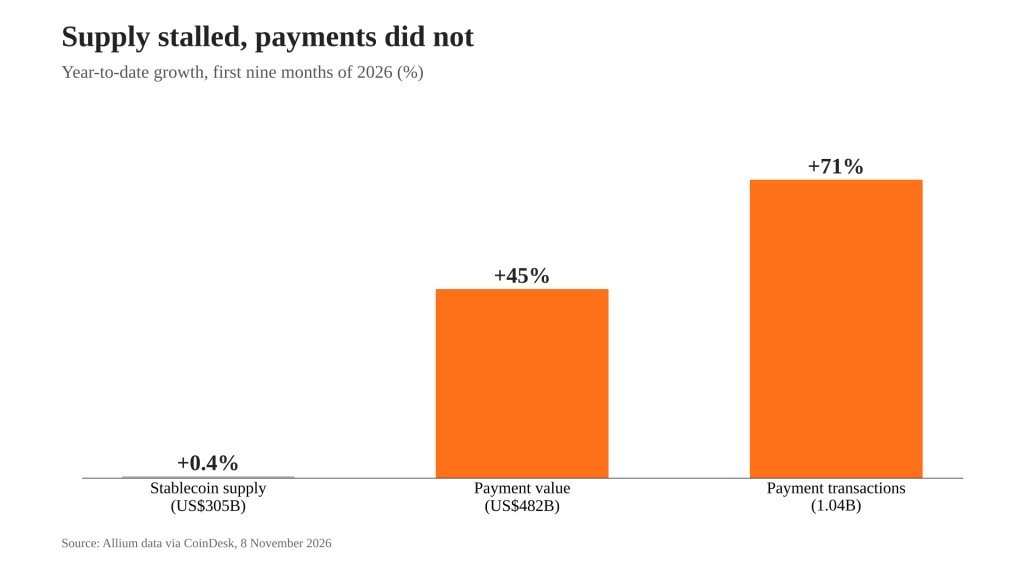
Supply stalled, payments did not. Source: Allium data via CoinDesk, 8 November 2026
Measuring use instead of float
Supply tells you how much money is parked in a system. It says little about how hard that money works. Tianwei Liu, CEO and co-founder of StraitsX, put the distinction plainly: supply “measures what is sitting outstanding, not how often money moves” [2].
Standard Chartered’s digital assets research team estimates that stablecoin velocity has roughly doubled to about 30 turns a month in 2026, from around 15 in 2025. USDC’s velocity rose to about 80 from 45, while USDT stayed near 7, a gap that reflects how differently the two tokens are used [1]. Circle’s own numbers show the same pattern inside a single issuer. USDC supply ended September at US$73.9 billion, flat on a year earlier, while on-chain volume rose 49% to US$13.9 trillion. Circle CEO Jeremy Allaire summed it up on the company’s earnings call: “Balances were flat, but usage continues to grow” [1].
The size of the average payment points in the same direction. It fell to US$462 from US$544 over the nine months [1]. Growth came from more frequent, smaller transfers, which is how money behaves once people spend it on ordinary things.
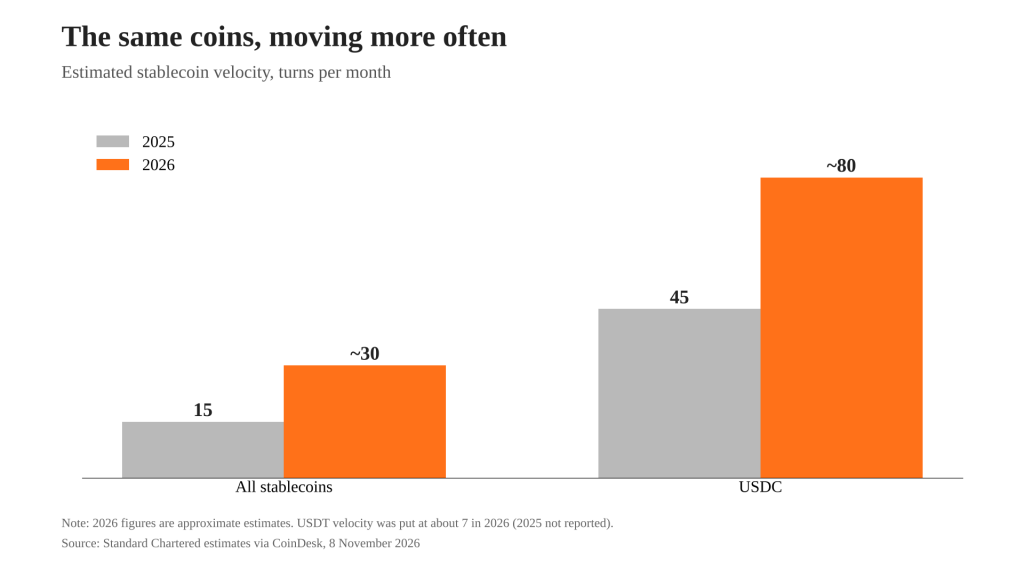
The same coins, moving more often. Source: Standard Chartered estimates via CoinDesk, 8 November 2026
Cards are the high-turnover end of the market
Payment cards are where this shift is easiest to see, because a card transaction is by definition a purchase. Visa reported an annualised stablecoin settlement run rate of US$20 billion as of September 2026, more than 15 times its level a year earlier, across more than 225 live stablecoin-linked card programmes. On 10 November it added Monad to the list of networks it settles on, alongside Ethereum, Solana, Avalanche, Base, Polygon, Stellar and others [3].
Card programme providers are growing alongside the networks. WasabiCard, which builds card programmes for businesses, has grown its enterprise client base from 500 to more than 700 since May, and its CEO Ray Yang explained why that growth barely registers in supply figures: “Payments just don’t need much new supply, because the same dollar can be used many times” [1]. New issuers keep arriving too. Singapore-based DCS DeCard extended its stablecoin-linked Visa cards to more than 70 markets across Europe, the Middle East, Africa and Latin America on 12 November [7].
Card spending also converts at the point of sale. A cardholder can hold stablecoins in a wallet, tap a card at a supermarket, and have the merchant paid in local currency over Visa’s network without the merchant ever touching a token. That makes cards a high-volume, low-float use of stablecoins: they add transactions far faster than they add outstanding supply.
That acceptance layer is what everyday stablecoin spending has been missing. Yam Ki Chan, former Managing Director for Asia Pacific at Circle, made the comparison in June: “you’re not using USDC to go buy coffee here in Singapore. You can, but you need a lot of different things to happen. In the same way that before credit cards and POS machines became popular, it was impossible to use a card” [10]. Card programmes fill that gap by putting stablecoin balances behind acceptance that already exists. Hassan Ahmed, Coinbase’s Country Director for Singapore, described the shift in similar terms: “If you look at the mix of payment flows between wires, cards, and stablecoins, the network effects are increasingly building in favor of stablecoins. The acceptance and origination side of the market is being built out in real time” [11].
What StraitsX’s card data shows
StraitsX issues the Singapore dollar and US dollar stablecoins XSGD and XUSD, and provides card issuance to companies building stablecoin-backed card programmes. Daily transactions across its card programmes grew from roughly 66,000 in January to 291,000 in October, an increase of about 4.4 times, with spend averaging about US$54 on routine purchases such as groceries, food and transport [2].
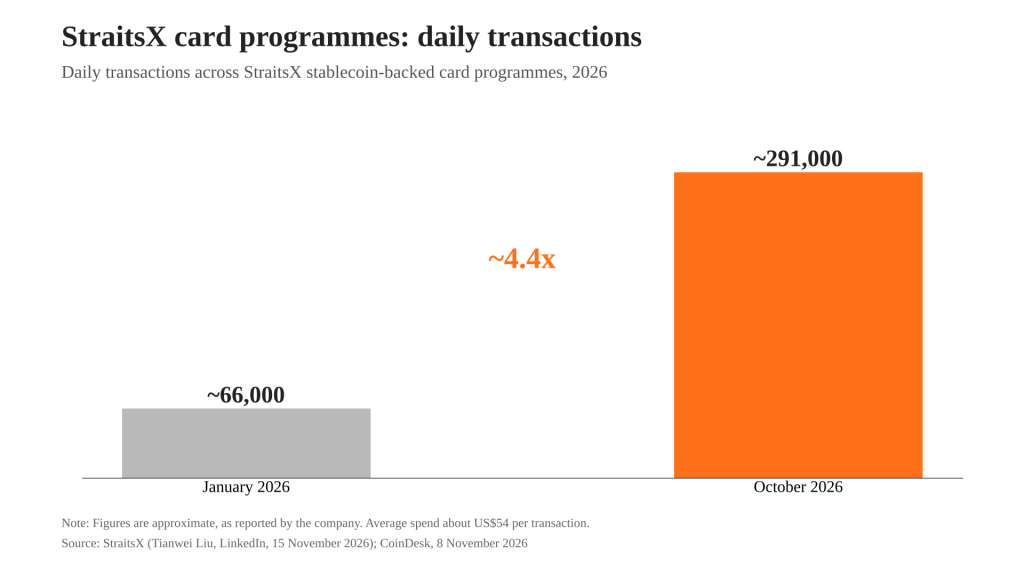
StraitsX card programmes: daily transactions. Source: StraitsX (Tianwei Liu, LinkedIn, 15 November 2026); CoinDesk, 8 November 2026
Those two figures are consistent with what StraitsX reported a month earlier. At October’s pace, 291,000 transactions a day at about US$54 each works out to roughly US$15.7 million a day, or around US$5.7 billion a year (Insignia Ventures Partners calculation). In mid-October, StraitsX reported more than US$6 billion in annualised card gross transaction value across its Asian stablecoin-backed card programmes, as it expanded card issuing with Visa to more than 100 markets [4].
A US$54 average ticket is far below the US$462 average across all stablecoin payments [1]. That gap is the clearest sign that these cards are being used for daily spending rather than occasional large transfers.
The mechanics behind those numbers are specific:
- Issuer-native settlement. Programmes can settle in XSGD and XUSD, which StraitsX issues itself, drawing on reserves clients hold with StraitsX, with USDC and direct SGD or USD prefunding also supported [5].
- Visa membership and BIN sponsorship. StraitsX issues cards under its own Visa membership. Its card platform cites a 12 to 14 week launch path for new programmes through BIN sponsorship, against the multi-year route of independent licensing and scheme approvals [5][6].
- Named programmes. OKX, RedotPay, Chocolate Finance and Pionex are among the programmes on StraitsX’s card platform [5]. For the OKX Card in Singapore, StraitsX acts as licensed issuer, BIN sponsor and infrastructure provider, handling the transaction from authorisation through clearing and settlement as a Major Payment Institution under Singapore’s payment services framework [6].
- Wallet provisioning. Cards can be tokenised into Apple Pay, Google Pay and Samsung Pay, which is how a stablecoin balance ends up as a tap at a checkout counter [5].
StraitsX is one example among several. Circle’s payments network and Visa’s settlement programme are scaling on the same logic, and WasabiCard and DCS DeCard are building card distribution on top of it. What these cases share is that their growth is measured in transactions settled, not in tokens issued.
Two kinds of stablecoin demand
Latin America is the other region where stablecoin use has grown fastest, and its pattern is different. Demand there began with savings and dollar access. Stablecoins made up 71% of crypto purchases by Bitso’s Argentine users in 2025, and 40% across its nearly 10 million retail users in Argentina, Brazil, Colombia and Mexico, overtaking Bitcoin on the platform for the first time [9].
The use is increasingly about moving money. Bitso’s stablecoin volumes among institutional clients rose 81% in the first half of 2026. Remittance company Félix Pago says settling in USDC around the clock, including nights and weekends, let it cut its flat fee from US$4.98 to US$2.99. A Mexican berry exporter now receives USDC from US buyers on the day of sale and converts it straight into pesos for farmers who used to wait nearly a week to be paid [9]. Each of these is a faster turn of the same dollars.
Isabel Sica Longhi, Ripple’s public policy director for Latin America, drew the line between the two uses: “We don’t use stablecoins for day-to-day transactions, but we use them for dollar access and money movement” [9]. StraitsX’s card data covers the part of the market that description leaves out. A US$54 average ticket on groceries and transport is day-to-day spending. The two regions show the same move from holding stablecoins to moving them, at different points in the payment chain: cross-border transfers and supplier payments in Latin America, everyday checkout spending through card programmes in Asia.
In both cases the blockchain stays in the background. The berry exporter was not especially curious that his payments ran on a blockchain [9], and a cardholder tapping at a supermarket never sees the stablecoin leg at all.
What higher turnover asks of the infrastructure
When the same pool of liquidity supports far more transactions, the pressure moves from issuance to everything around each payment. A card programme running hundreds of thousands of purchases a day has to settle reliably around the clock, keep enough liquidity on hand to fund authorisations before settlement completes, and run anti-money-laundering and fraud checks on every flow. Issuer controls are part of that toolkit: after a record theft from Binance in October, Tether, Circle and Ripple froze about US$2.67 billion of stolen tokens [9], an example of how an identifiable, regulated issuer can act on illicit flows. Refunds, chargebacks and reconciliation have to work as they do on any other card. Stablecoin settlement can also ease the funding burden behind card programmes. Chan pointed to payments company Nium, which uses USDC to settle with Visa: it can mint USDC and send it to Visa immediately, without waiting on banking hours, and without keeping as much pre-funding with the network [10].
This is also why settlement network choices are multiplying. Visa now supports ten networks for stablecoin settlement [3], and StraitsX has said it plans to issue XSGD and XUSD natively on Monad from early 2027 [8]. Each added network gives programme operators more options for where and how fast the settlement leg runs.
The limits of the data
The payments story is real but still small relative to on-chain activity overall. Raw stablecoin transfers totalled US$97.9 trillion in the first nine months of 2026, and only about 0.5% of that was classified as payments [1]. A BIS working paper found that treating every transfer as a payment misclassified almost six in ten transfer events [1], which is a reason to favour card data, where each transaction is a purchase, over raw chain volume. Standard Chartered has also pushed back its US$2 trillion stablecoin market forecast to 2030 from 2028 [1].
StraitsX’s card figures raise questions of their own. Growth from 66,000 to 291,000 daily transactions could come from more cardholders, from existing cardholders using their cards more often, or from both. A breakdown by active cardholder and repeat-use rate would show how much of the growth reflects habit.
Measured by movement
The industry spent its first decade arguing about how large stablecoin supply would grow. This year’s data points to a different measure of progress: how often the same dollars change hands, and for what. On that measure, the most useful evidence sits in card programmes, where every transaction is a purchase and the average ticket looks like a grocery bill.
For StraitsX, that means growth shows up in daily transactions settled through its issuer-native stablecoins and Visa programmes, at a time when total supply across the market is flat. If spending keeps compounding at anything like the January to October pace, transaction counts will tell the story of stablecoin adoption well before supply does. Chan framed the larger question as one the internet has asked before, after collapsing the cost of communication and then of data: “when we get the movement of money to zero per unit, what new application can we build?” [10] A daily grocery run paid from a stablecoin balance is one early answer.
References
- Omkar Godbole, “Stablecoin growth has stalled. The payments boom hasn’t”, CoinDesk, 8 November 2026 (updated 9 November 2026). https://www.coindesk.com/business/2026/11/08/stablecoin-growth-has-stalled-the-payments-boom-hasn-t
- Tianwei Liu, “Stablecoin supply has stayed largely flat this year…”, LinkedIn post, 15 November 2026. https://www.linkedin.com/posts/tianweiliu_stablecoin-supply-has-stayed-largely-flat-share-7526826762823946240-3qa_/
- “Visa adds Monad to stablecoin settlement network options”, The Block, 10 November 2026. https://www.theblock.co/news/ecosystems/2026-11-10-visa-monad-stablecoin-settlement-network-437201
- “StraitsX and Visa expand stablecoin card issuing to 100+ markets”, Fintech News Singapore, 15 October 2026. https://fintechnews.sg/138967/digitalassets/straitsx-visa/
- StraitsX, “Stablecoin-backed card issuer in Asia” (card issuance platform page), accessed 17 November 2026. https://straitsx.com/platform/card-issuance
- StraitsX, “How StraitsX Powers OKX Card in Singapore”, StraitsX blog, 2 June 2026. https://straitsx.com/blog-post/how-straitsx-powers-okx-card-in-singapore
- “DCS DeCard Takes Stablecoin-Linked Cards to 70+ Markets with Visa”, Fintech News Singapore, 12 November 2026. https://fintechnews.sg/141065/payments/dcs-decard-visa-stablecoin-cards-70-markets/
- “StraitsX to Bring XSGD, XUSD Stablecoins to Monad in Early 2027”, Blockhead, 1 October 2026. https://www.blockhead.co/2026/10/01/straitsx-to-bring-xsgd-xusd-stablecoins-to-monad-in-early-2027/
- Maria Clara Cobo, “Latin America May Have Found Crypto’s Killer App. It’s the Dollar”, Bloomberg (Weekend Essay), 13 November 2026. https://www.bloomberg.com/news/articles/2026-11-13/stablecoins-are-becoming-crypto-s-killer-app-across-latin-america
- On Call with Insignia Ventures, “On Call with Yam Ki Chan, Managing Director, Asia Pacific at Circle on Stablecoin’s Journey to Trillions in Asia”, Insignia Business Review, 2 June 2026. https://review.insignia.vc/2026/06/02/yam-ki-chan-circle/
- On Call with Insignia Ventures, “Why venture scale builders should take stablecoins seriously with Coinbase Singapore Country Director Hassan Ahmed”, Insignia Business Review, 13 April 2026. https://review.insignia.vc/2026/04/13/coinbase-hassan-ahmed/

Paulo Joquiño is a writer and content producer for tech companies, and co-author of the book Navigating ASEANnovation. He is currently Editor of Insignia Business Review, the official publication of Insignia Ventures Partners, and senior content strategist for the venture capital firm, where he started right after graduation. As a university student, he took up multiple work opportunities in content and marketing for startups in Asia. These included interning as an associate at G3 Partners, a Seoul-based marketing agency for tech startups, running tech community engagements at coworking space and business community, ASPACE Philippines, and interning at workspace marketplace FlySpaces. He graduated with a BS Management Engineering at Ateneo de Manila University in 2019.



 Home

 Publications

 Podcasts
 Search