
In Singapore, a principal consultant did not need a generative model to run a fraud for three years. According to police, he used original medical invoices as templates and forged 48 of them on an office laptop, drawing more than S$12,000 from his company’s group insurer between 2023 and 2025 [1]. The scheme surfaced only when the insurer noticed discrepancies and checked directly with the medical institutions [1]. A court sentenced him to 20 weeks’ jail in June 2026 [2].
That case relied on ordinary editing skills and a manual call-back. Generative tools remove the editing effort, and the volume of files that businesses now receive makes call-backs impractical. AI also supplies the way out: models that inspect every file at intake, at a scale no review team can match.
fileAI, the Singapore-based company that turns unstructured enterprise data into trusted records and governed AI workflows for finance, insurance, banking, healthcare and other sectors [3], is bringing its contribution to Product Hunt. Its flagship platform is fileForge, and fileForensics, which the company’s site presents as early fraud signals for file-heavy workflows and its newest launch, checks each file’s integrity, history and logic and looks for signals of AI-generated or manipulated content before data is extracted [4]. It follows two earlier fileAI launches on the platform: the fileAI OCR product in July 2025 and the fileAI MCP server in September 2025 [5][6].
The risk is growing with the technology
The sharpest data on how insurers experience this comes from Verisk’s State of Insurance Fraud study, based on surveys of 1,000 US consumers and 300 claims professionals conducted between December 2025 and January 2026 [7][8]. Ninety-nine percent of insurers said they had encountered manipulated or AI-altered documentation, and 98% agreed that AI editing tools are driving a rise in digital media fraud [7]. Seventy-six percent said AI-altered submissions had grown more sophisticated over the past year [7].
Confidence in detection trails those numbers. Only 43% of insurers said they were very confident assessing the authenticity of digital media at scale, and 32% were very confident they could identify a deepfake [7]. Two in three (66%) believed that digital media fraud often or very often goes undetected [7].
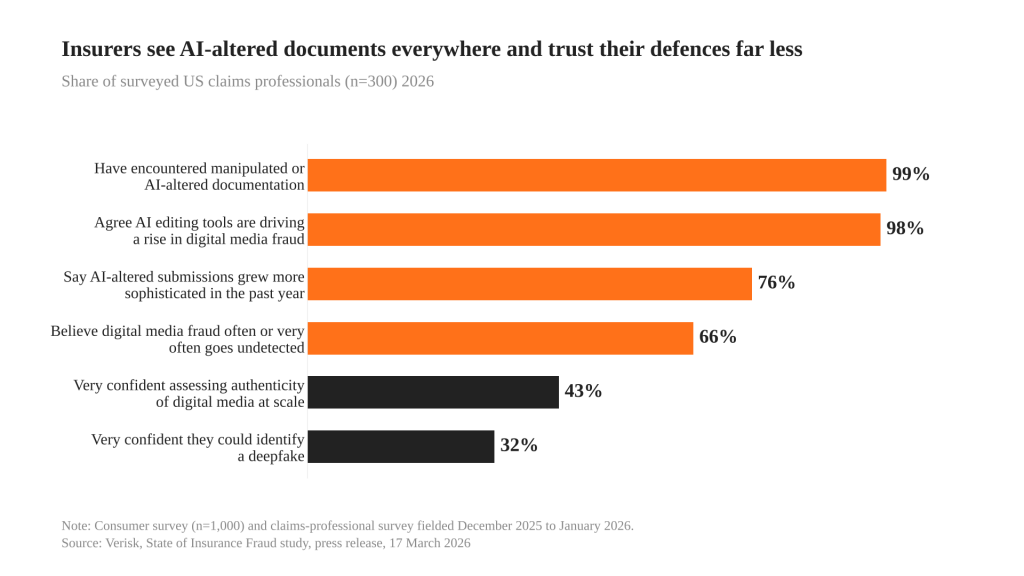
Share of surveyed US claims professionals agreeing with each statement, 2026 Source: Verisk, State of Insurance Fraud study (press release, 17 March 2026)
The supply side is widening too. Verisk found that 36% of consumers would consider digitally altering a claim image or document even if it broke insurer rules, rising to 55% among Gen Z against 12% among Baby Boomers [7]. In the United Kingdom, Aviva’s fraud figures reached £233 million, and the insurer reported more claims supported by AI-generated images and manipulated documents, particularly in motor [9].
Asia-Pacific supplies the wider context. A UNODC assessment released in July 2026 estimated that organised crime networks defrauded residents across the region of between US$88.3 billion and US$114.1 billion in 2025, up from US$18 billion to US$37 billion in 2023, which is nearly a fivefold increase at the low end [10]. The figure measures scam losses to individuals, a broader category than forged claims or invoices, so it does not size document fraud on its own. It does show how quickly organised fraud capacity has grown in the region, and UNODC expects the next shift to be from generative AI to agentic AI that can run social engineering campaigns autonomously [10].
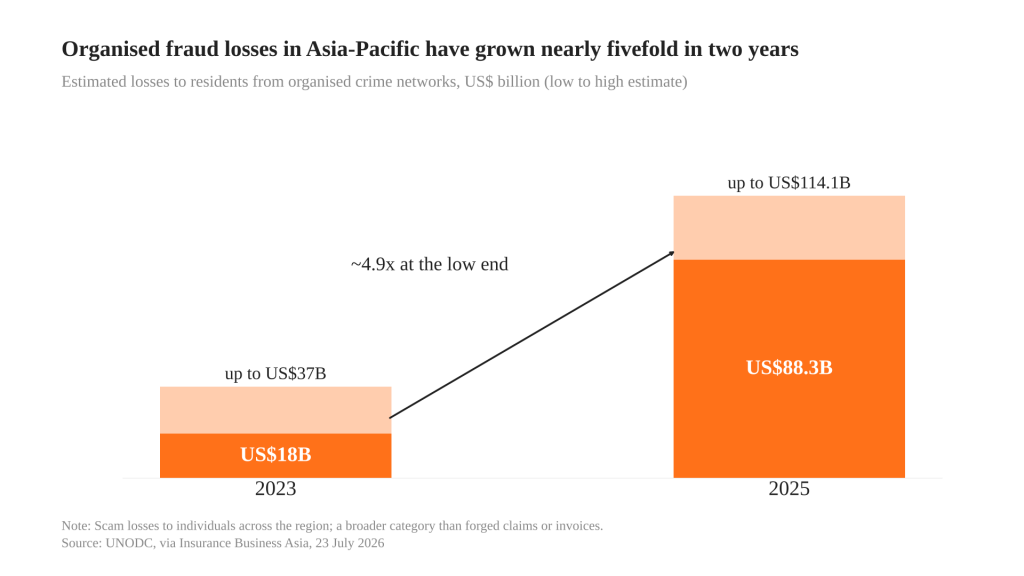
Estimated losses to residents from organised crime networks, US$ billion (low to high estimate) Source: UNODC, via Insurance Business Asia (23 July 2026)
Where the defence has to sit
Document-heavy industries have spent the past few years automating the intake of files. Claims, loan applications, supplier invoices and onboarding packs now pass through extraction models and, increasingly, AI agents that act on what they find. A forged invoice that is extracted cleanly becomes tidy structured data, ready to be matched, approved and paid. fileAI positions fileForensics as the step that establishes whether a document can be believed before extraction reports what it says [4].
Insurers already see the gap. In the Verisk study, 39% pointed to insufficient integration between fraud tools and claims systems, and 38% said their detection tools miss too many fraudulent or altered images and documents [8]. The same AI that speeds up intake can examine each file as it arrives, checking structure, metadata, provenance and signs of synthetic generation across every submission rather than a sampled few. The economics support the shift: CRIF says manual fraud checks account for up to 5% of banks’ operating costs [11].
Several vendors are building in this direction, across insurance and banking:
- Verisk: its Digital Media Forensics applies AI-driven algorithms to unstructured image data, analysing each customer-submitted loss photo for anomalies, and has been embedded in FRISS Media Check for European insurers [12].
- ABBYY: in August 2026 the document-processing company launched a document forensics offering for fintechs that assesses at the point of intake whether a document has been manipulated before its data is used in decisions [13].
- CRIF: in September 2026 it brought a GenAI-based service to UK banks and insurers that analyses IDs, utility bills and bank statements for visual manipulation and metadata discrepancies during onboarding, using deepfake detection models for AI-generated content [11].
- Insurance Council of Australia: working with EXL and Shift Technology, it was building a national AI-powered fraud detection and investigations platform slated for an early 2026 launch, designed to surface shared indicators such as image artefacts, document reuse and metadata similarities across carriers [14].
PYMNTS Intelligence data shows seven in ten financial institutions now use AI and machine learning to combat fraud, up from 66% in 2023 [14]. The pattern is consistent: each AI capability that widens the attack surface creates demand for AI-native verification at the point where files enter business systems.
fileForensics in practice
fileForensics runs each file through eight disciplines before it reaches a decision layer [15]: file integrity and structure; scan and image quality; origin, metadata and provenance; image and signature forensics; synthetic and AI-generated content; document understanding and extraction; privacy and compliance; and business logic and fraud intelligence.
The developer documentation shows how granular the checks are. Detectors cover AI-generated images, text, PDFs and Office files; copied-and-moved regions; exact duplicates of previously seen files; C2PA content credentials; revision history; mismatches between a file’s signature and its declared type; and data hidden after the end of a file [16]. Each detector reports a status, and the integrity decision returns one of three outcomes: review recommended, no signal, or incomplete evidence [16].
On the product page, the output is a score card for every file: a pass or flagged status for each document, a score for each element against the eight-discipline checklist, and a report compiled to the customer’s business requirements [4]. fileAI’s launch post adds an explainable risk rating with reason codes and a timestamped report that can be exported [15]. The company frames this as evidence for a human decision: the signals and evidence come from fileForensics, while the decision to log a case as fraudulent or malicious stays with the user [4]. The documentation is explicit that a review flag does not amount to a fraud finding, and that a “no signal” result does not prove a file is authentic [16].
Access runs through four entry points: the fileAI platform, an MCP server, an API and a developer portal [4]. Developers can add integrity checks to existing pipelines without re-platforming and try them in a self-serve sandbox, and fileAI offers a free review of a sample of recent claims documentation [4]. fileAI lists ISO 27001, ISO 42001, SOC 1 Type II and SOC 2 Type II certifications, along with GDPR and HIPAA compliance [4].
Where it plugs in
Insurance claims and underwriting are the first target, and fileAI’s insurance workflows already position fraud scoring beside classification and straight-through approval of low-complexity claims [17]. The fileAI site also lists banking and financial services (onboarding, lending, compliance and bank operations), accounting and finance (data capture, matching, reconciliation and close), and other industries including lab sciences, supply chain and BPO [4]. In accounting automation, fileAI’s fileLedger product draws on fileForensics for fraud detection alongside invoice and bank statement processing [18].
The architecture matters as much as the feature list. In October 2026, fileAI announced a strategic collaboration agreement with AWS to bring outcome-driven AI agents to banking, financial services and insurance customers, with fileScout mapping files ahead of extraction and fileForensics feeding fraud signals into the processing pipeline so that only fraud-checked data reaches the workflow [19].
The company’s investor base points the same direction. SMBC Asia Rising Fund and Singtel Innov8 backed fileAI in August 2026 to support its Japan expansion and the launch of fileScout, with SMBC contributing a network across banking and large regulated enterprises [20].
What to watch
Three open questions will decide how far AI-native defence travels.
- Published performance. The fileForensics product page gives no accuracy or detection rates [4]. Buyers in regulated industries will want benchmark figures, especially against newer generators.
- Probabilistic answers. FTI Consulting expects detection to become probabilistic as generated documents become indistinguishable from authentic ones, and suggests institutions will lean more on source-level verification, such as requesting statements directly from an applicant’s bank [21]. Forensic scoring and source verification are likely to work as complements.
- False positives. Verisk’s research also flagged the risk that legitimate claims could be delayed or denied if altered documents are wrongly flagged [22]. Treating the output as a signal with a human decision attached is a sensible design choice, though review queues still carry a cost.
The Product Hunt audience is a useful first test. fileAI’s July 2025 launch placed fifth for the day with 329 upvotes [5], and a crowd of developers integrating through an API or MCP server will probe a fraud-screening product harder than most.
AI has lowered the cost of producing a convincing fake, and it has raised the ceiling on what a verification layer can inspect. The businesses that read documents with software now have a reason to put that layer in front of extraction, and the vendors building it, fileForensics among them, are addressing a risk that AI itself created.
Disclosure: Insignia Ventures Partners is an investor in fileAI [23].
References
[1] Singapore Police Force. “Man To Be Charged For Insurance Fraud.” 22 April 2026. https://www.police.gov.sg/media-hub/news/2026/04/20260422_man_to_be_charged_for_insurance_fraud
[2] Daily Excelsior (PTI). “Singapore court jails Indian IT consultants for cheating on insurance claims.” 4 June 2026. https://www.dailyexcelsior.com/?p=2226326
[3] fileAI. “fileAI: Enterprise AI Workflow Automation & Data Intelligence.” Company website, accessed 12 November 2026. https://www.file.ai/
[4] fileAI. “fileForensics: Early fraud signals for file-heavy workflows.” Product page, accessed 12 November 2026. https://www.file.ai/fileforensics
[5] Leighton, Clare. “From zero to top-five: lessons from fileAI’s first ever Product Hunt launch.” fileAI Blog, 18 July 2025. https://www.file.ai/blog/from-zero-to-top-five-lessons-from-fileais-first-ever-product-hunt-launch
[6] Product Hunt. “fileAI launches” (fileAI AI OCR, 9 July 2025; fileAI MCP, 2 September 2025). https://www.producthunt.com/products/fileai-ai-ocr/launches
[7] Verisk. “AI Editing Tools Are Fueling a New Era of Insurance Fraud, According to New Research from Verisk.” Press release, 17 March 2026. https://s29.q4cdn.com/767340216/files/doc_news/AI-Editing-Tools-Are-Fueling-a-New-Era-of-Insurance-Fraud-According-to-New-Research-from-Verisk-2026.pdf
[8] Claims Journal. “Study Shows Consumer Willingness to Edit Claim Images.” 17 March 2026. https://amp.claimsjournal.com/news/national/2026/03/17/336303.htm
[9] eWEEK Staff. “UK Insurers Face AI-Doctored Claims as Aviva Fraud Hits £233M.” eWEEK, 7 June 2026. https://www.eweek.com/news/emea-uk-ai-insurance-fraud-aviva/
[10] Libatique, Roxanne. “Organized fraud is outgrowing Asia-Pacific’s cyber insurance market.” Insurance Business Asia, 23 July 2026 (citing UNODC, An Interconnected Criminal Ecosystem: Transnational Organized Crime Threat Assessment for South-East Asia 2026, 21 July 2026). https://www.insurancebusinessmag.com/asia/news/cyber/organized-fraud-is-outgrowing-asiapacifics-cyber-insurance-market-583321.aspx
[11] Towner, Lauren. “CRIF Debuts GenAI Anti-Fraud Tool to Stop Document Tampering in UK Onboarding.” FF News, 8 September 2026. https://ffnews.com/news/news-release-crif-launches-ai-anti-fraud-solution-for-financial-providers-to-tac-c8134a98
[12] FRISS and Verisk Claims UK. “FRISS and Verisk Claims UK Join Forces to Combat Digital Media Fraud.” Press release, 10 July 2025. https://www.friss.com/press/friss-and-verisk-claims-uk-join-forces-to-combat-digital-media-fraud
[13] Tarre, Mark. “ABBYY document forensics tackles AI-generated fraud for fintechs.” CFOtech UK, 3 August 2026. https://cfotech.co.uk/story/abbyy-document-forensics-tackles-ai-generated-fraud-for-fintechs
[14] PYMNTS. “AI Arms Race Pits Insurers Against Fraudsters.” 8 January 2026. https://www.pymnts.com/artificial-intelligence-2/2026/ai-arms-race-pits-insurers-against-fraudsters/
[15] fileAI. “The $88 Billion Blind Spot: Why APAC’s Insurers Can’t See Most of Their Fraud” (Introducing fileForensics). fileAI Blog, 24 September 2026. https://www.file.ai/blog/insurance-document-fraud-asia-fileforensics
[16] fileAI Docs. “Document forensics.” Developer documentation, accessed 4 November 2026. https://docs.file.ai/verify/forensics/
[17] fileAI. “Insurance Solutions: AI Workflows for Claims & Underwriting.” Solutions page, accessed 4 November 2026. https://www.file.ai/solutions/insurance
[18] fileAI. “fileLedger: AI Accounting Automation.” Product page, accessed 4 November 2026. https://www.file.ai/fileledger
[19] fileAI. “fileAI Signs Strategic Collaboration Agreement with AWS to Accelerate Rollout of Outcome-Driven AI Agents for BFSI Leaders.” PR Newswire, 26 October 2026. https://www.prnewswire.com/apac/news-releases/fileai-signs-strategic-collaboration-agreement-with-aws-to-accelerate-rollout-of-outcome-driven-ai-agents-for-bfsi-leaders-302917897.html
[20] fileAI. “SMBC Asia Rising Fund and Singtel Innov8 Back fileAI as Enterprise AI Adoption Accelerates Across Asia.” PR Newswire Asia, 27 August 2026. https://kyodonewsprwire.jp/release/202608274801
[21] FTI Consulting. “Understanding and Combating AI-Powered Fraud in Financial Ecosystems.” White paper, 17 July 2026. https://www.fticonsulting.com/en/germany/insights/white-papers/understanding-combating-ai-powered-fraud-financial-ecosystems
[22] Reinsurance News. “AI editing tools linked to rising insurance fraud, Verisk reports.” 18 March 2026. https://www.reinsurancene.ws/ai-editing-tools-linked-to-rising-insurance-fraud-verisk-reports
[23] EIN Presswire via Kalkine Media. “USD 14M Series A funding for AI workflow automation startup fileAI.” 4 February 2025. https://kalkinemedia.com/news/world-news/usd-14m-series-a-funding-for-ai-workflow-automation-startup-fileai

Paulo Joquiño is a writer and content producer for tech companies, and co-author of the book Navigating ASEANnovation. He is currently Editor of Insignia Business Review, the official publication of Insignia Ventures Partners, and senior content strategist for the venture capital firm, where he started right after graduation. As a university student, he took up multiple work opportunities in content and marketing for startups in Asia. These included interning as an associate at G3 Partners, a Seoul-based marketing agency for tech startups, running tech community engagements at coworking space and business community, ASPACE Philippines, and interning at workspace marketplace FlySpaces. He graduated with a BS Management Engineering at Ateneo de Manila University in 2019.



 Home

 Publications

 Podcasts
 Search