
CNBC and Statista’s World’s Top Fintech Companies 2026 reads as a census of an industry that has grown up: licensed, profitable, increasingly invisible, and preparing for customers that are not human.
Five hundred companies. Eight segments. Fifty-five countries. On July 22, CNBC and Statista published the fourth edition of the World’s Top Fintech Companies, distilled from 3,500 assessed firms and more than 25,000 data points [1]. Statista describes the project as a journalistic publication, funded and directed by the two partners, with free applications and no fee to appear [10]; the list is compiled to be read, not sold.
The headline numbers describe an industry in rude health. Fintech generated $650 billion in revenue in 2025, up 21% from the previous year, against 6% annual growth for the $15 trillion broader financial services market, according to McKinsey’s “The next age of fintech” report cited by CNBC [1]. The year brought 31 notable fintech IPOs. The cumulative market capitalization of publicly listed fintechs now sits at $850 billion, a record [1].
Healthy, yes. But the more interesting story hides underneath the totals. Read the list for who made it, which categories swelled, which category exists for the first time, and where the companies keep their headquarters, and it stops being a leaderboard. It becomes a forecast.
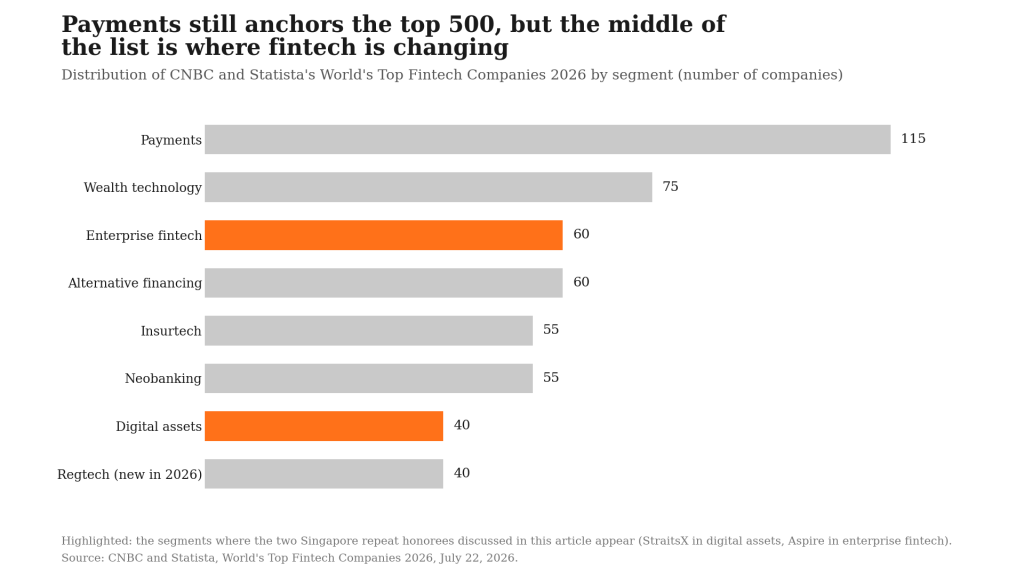
Payments still anchors the top 500, but the middle of the list is where fintech is changing Distribution of CNBC and Statista’s World’s Top Fintech Companies 2026 by segment
CNBC and Statista, World’s Top Fintech Companies 2026, July 22, 2026
The bar moved from shipping fast to holding licenses
What does a fintech census reward in 2026? CNBC’s answer is blunt: “scale, profitability and regulatory maturity” [1]. Challenger banks on the list have hardened into fully licensed operations. Neobanks that began life as prepaid-card apps now run comprehensive platforms on independent banking licenses or strategic partner banks [1].
Consider how complete a reversal that is. For most of the 2010s, fintech’s implicit pitch was regulatory arbitrage: outrun the compliance departments of the incumbents, apologize later. The 2026 list rewards the companies that did the opposite, and it makes the point structurally. Regtech debuts as its own category this year, 40 companies whose entire business is keeping everyone else inside the lines, across reporting, compliance, identity verification, and anti-money-laundering monitoring [1]. CNBC calls its emergence “symptomatic of a maturing ecosystem,” particularly as AI introduces new risks [1].
Insignia Business Review made a version of this argument a year ago: in Southeast Asia especially, the durable moat in fintech is the combination of licenses and distribution, assets that take years to assemble and cannot be copied by a faster engineering team [2]. The 2026 list, stacked with repeat honorees and now carrying a dedicated compliance category, is that thesis showing up in the data.
Payments won by disappearing
Payments remains the largest segment for the fourth straight year: 115 companies, 23% of the list [1]. The label stayed the same; the business underneath it did not. CNBC notes that companies have moved on from building checkout solutions to the real-time movement of money across borders [1].
Checkout is a feature users see. Settlement is infrastructure they never think about. The value has migrated from the first to the second, and the strongest payments companies on the list are no longer competing for the interface at all. They are competing to be the rails underneath everyone else’s interface.
Few companies express this more cleanly than StraitsX, a repeat honoree in the digital assets segment [1]. The Singapore-headquartered firm, a Major Payment Institution licensed by the Monetary Authority of Singapore and issuer of the XSGD and XUSD stablecoins, spent the past year wiring itself into other countries’ payment systems. Under Singapore’s Project BLOOM initiative, it partnered with Thailand’s KASIKORNBANK and Orbix Technology so that a Thai traveler in Singapore can pay through KBank’s Q Wallet while XSGD settles the transaction behind the scenes and the merchant receives Singapore dollars instantly [3][4]. Taiwan and Japan come next, with all cross-border transactions settled in XSGD in real time [3]. What does the consumer see? A QR code and a familiar wallet. Nothing else.
The traction behind that invisibility is anything but quiet: StraitsX’s stablecoin card issuance rose 83-fold and transaction volume 40-fold year over year through 2025, according to CoinDesk [5]. “This sets the foundation for a future where stablecoins become the invisible infrastructure that powers everyday payments,” StraitsX CEO and co-founder Tianwei Liu said when announcing the Asia network expansion [3].
The same cross-border logic holds at the consumer edge of the segment. YouTrip, a repeat honoree in payments [1], built its multi-currency wallet and prepaid Mastercard around zero-fee FX for travelers, and in May extended the product to a new demographic entirely with YouTrip Family, a wallet and card for children aged 7 to 18 with parental controls [11]. Different customer, same underlying contest: whoever owns the currency conversion owns the relationship.
The crypto category quietly became an infrastructure category
Look at how CNBC defines its digital assets segment: 40 companies that “streamline and enable the use of blockchain-based applications and digital assets, rather than tokens or protocols themselves” [1]. Firms that create, issue, and manage tokens for other businesses have a strong showing, and the sector’s technology is now “being used in real business cases as the digital assets sector becomes institutionalized” [1].
No room for speculation vehicles. Plenty of room for plumbing.
That editorial choice mirrors the regulatory direction of travel across Asia, where MAS chose to build a licensing regime for stablecoin issuers and payment institutions rather than ban or ignore the asset class. Singapore’s regulatory head start explains why the city-state supplies five of the segment’s 40 companies, including a newcomer to the list this year: Triple-A, MAS’s first licensed crypto payments player, whose instant-conversion gateway lets merchants accept crypto without ever holding it or wearing its volatility [1][12]. Institutionalization, in practice, looks exactly like that: the asset class disappears into a settlement detail.
The segment’s definition also hints at what arrives next. In December, StraitsX announced plans to launch XSGD and XUSD on Solana in early 2026, the first Layer 1 blockchain to host both stablecoins simultaneously, with support for x402, an interoperability standard designed for autonomous machine-to-machine and AI-agent micropayments [6]. Sit with that sentence for a moment. A regulated, MAS-licensed stablecoin issuer is laying payment rails for transactions initiated by software rather than people. The institutionalization of digital assets and the arrival of agentic AI are not two stories. They are converging on the same infrastructure.
Where AI meets the balance sheet
Enterprise fintech holds 60 companies and 12% of the list, spanning embedded finance, open banking, and finance-related automation [1]. CNBC’s framing gives the category its weight: AI is reshaping the systems that monitor, verify and move money, and autonomous agents demand new infrastructure to keep companies “safe, controlled and compliant” [1].
Aspire, a repeat honoree in the segment [1], has spent 2026 demonstrating both halves of that sentence. Start with the regulated half. The Singapore-headquartered platform serves more than 50,000 businesses with multi-currency accounts, FX, corporate cards, payroll infrastructure, and spend management across 16 currencies, on a foundation of more than ten licenses spanning Singapore, Hong Kong, Australia, Europe, the United States, and Canada [7]. In April it launched in the US, its third continent, arriving with partners including Stripe and Deel after securing Money Services Business registration and SEC Registered Investment Adviser status [7]. “Our ambition isn’t incremental improvement — we want to define a new $3 trillion category by bringing regulated financial operations together with intelligent software and automation for global startups,” co-founder and CEO Andrea Baronchelli said at the launch [7].
Then, two months later, the AI half. Aspire shipped an MCP integration that lets customers operate their finance stack, reviewing card spend, checking invoice and approval statuses, monitoring balances across entities, from inside AI platforms like Claude and ChatGPT, governed by the same roles and permissions their teams already configured [8]. “As businesses increasingly run through networks of AI agents, they will need financial infrastructure that AI can securely access and operate within,” Baronchelli said. “Aspire is building the banking layer for this new generation of AI-native companies.” [8]
Notice the order of operations. Licenses and registrations first; the AI surface built on top of them, not around them. Compliance as the foundation for automation rather than its casualty. That sequencing is the enterprise fintech thesis in miniature, and it is exactly where CNBC’s framing of the whole 2026 list points.
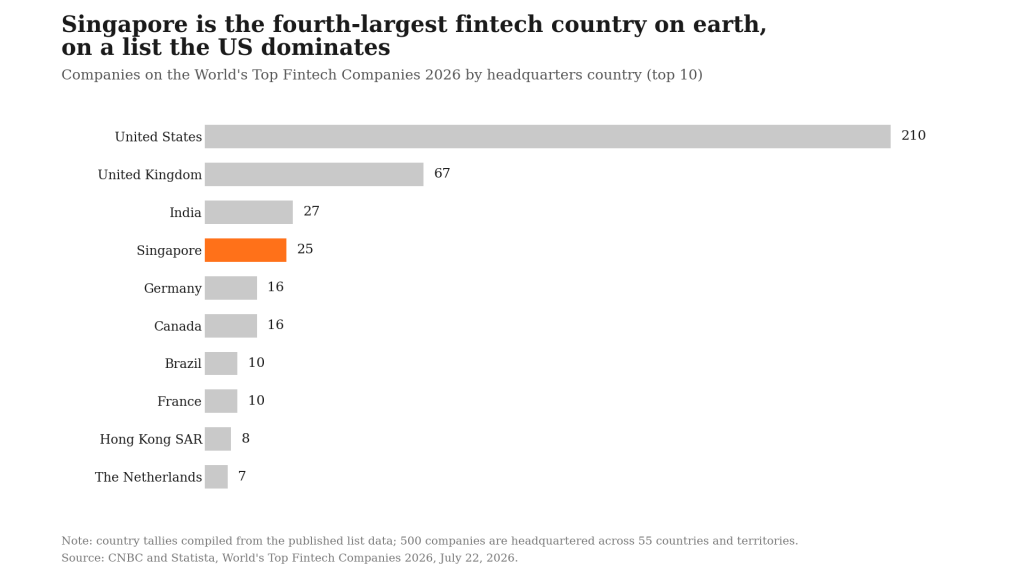
Singapore is the fourth-largest fintech country on earth, on a list the US dominates Companies on the World’s Top Fintech Companies 2026 by headquarters country (top 10) CNBC and Statista, World’s Top Fintech Companies 2026, July 22, 2026
The map underneath the list
Geography tells its own story. American companies account for around 42% of the 500 and British companies 13% [1]. India takes third with 27; Singapore takes fourth with 25, the two having swapped places since last year [1]. London leads all cities with 64 companies, and Singapore is one of only five cities worldwide with double-digit representation, alongside London, New York, Bengaluru, and Paris [1].
Pause on that fourth-place finish. A city-state of six million people, ahead of Germany, ahead of Canada, ahead of France. That is not an accident of sampling; it is the compounding return on a regulatory regime, MAS licensing across payments, digital assets, and capital markets, that lets a company build once and expand outward. By our count from the list data, Southeast Asia-headquartered companies appear roughly 34 times across the eight segments: payments names like Thunes, Tazapay, and YouTrip, wealth platforms like Endowus and StashAway, digital asset infrastructure like StraitsX and Triple-A [1].
The direction of travel matters more than the count. The corridor between Southeast Asia and the rest of the world now runs both ways: outside platforms route into the region through local champions, while regionally built infrastructure extends outward, StraitsX’s settlement network into Thailand, Taiwan, and Japan, and Aspire’s platform into the US [9]. On this list, Southeast Asia is not an emerging-markets curiosity. It is an exporter of financial infrastructure.
What the list says about the future
Strip away the segment taxonomy and the top 500 makes three predictions.
The future of fintech is regulated by default. The winners hold licenses, and the newest category on the list exists to keep everyone else compliant. The cost of entry has shifted from engineering to trust, and trust compounds slowly, which is why repeat honorees dominate.
The future of fintech is invisible. Payments migrating from checkout to settlement, digital assets redefined around infrastructure rather than tokens: both describe value accruing to layers the end user never sees. A Thai traveler scanning a QR code in Singapore does not know a stablecoin settled her lunch. That is the point.
And the future of fintech has non-human customers. The x402 standard for agent micropayments and MCP integrations that let AI operate a company’s finance stack within existing permissions are early answers to the same question: what does financial infrastructure look like when software initiates the transaction? If CNBC is right that autonomous agents demand new infrastructure to keep companies safe, controlled, and compliant [1], the 2027 edition may need another new category entirely.
The 2026 list is a portrait of an industry that stopped fighting the financial system and started becoming it. Watch the companies already building for the part of the future the list can only gesture at: finance that is licensed like a bank, invisible like plumbing, and operated, increasingly, by machines on our behalf.
References
- Tasmin Lockwood, “The world’s top fintech companies 2026,” CNBC, July 22, 2026. https://www.cnbc.com/worlds-top-fintech-companies-2026/
- “The License-Distribution Moat: Why Southeast Asian Fintechs Are Building the Right Foundations,” Insignia Business Review, July 11, 2025. https://review.insignia.vc/2025/07/11/fintechs/
- “StraitsX to Extend Payment Network Across Asia, Advancing Stablecoin-Native Cross Border Settlement,” StraitsX, November 4, 2025. https://www.straitsx.com/blog-post/straitsx-to-extend-payment-network-across-asia-advancing-stablecoin-native-cross-border-settlement
- “KBank, StraitsX, Grab team up to expand Q Wallet to enable Thailand–Singapore cross-border payments,” TechNode Global, April 8, 2026. https://technode.global/2026/04/08/straitx-kbank-grab-team-up-to-expand-q-wallet-to-enable-thailand-singapore-cross-border-payments/
- “Stablecoin payments go ‘invisible’ in Southeast Asia as crypto card business surges,” CoinDesk, March 29, 2026. https://www.coindesk.com/business/2026/03/29/stablecoin-payments-go-invisible-in-southeast-asia-as-crypto-card-business-surges
- “StraitsX To Launch XSGD and XUSD Stablecoins on Solana in 2026,” The Crypto Times, December 16, 2025. https://www.cryptotimes.io/2025/12/16/straitsx-to-launch-xsgd-and-xusd-stablecoins-on-solana-in-2026/
- “Aspire Expands Global Footprint with USA Launch,” Fintech News Singapore, April 8, 2026. https://fintechnews.sg/128605/digital-banking-news-singapore/aspire-usa-launch/
- “Aspire Brings Finance Workflows Into AI Platforms With MCP Integration,” Fintech News Singapore, June 23, 2026. https://fintechnews.sg/133460/ai/aspire-mcp-integration/
- Paulo Joquino, “The Corridor Runs Both Ways,” Insignia Business Review, July 14, 2026. https://review.insignia.vc/2026/07/14/the-corridor-runs-both-ways/
- “World’s Top Fintech Companies,” Statista (project page and methodology FAQ), accessed July 23, 2026. https://www.statista.com/page/worlds-top-fintechs
- “Singapore’s YouTrip Launches a Children’s Travel Card Into a Gap Asia’s Fintechs Left Open,” Skift, May 28, 2026. https://skift.com/2026/05/28/singapores-youtrip-launches-a-childrens-travel-card-into-a-gap-asias-fintechs-left-open/
- “Top Crypto Payments Gateways in Singapore: How They Operate?,” The Coin Republic, June 2, 2026. https://www.thecoinrepublic.com/2026/06/02/top-crypto-payments-gateways-in-singapore-how-they-operate/

Paulo Joquiño is a writer and content producer for tech companies, and co-author of the book Navigating ASEANnovation. He is currently Editor of Insignia Business Review, the official publication of Insignia Ventures Partners, and senior content strategist for the venture capital firm, where he started right after graduation. As a university student, he took up multiple work opportunities in content and marketing for startups in Asia. These included interning as an associate at G3 Partners, a Seoul-based marketing agency for tech startups, running tech community engagements at coworking space and business community, ASPACE Philippines, and interning at workspace marketplace FlySpaces. He graduated with a BS Management Engineering at Ateneo de Manila University in 2019.



 Home
Home

 Publications
 Podcasts
  Search