
Greg Krasnov puts the decision in plain arithmetic. “When looking at where the money is, we’re talking about a potential revenue pool of $50 to $100 billion on lending versus $1 to $2 billion on payments,” the Tonik founder and CEO told ANC’s Ron Cruz on Startup in an episode that aired August 11, 2026. “So it’s just the order of magnitude difference in market scale in the opportunity that has led us to choose a credit-led strategy” [1]. It is, by his own account, one of the more obvious calls he has made. It is also the reason a five-year-old Philippine digital bank with no ride-hailing app, no e-wallet, and no super-app parent just became the first standalone lender in the country to post sustained profitability.
Even after 10 million customers
Krasnov’s clearest line in the ANC interview is about what payments actually pay. “Those are all very, very difficult products that even after 10 million customers will not give you good profitability, because the monthly revenue is very small, margins are very thin,” he said, describing the wallet and debit-card strategies some digital bank competitors leaned on. “BSP is actively pushing down on the rates on the payments in order to get more digital adoption. GCash obviously has gotten the market quite used to fairly low rates as well. So the key is credit” [1].
That is a television-friendly compression of an argument Krasnov had already made with harder numbers three and a half months earlier, in his own essay for Insignia Business Review. Payment-led platforms, he wrote, generate a monthly revenue per active customer of $0.30 to $0.60, against $10 to $20 for emerging-market consumer lending, $5 to $10 once adjusted for credit risk. Card and wallet interchange of 0.5 to 2 percent, compressed further by regulators and by the dominance of QR payments over card payments, cannot cover a cost of risk that typically runs above 10 percent in unsecured EM lending. “A payment-led player needs ten to twenty times the transaction volume to match the unit revenue of a single consumer loan,” he wrote. “Most never get there” [6].
The regional evidence he cited backs the arithmetic up. GCash’s parent, Mynt, took $393 million from Japan’s MUFG at a $5 billion valuation, justified in the press release by the “vast pool of untapped customers” outside traditional banking, a credit thesis wearing a payments company’s clothes. Maya, the other large Philippine mobile wallet, did not post its first full year of profitability until 2025, after an explicit pivot into digital banking and lending. Grab Financial’s loans disbursed hit $3.2 billion in 2025, up 47 percent year over year, and M-Pesa’s Fuliza overdraft now processes more lending volume than the original wallet processes payments [6]. None of these are Tonik comparisons Krasnov needed to invent. They are what happens when payment-led platforms eventually go looking for the revenue their transaction volume alone was never going to produce.
Six years of saying the same thing
None of this is new for Krasnov, which is itself part of the story. In July 2020, before Tonik had launched, he told Insignia’s podcast that “the most interesting business model is actually an asset-liability model. True monetization for a bank is through loans” [8]. In March 2022, describing the market he was underwriting into, he put it in blunter terms: “In a country the size of the Philippines, with 110 million-plus population, only to have like a couple of million records in the credit bureau. It’s ridiculous. To us that represents this tremendous opportunity for people who haven’t borrowed before or are new to credit, and who are completely ignored by banks today” [9]. By September 2023, with the bank two years into operation and still working toward unit profitability, he was explicit about the trade-off: “I’m a bit of an old-school guy. I believe that a bank should be profitable and the bank should be selling profitable products as a starting point, and you don’t scale it out until you’ve achieved that” [10].
The regulatory logic behind the model got its clearest public airing in March 2025, on Insignia’s long-form Against All Odds series: “If you want to scale your balance sheet into the billions of dollars, which is what the Philippines needs, you need deposits. And the only way to take deposits is to have a banking license. That’s what led me to approach the central bank and say, ‘Guys, can you give me a license to both collect deposits digitally and lend digitally?’” [11]. By April 2026, that six years of public argument had a name and a full essay: “The Next Decade of Emerging Market Fintech Will Be Won on Credit, Not on Users.” Its closing line, “Payments were the entry strategy of the last cycle. Credit is the business model of this one,” is the same claim the ANC interview makes four months later, for a different audience and without the footnotes [6]. What changed between April and August was not the thesis. It was that the Q1 2026 income statement had, by then, spent three months backing it up.
The unit economics traditional banks got wrong
Krasnov’s explanation for why traditional lenders stayed away is specific: not that Filipino borrowers are bad credit risks, but that nobody built the infrastructure to tell the difference. “Traditional banks have always been saying, ‘Oh, credit risk is too high. The Filipinos are so irresponsible, they never pay back,’” he said on ANC. “Now, the reality is the bank needs to know how to create the conditions for, A, taking the customer that is credit reliable, and, B, making sure that customer doesn’t get over-debted” [1].
That is, in effect, a founder’s plain-language version of the argument FICO makes with a case study: Grab Finance’s 22 AI-driven credit decision workflows lifted loan eligibility by 50 percent, evidence that better decisioning, not just more lending capacity, is what expands who can safely borrow [2]. Krasnov says Tonik solved the same problem from a different angle, largely through employer partnerships that bundle deposits and credit into what he calls a “financial wellness solution,” a channel that lets the bank see a borrower’s income and repayment capacity directly rather than inferring it from transaction history [1]. Two years earlier, on the same point, he had described the underlying constraint more mechanically: “You need to train your credit system. And you need data; you need performance data in order to train that” [10]. Traditional banks, ecosystem apps, and Tonik are all, in the end, trying to answer the same underwriting question. They are just building different instruments to answer it, on different timelines.
What the numbers behind “sustained profitability” actually show
The results Krasnov points to are concrete. Tonik’s loan portfolio reached $110 million as of April 2026, up 2.3 times year over year, a growth rate he confirmed directly in the ANC interview and one that followed 2.1x growth the year before [1][3]. Annualized revenue run-rate sits above $60 million, 99 percent of it from lending; net interest margin is 51 percent; lending RAROC is 25 percent; the loan-to-deposit ratio is 82 percent; and net LTV-to-CAC is 23 times [3]. Tonik’s own press release put the comparison in a single ratio: revenue on a loan client runs roughly 20 times higher than revenue on a payment client [3][7]. “Today we operate at the highest loan-to-deposit ratio in the industry, which means we have the most efficient balance sheet in the industry,” Krasnov said on ANC. “Our competitors are nowhere close” [1].
That efficiency was a choice, not a default. Tonik’s deposit base “went vertical” within months of its 2021 launch, Krasnov said, fast enough that the bank blew through its 12-month deposit target in the first three. Rather than keep chasing deposit growth, the bank deliberately slowed it down. “We saw, okay, deposits, without having anywhere to deploy them into loans, scalable loans, they don’t really get you anywhere. They just hang on your balance sheet, and they lose money for you” [1]. Maya Bank and Overseas Filipino Bank, a LandBank subsidiary, both reached profitability before Tonik, and both did it with an ecosystem or a state-backed parent behind them [7]. Tonik got there by turning down growth it could have easily taken.
Tonik’s Q1 2026 Standalone Unit Economics
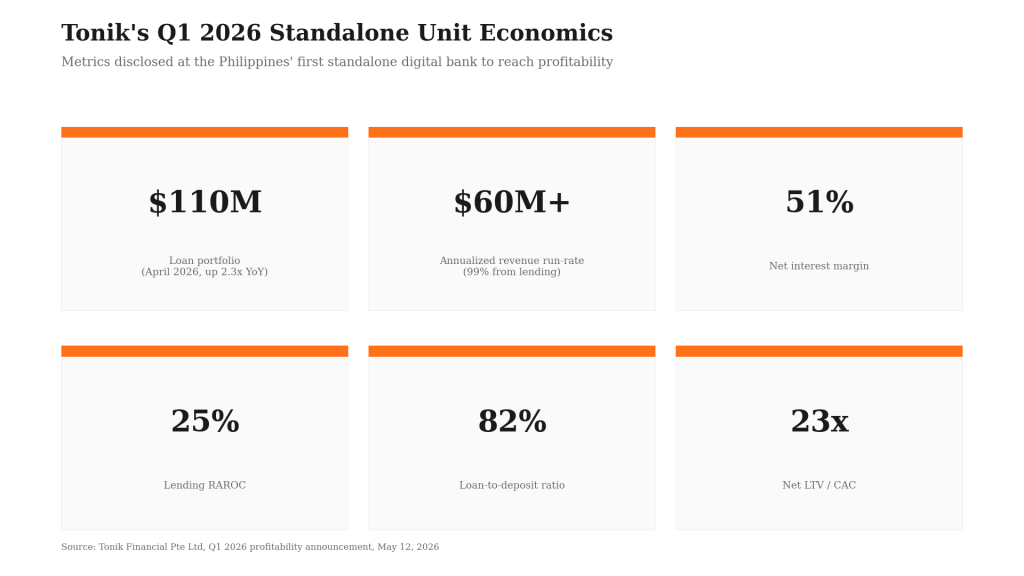
Metrics disclosed at the Philippines’ first standalone digital bank to reach profitability
Source: Tonik Financial Pte Ltd, Q1 2026 profitability announcement, May 12, 2026
An unusual founder for a credit business
Krasnov’s own account of why he built this way traces back to before Tonik existed. “I spent the first 10 years of my career as a private equity investor doing leveraged buyouts, where you’re very focused on cash flow,” he said on ANC. “I’ve always been very focused, in all the businesses I’ve built, on profitability, sustainable profitability, and this informs the strategy with which I tend to build businesses” [1]. He calls it an unusual instinct for a fintech founder, and the funding environment he launched into backs him up: global fintech venture funding fell from $103 billion in 2022 to $28 billion in 2024, a 73 percent collapse that Krasnov has argued did more to validate credit-led models than any investor memo could, by forcing capital into businesses that produce real net interest income rather than thin interchange [6]. Tonik’s own investors, he said on ANC, occasionally pushed for a more growth-oriented posture in the earlier, looser funding years. “But when you’re in a credit business, you really need to start with building solid foundations. It’s a marathon. It’s not a sprint” [1].
What the 2026 IPO Filings Revealed About 2024 Loan Books
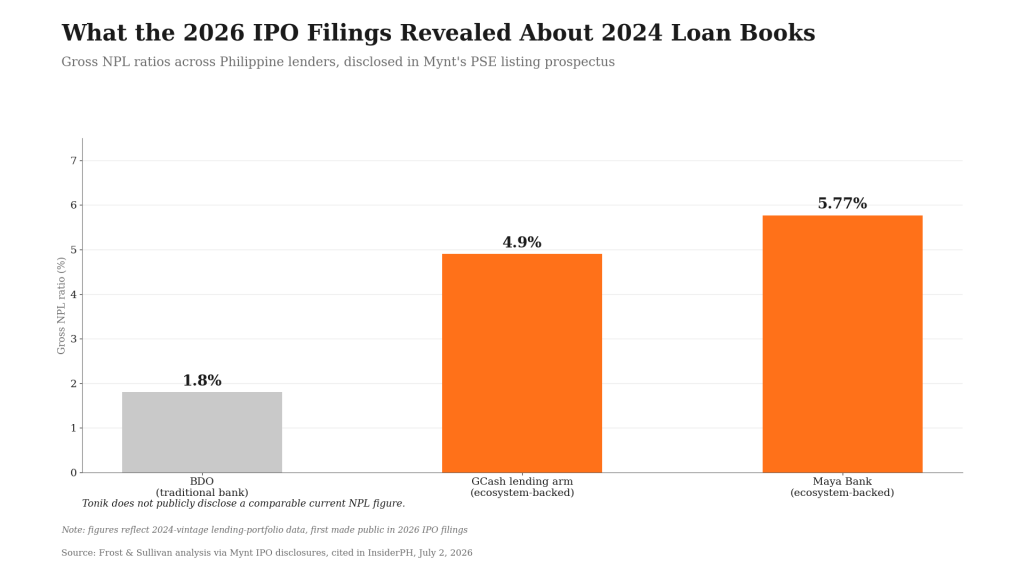
Gross NPL ratios across Philippine lenders, disclosed in Mynt’s PSE listing prospectus
Note: figures reflect 2024-vintage lending-portfolio data, first made public in 2026 IPO filings
Source: Frost & Sullivan analysis via Mynt IPO disclosures, cited in InsiderPH, July 2, 2026
The village problem
Krasnov welcomes competition more openly than most founders would. Bangko Sentral ng Pilipinas is currently reviewing applications for additional digital bank licenses, more than five years after the regulator’s original licensing circular capped the category at six holders and later held a moratorium on new entrants until January 2025; only four additional licenses are available even now [6]. Krasnov frames the prospect of new entrants as good news, not a threat. “It’s an enormous space, and it’s like a huge mammoth, and it’s gonna take a village to kill this mammoth and drag it into the cave,” he said on ANC. “Ninety percent of the Filipinos have never had a bank loan. So when it comes to credit, there’s a very blue ocean out there” [1].
That openness sits in some tension with the ecosystem-data argument other observers make about the sector. Small World FS has argued that “platform banks,” digital banks embedded inside a larger consumer ecosystem such as Grab’s Superbank or MariBank, hold a structural advantage over standalone competitors, more behavioral data, deeper distribution, a customer relationship that starts somewhere other than a loan application [4]. Wendell Tan, a principal in Arthur D. Little’s Financial Services practice, has gone further, arguing that AI-underwriting technology itself will not stay a durable moat once every digital bank has access to comparable tools, so the real advantage has to come from something a model cannot copy: the data an ecosystem generates simply by existing [4]. Krasnov’s answer, in effect, is that credit risk assessment done directly, through employer partnerships and years of proprietary repayment data, is its own kind of moat, one that does not require a ride-hailing app or a wallet to build. Whether that holds up against ecosystem-scale behavioral data at a larger scale is the open question neither side has fully answered yet.
The regulator Krasnov calls a partner
Tonik holds license number 001. It was, by Krasnov’s account, co-designed with Bangko Sentral ng Pilipinas roughly eight years ago, before Tonik launched anywhere, making it the first digital bank license issued not just in the Philippines but anywhere in Southeast Asia [1]. “I’ve dealt with many regulators around the world in my career, and I’ve never seen the level of proactiveness and the level of strategic insight that BSP brings,” Krasnov said, crediting the central bank’s approach for helping the country manage post-COVID inflation as well as for building the digital bank framework itself [1]. His policy wish list is narrow: continued delineation between what digital banks and rural banks are permitted to do, and more support for banks experimenting with digital credit-assessment tools, “the one key area where we’re still lagging behind” [1].
That regulatory relationship is being tested from a different angle right now. BSP has a separate draft circular out for industry comment that would require rural banks operating digital platforms to keep at least 70 percent of their customers within their physical operating area, capping out-of-area digital customers at 30 percent, with reclassification as a full digital bank, and its 1-billion-peso minimum capital requirement, as the penalty for breaching the cap [15]. The rule does not touch Tonik, which already holds the full licence Krasnov helped design. But its underlying logic, that geography and physical presence are reasonable proxies for the kind of customer relationship a lender actually has, is the regulator’s own version of the standalone-versus-ecosystem question Krasnov is answering with underwriting data instead.
What comes next
Krasnov’s five-year outlook is specific about where the opportunity sits and unspecific about how fast it closes. “We think the mass market credit space has been ignored by the traditional banks for too long, and digital banks are here to solve it,” he said on ANC, pointing again to the $50 to $100 billion opportunity and to deposits sitting in the traditional banking sector earning less than 1 percent interest as the funding source waiting to be redirected. “We look forward to continuing to be the pioneer and hopefully the leader in the space. We were growth leader last year, and we’re looking to convert that into sustained profitability with growth” [1]. The company’s own near-term roadmap is narrower than the outlook: expanding employer-channel lending through its Tendo product, scaling its merchant installment network, and building out revolving credit products for repeat borrowers, where the returns compound with each cycle [7].
The evidence Krasnov can point to now is real: a loan book growing 2.3 times a year, a balance sheet competitors are “nowhere close” to matching, and a first standalone profitable quarter that took five years, one real credit-quality scare, and six years of saying the same thing in public to reach. Whether Tonik keeps finding the real money depends on the same thing it always has, whether the bank’s underwriting holds up the next time the credit cycle turns against it, not just this one.
References
[1] “Tonik: Credit, not payments, is the future of PH digital banking,” Startup, ANC 24/7, August 11, 2026. https://www.youtube.com/watch?v=KzRXC0xY-xw
[2] Aashish Sharma / FICO, “How AI Is Expanding Credit Access Across Southeast Asia,” Fintech News Malaysia, August 12, 2026. https://fintechnews.my/60139/fintech-lending-malaysia/ai-expanding-credit-access-southeast-asia/
[3] Tonik Financial Pte Ltd, Q1 2026 profitability announcement, PR Newswire, May 12, 2026.
[4] Miles Harding, “The Accelerating Evolution of Digital Banking in SEA and Its Impact on Personal Finance,” Small World FS, August 12, 2026. https://www.smallworldfs.com/blog/2026/08/12/the-accelerating-evolution-of-digital-banking-in-sea-and-its-impact-on-personal-finance/
[5] “Tonik posts Q1 income, 1st standalone digital lender in PHL to turn profitable,” BusinessWorld, May 13, 2026. https://www.bworldonline.com/
[6] Greg Krasnov, “The Next Decade of Emerging Market Fintech Will Be Won on Credit, Not on Users,” Insignia Business Review, April 28, 2026. https://review.insignia.vc/2026/04/28/tonik/
[7] Paulo Joquino, “What Profitability as a Standalone Digital Bank in the Philippines Means for Tonik,” Insignia Business Review, May 13, 2026. https://review.insignia.vc/2026/05/13/tonik-profitability/
[8] On Call with Insignia, “Building Southeast Asia’s First Digital-Only Bank in the Philippines with Tonik CEO and Founder Greg Krasnov,” Insignia Business Review, July 16, 2020. https://review.insignia.vc/2020/07/16/building-southeast-asias-first-digital-only-bank-in-the-philippines-with-tonik-ceo-and-founder-greg-krasnov/
[9] On Call with Insignia, “Tonik CEO Greg Krasnov Shares the 6Ps of Neobanks and Leading the Philippines’ Consumer Banking Revolution,” Insignia Business Review, March 14, 2022. https://review.insignia.vc/2022/03/14/season-4-episode-4-tonik-ceo-founder-greg-krasnov-6ps-of-neobanks-leading-philippines-consumer-banking-revolution/
[10] On Call with Insignia, “Call 139: How This Philippine Digital Bank Views Growth, From Loans to AI with Tonik CEO Greg Krasnov,” Insignia Business Review, September 26, 2023. https://review.insignia.vc/2023/09/26/season-5-episode-28-call-139-tonik-digital-bank-philippines-greg-krasnov/
[11] Paulo Joquino, “The Banker Who Brought Digital Banking to the Philippines | Against All Odds with Tonik CEO and Founder,” Insignia Business Review, March 10, 2025. https://review.insignia.vc/2025/03/10/banker-tonik-greg-krasnov/
[12] On Call with Insignia, “Tonik CEO and Founder Greg Krasnov Gets the Tea on Japan IPOs from Tokyo Stock Exchange APAC Deputy Head Beomsu Son,” Insignia Business Review, November 11, 2025. https://review.insignia.vc/2025/11/11/tonik-tse/
[13] “Tonik Raises $12M to Boost Capital Amid Rising NPL Pressures,” Asia Business Outlook, December 4, 2025.
[14] Miguel R. Camus (ed.), “How GCash’s bad loans compare with Maya, BDO, BPI and global peers,” InsiderPH, July 2, 2026. https://insiderph.com/how-gcashs-bad-loans-compare-with-maya-bdo-bpi-and-global-peers
[15] “BSP eyes digital-centricity rules for rural banks,” Philstar, February 12, 2026.

Paulo Joquiño is a writer and content producer for tech companies, and co-author of the book Navigating ASEANnovation. He is currently Editor of Insignia Business Review, the official publication of Insignia Ventures Partners, and senior content strategist for the venture capital firm, where he started right after graduation. As a university student, he took up multiple work opportunities in content and marketing for startups in Asia. These included interning as an associate at G3 Partners, a Seoul-based marketing agency for tech startups, running tech community engagements at coworking space and business community, ASPACE Philippines, and interning at workspace marketplace FlySpaces. He graduated with a BS Management Engineering at Ateneo de Manila University in 2019.



 Home
Home

 Publications
 Podcasts
  Search