
Indonesia was one of the first markets of Carro outside Singapore. As the company’s growth story increasingly points toward higher-GDP-per-capita markets like Australia, Hong Kong, and Taiwan, it hasn’t let its oldest market plateau; and it can only do so because of infrastructure, and a leader, built for a different purpose entirely.
Carro entered Indonesia in 2017, two years after its Singapore founding and in the same year it entered Thailand. [1] It deepened that position in 2018 by acquiring Jualo, a local classifieds marketplace, in a deal folded into an extended Series B round. [2] By any measure, Indonesia is not a peripheral market for Carro. It is one of the two markets the company expanded into first, older than its position in Malaysia, Japan, Taiwan, Hong Kong, and, as of this year, Australia.
Nine years later, Carro’s growth story has a different center of gravity. The company’s most visible recent moves, a three-floor flagship store in Hong Kong, deepening integration in Japan, and the acquisition of Australian platform CarPlace in 2026, have all pointed toward developed markets with thicker automotive margins. [3][4] Aaron Tan, Carro’s CEO, has been explicit about why: in a July 26, 2026 Business Times podcast, he said gross profit per unit in Australia runs “anywhere from 15 to 20 something percent per car,” while “if you look at it from closer to home in Thailand and Indonesia, those margins tends to be lesser than 15%,” a gap he attributed to informal, unaudited dealer competition that undercuts price in markets where price is the easiest thing for a buyer to compare. [5]
That is the setup for a familiar story in platform businesses: a company matures, discovers where the best margins live, and quietly lets its earliest, hardest markets plateau while capital and attention move to where the returns are cleaner. Carro is doing something different in Indonesia. Rather than deprioritizing the market, it is widening what the market means to its business: new-car retail through Chinese manufacturers Jaecoo and Chery, plus a wholesale model supplying the same independent dealer network it previously competed against, layered on top of the financing, insurance, maintenance and repair, B2B rental through MPM Rent, and auction platform Auksi it already runs there. [6] The company is not fully exiting used-car ownership so much as reducing its dependence on it, adding a capital-lighter retail and distribution line rather than replacing the ecosystem business underneath it. Aaron Tan framed the move as strengthening Carro’s commitment to Indonesia specifically because it is a priority market, at the same time competitors have reduced or exited operations there. [6]
The Shape of the Ceiling
Indonesia’s used-car economics were never a demand problem. Southeast Asia’s largest car market, by Tan’s own account, is dense with buyers. [5] The ceiling was structural: a large population of small, informal dealers operating without audited accounts, competing on price because price is the only lever available to an unaudited seller, and dragging the entire category’s per-unit economics below what a capital-intensive, inventory-owning model like Carro’s original playbook could sustain at scale. [5]
That is what a market plateau actually looks like from inside a platform business. It is not slowing demand. It is a ceiling built into the terrain itself, one that more effort inside the same model cannot lift. Another player met that same ceiling and made the more conventional choice: it shut its Indonesian operations after less than a year, citing intense competition. [7] A company can respond to a structural ceiling in roughly three ways: leave, keep running the same model at thin margins indefinitely, or change what the business actually does inside the market. Carro’s Indonesia news is the third option, executed nine years into operating there.
The two halves of Indonesia’s car market have also been moving in opposite directions, which is a large part of why a wholesale line into independent used-car dealers makes commercial sense on its own. New car sales have swung hard with the economic cycle, from just over a million units in 2015 to roughly half that at the pandemic’s low point in 2020, before recovering past a million again by 2023 and settling near 800,000 in 2025. [13] Used car sales, by contrast, kept growing straight through that volatility: the market reached an estimated 1.5 million units in 2025, and even in a year when new car sales fell 11% year-on-year through September, used car sales rose about 5% over the same period. [13] A wholesale channel supplying that steadier, now-larger market is not a consolation prize for stepping back from new-car retail; it is a second growth line running in parallel with it.
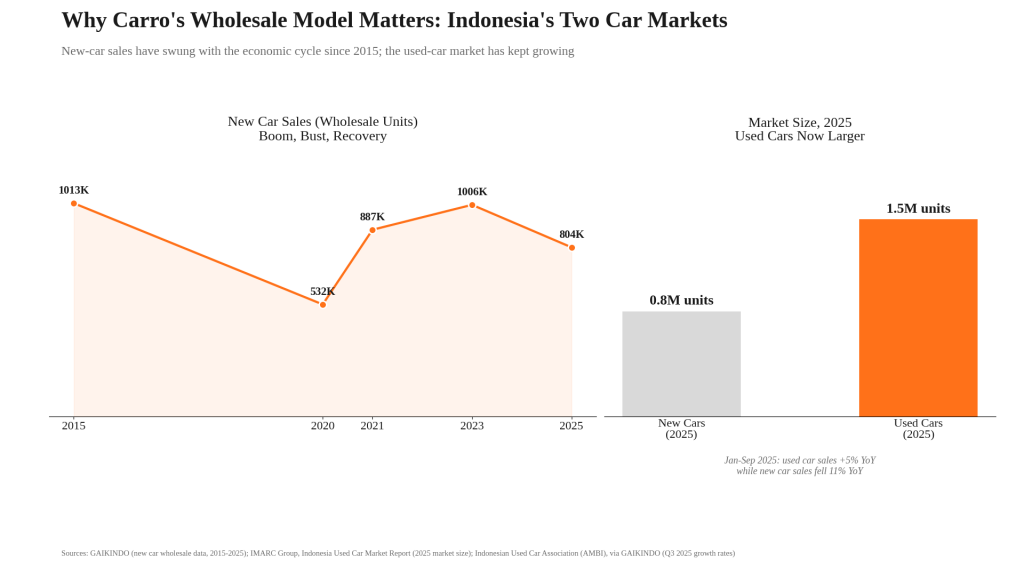
Why Carro’s Wholesale Model Matters: Indonesia’s Two Car Markets
The specific product Carro added is not incidental. Southeast Asia’s EV adoption is accelerating faster than most developed markets: ASEAN-6 EV sales rose more than 60% in 2025 to an average 18% share of new vehicle sales, and Indonesia’s own EV market grew 49% year-on-year over the same period. [8] Retailing Jaecoo and Chery into that growth curve, rather than continuing to compete for used-vehicle inventory in a segment where margins were already capped, puts Indonesia on the fastest-growing part of the market instead of its most contested part.
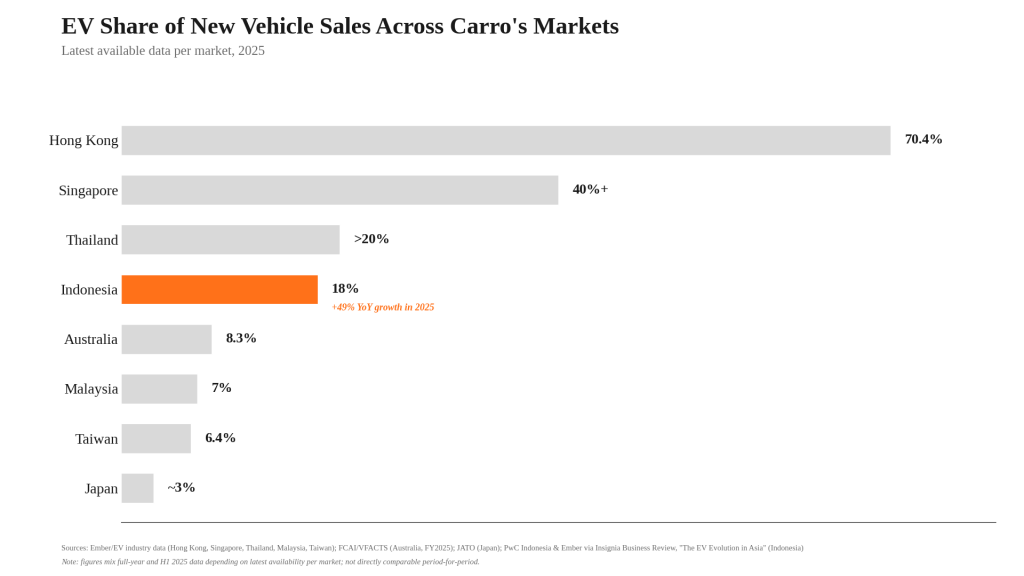
EV Share of New Vehicle Sales Across Carro’s Markets
The Foundation Was Built by the Person Now Running It
Bryan Tan joined Carro as Chief Data Scientist by way of an unconventional path: before Carro, he was a nuclear physicist completing a PhD in Earth Science on machine learning and computational physics at Cambridge, working on containing radioactivity from spent nuclear fuel using supercomputers. [9] Aaron Tan, a friend from his army days, recruited him to build a data science team to anchor the car trade’s digitalization, “grounded in deep math, science and technology.” [9]
What Bryan built became foundational rather than peripheral to the business. As Chief Data Scientist, he oversaw all of Carro’s machine learning and AI programs, spanning buying, selling, leasing, insurance, and finance: price automation in car transactions, distance- and behavior-based insurance premiums, AI-monitored engine health, and automated inspection and listing. [9] The clearest impact showed up in pricing specifically, narrowing a spread between buy and sell price that used to run wide under data opacity, on the way to a business posting a 422% compound annual growth rate in 2021. [9]
That infrastructure has a second life in the exact product line now anchoring Indonesia’s pivot. Uncertainty over battery degradation and resale value, residual value anxiety, is the binding constraint on EV adoption once early purchase incentives fade, and the same AI capabilities Bryan built for used-car pricing, engine health monitoring, and behavior-based insurance are precisely the tools that answer it. [8] The dealer relationships built on top of that trust layer trace the same lineage: Carro’s shift from secondary marketplace to primary distributor began with an authorised dealership agreement for Geely’s premium EV brand Zeekr in Singapore, before the company added Dongfeng Motor Corporation as an authorised dealer in Singapore and Malaysia in early 2026, through a partnership with Volt Auto. [8] Jaecoo and Chery in Indonesia are the next brands in that same sequence, arriving months after it began two markets over. [6][8]
In 2023, the architect of that trust layer took it to Indonesia directly. Bryan Tan became CEO of Carro Indonesia, moving from Singapore with colleagues from his data team, and grew the market fivefold in his first year. [10] His work on pricing and AI/ML has been the bridge between Carro’s P&L and its technology, particularly important in a market that has needed more process automation and market education than most. [10] His mother’s side of the family is Indonesian, a personal tie to the market layered on top of the professional one. [11]
An Ecosystem, Not a Swap
The technology underneath extends the same logic outward. Carro’s software is built modular: launching a new market means spinning up a new instance of the ERP system already built, connecting local communications providers, and having the software work largely out of the box. [5] Applied inward, that same visibility into aging inventory and gross profit per unit is what would have made Indonesia’s thinning used-car margins legible long before they became the subject of public remarks. [5]
The multi-brand dealer model completes the picture. Carro operates as a platform rather than a distributor, working with multiple brands rather than being tied to one; Chinese EV manufacturers have proven more willing than legacy brands to appoint multiple dealers, and Carro was targeting more than ten brands globally by the end of 2026. [5] Jaecoo and Chery are the third and fourth brands in a model already proven in Singapore and Malaysia.
None of this replaces what Carro Indonesia already runs: financing, insurance, maintenance and repair, B2B rental through MPM Rent, and an auction platform, Auksi. [6] More than 70 percent of Carro’s gross profit is recurring, generated by services that attach to a vehicle sale rather than the one-time markup on the vehicle itself, which is why the new retail and wholesale lines read less like an exit from used cars and more like an additional layer on an ecosystem that was never actually dependent on owning inventory to make money. [3][5]
Depth, Applied Where the Terrain Requires It
In the same July podcast, Tan set the terms for the next phase of Carro’s growth: “The next six to 12 months, I probably would still prefer to go deep rather than go abroad. And that means going deeper into Japan, going deeper into Hong Kong, going deeper into Australia, Singapore even… I think the next six to 12 months is really to grow the business organically versus trying to expand to more markets or do more acquisitions.” [5] Every market he named there was a developed one, and it is worth being precise about what that comment was and was not about. Tan was responding to investors who have suggested, in hindsight, that Carro should have entered growth markets like Indonesia and Thailand before developed ones; his disagreement was about the order in which a young company should have built toward thicker margins, not a case against having entered Indonesia at all, a market Carro committed to just two years into its existence. [5]
Read that way, “going deep” was never a commitment to only the newest, highest-margin markets. It was a commitment to organic growth over further geographic or acquisitive expansion, full stop, across every market Carro already operates in, including the one it has run the longest and the one led by the executive who built its data foundation. Indonesia’s new-car retail push is what that commitment looks like when applied to a market whose terrain requires a broader model rather than the same model executed more diligently. Whether Thailand, the other market Tan named as sub-15% GPU, receives a similar addition is the clearest signal to watch for next. [5]
What a Durable Growth Story Needs
Carro has been preparing a US listing since at least mid-2026, reportedly targeting a valuation above $3 billion and a raise of up to $500 million, with Tan careful to characterize an IPO as one option among several rather than a confirmed endpoint. [12][5] The Indonesia shift is happening amid that preparation, tying the new retail and wholesale lines directly to margin improvement and capital efficiency. [6]
For a company being evaluated by institutional public-market investors, that timing does real work. A growth story built entirely on developed-market expansion, Australia, Hong Kong, Taiwan, Japan, is a story about where the easiest margins are, and any well-capitalized competitor can chase the same markets once they are identified. A growth story that also includes a structural fix to the company’s oldest, hardest market, led by the person who built the data engine that makes the fix possible, is a different kind of evidence: it shows the infrastructure built for one purpose, expanding cleanly into unfamiliar developed terrain, generalizes to the harder problem of broadening a market a company already knows intimately and has chosen not to leave.
The Case Study
Every platform business eventually accumulates an early market whose native competitive terrain caps what its original model can earn there. The instinctive responses are to exit, following the logic that capital is better spent where margins are cleaner, or to keep grinding inside a model that terrain has already outgrown. Both responses treat the ceiling as a verdict on the market rather than a limitation of the model built for it.
Carro’s Indonesia pivot is a case study in a third path, one that was only available because the company had already built the pieces elsewhere, and staffed the market with the person who built them: a modular platform that makes any market’s unit economics legible quickly, an AI trust layer originally built for used cars that transfers directly to EV residual-value risk, a multi-brand dealer model proven in markets it was not originally built for, a recurring-revenue structure that does not require owning inventory to capture the value of a customer relationship, and a CEO whose entire career at Carro has been building the pricing and data intelligence underneath all of it. Indonesia did not plateau because Carro stopped investing in it. It plateaued because its original model hit the ceiling that terrain was always going to impose. Breaking through that ceiling took nine years of infrastructure, and one nuclear physicist turned data scientist turned CEO, built mostly for somewhere else.
References
- CanvasBusinessModel.com, *What Is Brief History of Carro Company?*, timeline citing Carro’s 2015 founding and 2017 expansion into Thailand and Indonesia. https://canvasbusinessmodel.com/blogs/brief-history/carro-brief-history
- e27, *Automotive marketplace Carro adds US$30M to Series B round; acquires Indonesia’s Jualo.com*, August 5, 2019. https://e27.co/carro-bags-us30m-acquire-indonesias-jualo-20190805/
- Insignia Business Review, *Looking Under the Hood of Carro in 2026*, July 30, 2026. https://review.insignia.vc/2026/07/30/carro/
- Insignia Business Review, *How the Carro Approach to Going Global Lines Up With Its Profitability, Growth, and IPO Readiness*, March 15, 2024. https://review.insignia.vc/2024/03/15/carro-global-strategy/
- Transport BT (The Business Times), *Carro’s APAC Car Market Expansion Conversation*, podcast interview with Aaron Tan hosted by Darren Wong, July 26, 2026. https://www.businesstimes.com.sg/podcasts/big-everywhere-else-carro-ceo-explains-its-latest-move-australia-and-future-plans
- Tech in Asia, *Carro switches gears: Indonesia focus shifts to cars*, August 19, 2026, as reported via youngster.id, *Incar Profitabilitas, CARRO Pivot ke Penjualan Mobil Baru asal Tiongkok di Indonesia*, August 19, 2026. https://youngster.id/headline/digital-business/incar-profitabilitas-carro-pivot-ke-penjualan-mobil-baru-asal-tiongkok-di-indonesia/
- Inc42, *Cars24 Shuts Shop In Indonesia & Saudi Arabia To Focus On India Ops*, May 2023. https://inc42.com/buzz/cars24-shuts-shop-in-indonesia-saudi-arabia-to-focus-on-india-ops/
- Insignia Business Review, *The EV Evolution in Asia: How Tech Ecosystems Might Sustain the Transition*, March 24, 2026 (citing PwC Indonesia’s ASEAN-6 eReadiness 2025 report and Ember’s ASEAN EV adoption study). https://review.insignia.vc/2026/03/24/ev/
- Insignia Business Review, *A Leader A Minute Episode 6: The Nuclear Scientist Powering Carro’s AI Engine*, On Call with Insignia Ventures podcast, interview with Bryan Tan, May 11, 2022. https://review.insignia.vc/2022/05/11/a-leader-a-minute-carro-chief-data-scientist-bryan-tan/
- Insignia Business Review, *When It Takes More Than One CEO to Build a Global Company: A Story From Carro Indonesia*, July 13, 2024. https://review.insignia.vc/2024/07/13/global-company-carro-indonesia/
- Insignia Business Review, *Why It’s Not the Usual Startup Movie: Against All Odds Producer Commentary*, September 26, 2024. https://review.insignia.vc/2024/09/26/against-all-odds/
- Caproasia, *Southeast Asia 2nd-Hand Car Marketplace Carro Plans United States IPO & Singapore Secondary Listing in 2026 to Raise $500 Million at $3 Billion Valuation*, June 24, 2026. https://www.caproasia.com/2026/06/24/southeast-asia-2nd-hand-car-marketplace-carro-plans-united-states-ipo-singapore-secondary-listing-in-2026-to-raise-500-million-at-3-billion-valuation-founded-in-2015-by-aaron-tan-aditya-lesmana/
- GAIKINDO (Association of Indonesia Automotive Industries), annual wholesale sales data (2015, 2020, 2021, 2023, 2025) and *Used Car Sales Grow Five Percent in Q3 2025*, October 29, 2025, citing the Indonesian Used Car Association (AMBI), https://www.gaikindo.or.id/en/used-car-sales-grow-five-percent-in-q3-2025/; used-car market size from IMARC Group, *Indonesia Used Car Market Report*, 2025.

Paulo Joquiño is a writer and content producer for tech companies, and co-author of the book Navigating ASEANnovation. He is currently Editor of Insignia Business Review, the official publication of Insignia Ventures Partners, and senior content strategist for the venture capital firm, where he started right after graduation. As a university student, he took up multiple work opportunities in content and marketing for startups in Asia. These included interning as an associate at G3 Partners, a Seoul-based marketing agency for tech startups, running tech community engagements at coworking space and business community, ASPACE Philippines, and interning at workspace marketplace FlySpaces. He graduated with a BS Management Engineering at Ateneo de Manila University in 2019.



 Home
Home

 Publications
 Podcasts
  Search