
On June 16, 2026, SpaceX announced it would acquire Cursor, the AI coding tool used by millions of developers, for $60 billion in all-stock consideration [1]. The deal closed less than a week after SpaceX debuted on the Nasdaq in what became the largest IPO in US history. Cursor brought roughly $2.6 billion in annualized revenue and a rapidly growing enterprise customer base [2].
The acquisition was the final piece of a deliberate vertical stack. In February 2026, SpaceX had already absorbed xAI, Elon Musk’s AI research company and maker of the Grok model in a combined $1.25 trillion deal that folded Grok into SpaceX’s AI division [3]. The result is an architecture few competitors can replicate: Starlink provides the connectivity layer (61% of SpaceX’s total revenue, $4.4 billion in operating income in 2025, 39% operating margin) [4]; xAI provides the model layer; Cursor now provides the developer tooling layer that sits between those models and the humans who build with them.
This is what an AI supply chain looks like when built from the infrastructure up. It is also, in its completeness, a useful frame for understanding why the most interesting AI bets in enterprise Asia are being made from the opposite direction: not from infrastructure outward, but from domain depth inward.
The Supply Chain as Strategic Frame
The term ‘supply chain’ has a specific meaning in manufacturing: the sequenced set of inputs, raw material, processing, distribution, interface, without which the end product cannot reach the customer. Applied to AI, the supply chain runs from compute and connectivity through models and fine-tuning to the applications and tooling that deliver value to the end user.
What SpaceX has assembled is a general-purpose version of this chain. Starlink provides compute connectivity at scale, including the orbital data center infrastructure that no terrestrial competitor can currently match [5]. xAI/Grok is the model layer. Cursor is the interface for the most valuable users of that model: the developers who build everything else.
The supply chain frame matters because it clarifies where the moat sits. In manufacturing, a company that owns the full supply chain can set prices, lock in customers, and prevent substitution at any layer. In AI, a company that owns connectivity, model weights, and developer tooling does the same. The SpaceX acquisition of Cursor is not primarily about coding assistants; it is about ensuring that the developers who build on Grok have no natural reason to switch.
What that supply chain cannot do, however, is reach into markets where the raw material, the proprietary data, does not exist in general-purpose form. Railway contract archives. Southeast Asian customer conversations in six dialects. Alternative credit data for thin-file borrowers who have never held a bank account. These are not inputs SpaceX can acquire at any price.
fileAI: The Operator’s Supply Chain
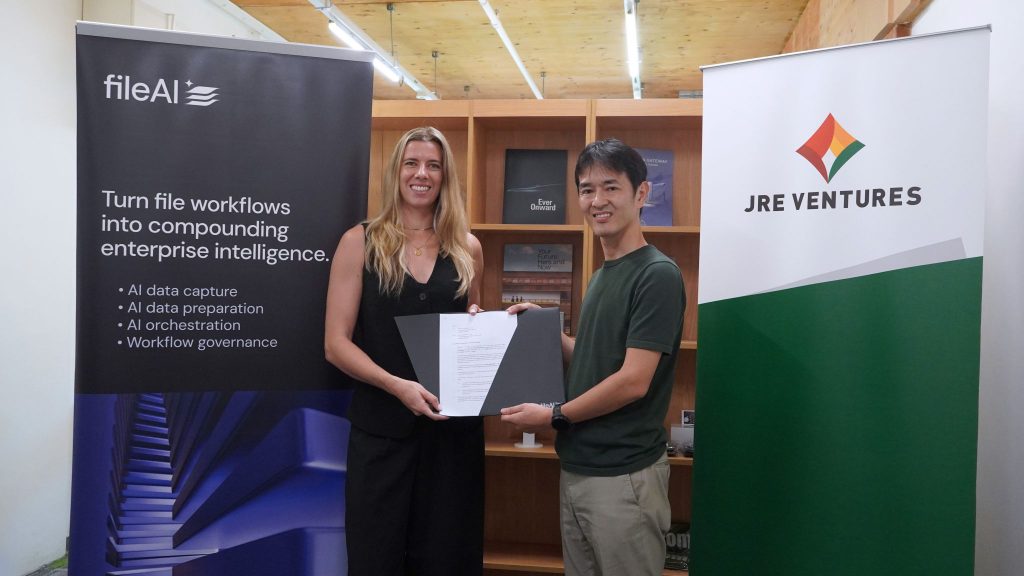
fileAI co-founder Clare Leighton with JRE Ventures MD Junichi Eto
JR East Group operates Japan’s largest railway network, a 70-year accumulation of physical infrastructure, operational data, and the contractual documentation that governs all of it [6]. Most of that documentation exists as paper or legacy digital files: static, unsearchable, and effectively invisible to any analytical system.
In June 2026, JRE VENTURES, the corporate venture capital arm of the JR East Group, announced a strategic investment in fileAI, the Singapore-based AI-native intelligence platform [7]. The partnership’s immediate focus is converting JR East’s historical contracts and operational records into structured, searchable, and AI-queryable knowledge assets. fileAI’s governed AI platform applies proprietary AI agents to transform those records from storage cost to operational intelligence.
The framing here is that of an institution building its own AI supply chain: physical infrastructure (the railway) → decades of proprietary documentation → a governed intelligence layer capable of surfacing contracts, obligations, and operational knowledge on demand.
JR East does not need a general-purpose coding assistant. What it needs is a layer that understands the specific semantics of its contracts, the regulatory context of Japanese rail operations, and the governance requirements of a publicly traded infrastructure company.
fileAI’s platform addresses the specific bottleneck in that chain: the transformation step between raw institutional knowledge (locked in documents) and actionable intelligence (available to operators in real time). No general-purpose model trained on public internet data can do this without first being trained on the institution’s own archives, which requires a governed, secure workflow that a general-purpose coding tool is not designed to provide.
WIZ.AI: The Conversation Supply Chain
Enterprise customer service in Southeast Asia has a fundamental input problem that general-purpose AI has not solved. A customer calling a bank in Singapore may speak Mandarin, Singlish, Cantonese, or Bahasa Melayu within the same conversation. A customer in the Philippines may switch between Filipino, English, and regional dialect. A customer in Indonesia may speak Javanese-inflected Indonesian. The raw material for customer conversation AI, dialect-native training data, domain-specific banking workflows, real-time enterprise system integration, does not exist in general-purpose model weights.
In May 2026, WIZ.AI launched Wizlynn, a multi-agent inbound platform built to deploy GenAI in real customer service operations [8]. Wizlynn’s architecture reflects a supply chain built around three specific inputs: dialect fluency, banking domain knowledge, and deployment speed. In testing, Wizlynn achieved a 92.5% AI Resolution Rate for inbound customer queries, with up to 95% successful transfer to the correct human agent when escalation was required [9]. The platform ships with more than 40 specialized AI agents purpose-built for banking scenarios: account enquiries, card services, deposits, transfers, loan applications, payments, and identity verification.
The deployment model is itself part of the supply chain logic. Wizlynn can be live within two days, with full service operational the following week. That speed reflects years of pre-built domain scaffolding: the dialect models, the banking intent classifiers, the enterprise integration layers are already trained and waiting. The customer’s deployment window is the last mile, not the hard problem.
What WIZ.AI has assembled over several years of Southeast Asian enterprise deployments is the proprietary supply chain for customer conversation AI in this region: dialect training data, banking domain expertise, multi-agent orchestration, and deployment infrastructure. These are not inputs available for purchase from a US-based general-purpose AI provider.
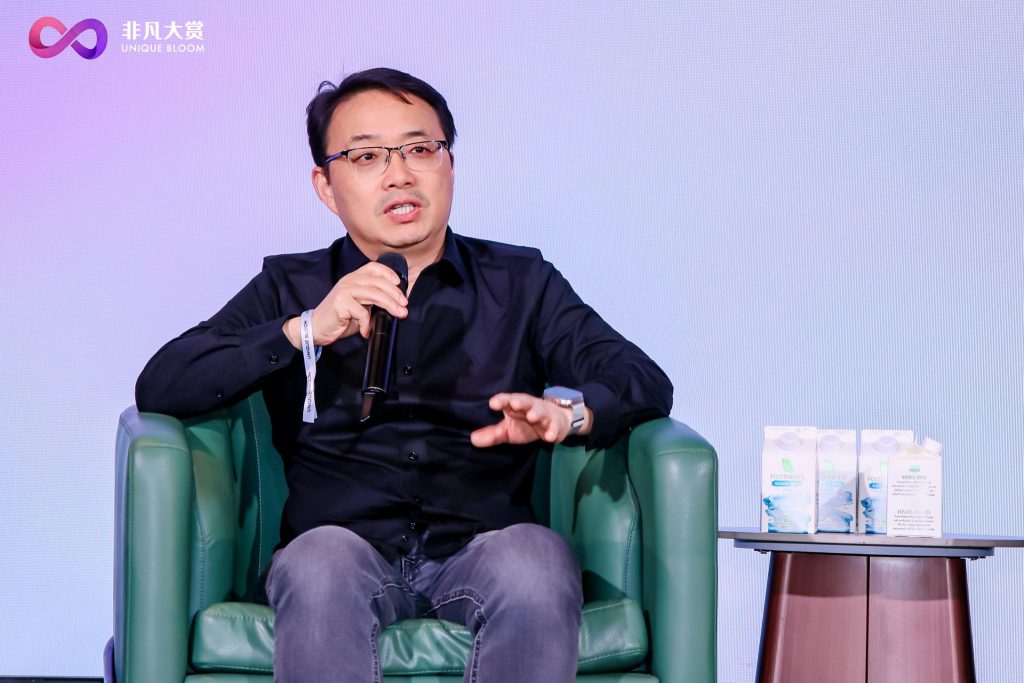
Jianfeng Lu, CEO of WIZ.AI, at the Unique Bloom 2026 , SG AI Agent Summit as a guest panelist.
Surfin: The Credit Intelligence Supply Chain
The formal financial system was not built for 60 million people in eight countries who transact primarily through mobile phones, lack traditional credit history, and operate in regulatory environments that range from mature (Australia, India) to emerging (Nigeria, Uganda, Kenya) [10]. Traditional credit models require the inputs those systems generate: payslip histories, collateral valuations, bank statement records. For thin-file borrowers, those inputs do not exist.
Surfin‘s proprietary credit scoring engine is built around a different set of raw materials: smartphone usage patterns, social media behavior, e-commerce activity, digital footprint signals, and transaction histories across Surfin’s own platform [11]. The engine aggregates these into a 360-degree borrower profile that enables sustainable lending at scale across geographies where traditional underwriting would decline the application entirely.
This is a supply chain for credit intelligence: alternative data sources → proprietary scoring model → lending, payments, and financial services infrastructure. Surfin has processed approximately $2.7 billion in cumulative transactions across its platform and now serves users in Indonesia, Mexico, Philippines, Nigeria, Kenya, India, Uganda, and Australia [12]. In April 2026, the company signed a Memorandum of Understanding with the Philippine Social Security System, a signal of the institutional validation that domain-specific AI models attract once they have demonstrated sustained performance [13].
Surfin’s Series A, completed in April 2025 at $26.5 million, brought total fundraising to $39 million [14]. The round reflected not just the scale of the platform but the compounding nature of its credit intelligence layer: every loan made with Surfin’s model, repaid or defaulted, improves the model’s calibration on thin-file borrowers in specific markets. A general-purpose model cannot buy that history. It can only be built.
The Compounding Difference
SpaceX spent $60 billion on Cursor because controlling the developer tooling layer creates a lock-in that compounds over time: developers who build on Grok use Cursor; Cursor improves on Grok usage data; Grok improves with every developer deployment built on Starlink’s infrastructure. The flywheel is real, and it compounds fastest when it can run at general-purpose scale.
The vertical supply chains in enterprise Asia compound differently — not through scale breadth, but through domain depth. Each JR East contract digitized by fileAI makes the governance model more accurate for the next Japanese infrastructure operator. Each Wizlynn deployment adds dialect examples and banking resolution patterns that train the models for the next Southeast Asian bank. Each Surfin loan approved in Indonesia calibrates the credit engine for the next thin-file borrower in a comparable market.
The depth compounds faster in domains where the raw material is scarce, proprietary, and regulatory-constrained — which describes most enterprise AI use cases in Asia. These are not domains where Cursor closes the supply chain gap. They are domains where the supply chain has to be built from the specific inputs up, which is exactly what fileAI, WIZ.AI, and Surfin have been doing.
What Cannot Be Acquired
The SpaceX-Cursor deal is a landmark in general-purpose AI consolidation. It signals that the era of standalone AI tooling is ending — the infrastructure layer will absorb the interface layer, and the moat will belong to whoever owns the stack from physical connectivity to developer workflow.
That consolidation creates space, not just competition. The verticals where AI delivers the most durable value are precisely the verticals where the raw material — legacy institutional knowledge, regional language data, alternative credit signals — is not publicly available, not exportable, and not reproducible by a general-purpose model trained on public data. Consolidation at the general layer clarifies the value of the vertical layer: it is what the conglomerates cannot buy.
The companies building proprietary data supply chains in enterprise Asia are not in competition with SpaceX. They are building something structurally different — and in the markets they serve, structurally superior.
References
[1] CNBC. “SpaceX to acquire the AI coding startup Cursor for $60 billion.” June 16, 2026. https://www.cnbc.com/2026/06/16/spacex-spcx-cursor-acquisition-ipo.html
[2] Yahoo Finance. “SpaceX locks in $60 billion Cursor deal.” June 16, 2026. https://finance.yahoo.com/technology/ai/articles/spacex-buy-cursor-ai-coding-103445855.html
[3] Futurum Group. “SpaceX Acquires xAI: Rockets, Starlink, and AI Under One Roof.” 2026. https://futurumgroup.com/insights/spacex-acquires-xai-rockets-starlink-and-ai-under-one-roof/
[4] Via Satellite. “Assessing SpaceX Finances, Addressable Market, and the AI Pitch Ahead of IPO.” June 3, 2026. https://www.satellitetoday.com/finance/2026/06/03/assessing-spacex-finances-addressable-market-and-the-ai-pitch-ahead-of-ipo/
[5] Quasa.io. “SpaceX Didn’t Merge with xAI for Grok: The Real Business Is Orbital Compute.” 2026. https://quasa.io/media/spacex-didn-t-merge-with-xai-for-grok-the-real-business-is-orbital-compute
[6] PR Newswire. “fileAI Expands into Japan with Strategic Partnership with JRE VENTURES.” June 14, 2026. https://www.prnewswire.com/news-releases/fileai-expands-into-japan-with-strategic-partnership-with-jre-ventures-302799206.html
[7] Ibid.
[8] PR Newswire APAC. “WIZ.AI Launches Wizlynn: A Reliable Multi-Agent Inbound Platform for Enterprises.” May 19, 2026. https://www.prnewswire.com/apac/news-releases/wizai-launches-wizlynn-a-reliable-multi-agent-inbound-platform-for-enterprises-302774543.html
[9] Ibid.
[10] PR Newswire. “Surfin raises US$12.5 million from Insignia Ventures Partners.” October 9, 2024. https://www.prnewswire.com/news-releases/fintech-platform-for-the-underserved-middle-class-surfin-raises-us12-5-million-from-insignia-ventures-partners-as-it-sustainably-uplifts-60-million-lives-across-3-continents-302271539.html
[11] ESG News. “Yanan Wu and Surfin’s 60M User Fintech Platform Redefining Financial Inclusion.” 2025. https://esgnews.com/yanan-wu-rise-of-surfin-60-million-user-financial-inclusion-platform/
[12] Ibid.
[13] Fintech Global. “FinTech firm Surfin Meta Digital Technologies secures $26.5m to fuel global expansion.” April 28, 2025. https://fintech.global/2025/04/28/fintech-firm-surfin-meta-digital-technologies-secures-26-5m-to-fuel-global-expansion/
[14] Ibid.

Paulo Joquiño is a writer and content producer for tech companies, and co-author of the book Navigating ASEANnovation. He is currently Editor of Insignia Business Review, the official publication of Insignia Ventures Partners, and senior content strategist for the venture capital firm, where he started right after graduation. As a university student, he took up multiple work opportunities in content and marketing for startups in Asia. These included interning as an associate at G3 Partners, a Seoul-based marketing agency for tech startups, running tech community engagements at coworking space and business community, ASPACE Philippines, and interning at workspace marketplace FlySpaces. He graduated with a BS Management Engineering at Ateneo de Manila University in 2019.



 Home
Home

 Publications
 Podcasts
  Search