
There is a moment most finance leaders will recognise. An investor is in the room. The question arrives mid-presentation: “What if your growth assumption changes?” The answer exists, buried somewhere in the model. But the model was not built for a live audience. So the answer the CFO gives is the honest one: “Let me come back to you.”
It is a reasonable exchange. The data was there. The judgment was there. What was missing was the tool.
That gap — between having the answer and being able to act on it — is exactly where AI is making its most useful contribution to the finance function today. Not by replacing the CFO, but by closing the distance between analysis and decision.
The Expanded CFO Mandate
The CFO’s role at a growth-stage company has never been narrow. Treasury sits at the top of the list: cash in the bank, the 13-week rolling forecast, a unified view across all balances. A signed term sheet is promising, but it is not cash — and the CFO is the one who knows the difference. Beyond treasury, the mandate extends to financial planning, governance, tax, finance systems, and fundraising. Numbers that can be verified. Transactions that are properly approved and disclosed. Scenario models that can answer “what if” on the spot, not the following day.
Mapping out this checklist makes the scope clear: treasury, financial planning, risk management, stakeholder management, governance, fundraising, and the finance infrastructure that holds it together. Together, these functions demand a breadth that is difficult to maintain when a significant portion of each working week is spent collecting data, cleaning it, building the model, and updating the deck.
The question is not whether the workload is manageable. The question is whether it is manageable with the right tools.
Use Case One: Zero Data, Zero Code, Ready Before the Meeting
Most CFOs have spent years in spreadsheet models. The intimacy is real. Some have woken up in the night, opened the laptop, adjusted an assumption. The model becomes an extension of how finance leaders think.
The limitation of that model, though, is presentation. Days of work go into building something that cannot be interrogated live. Investors ask for a scenario. The answer exists, but the tool is not built for the moment.
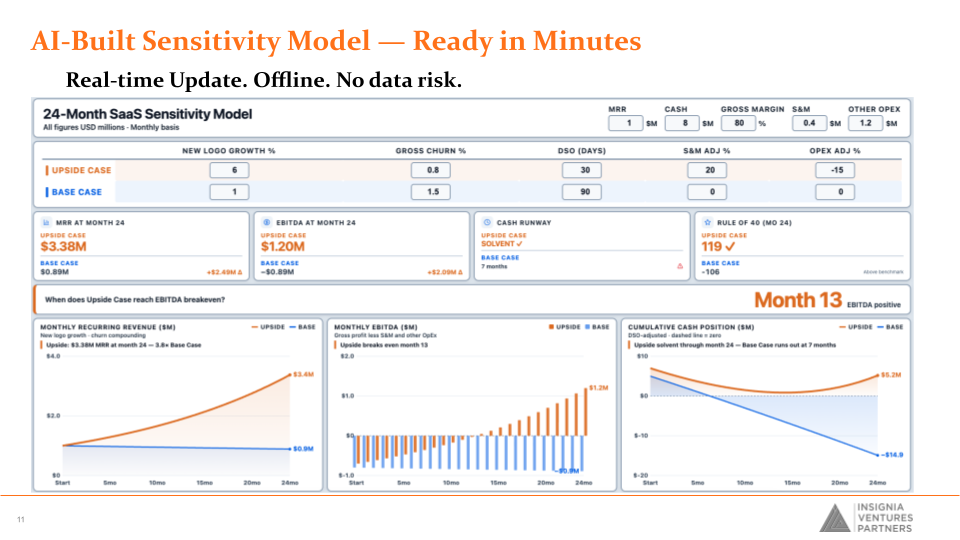
The key insight of the first use case is not the sophistication of the output. It is how little is required to produce it. A 24-month SaaS sensitivity model, built using a single AI prompt without any code, does not require the finance team to load internal data before it can be used. The model starts from generic SaaS assumptions — growth rates, churn, OpEx structure — and runs entirely offline. Sensitive data never leaves the machine. The prompt follows a five-part structure: Role (expert SaaS CFO and financial modeler), Task (build a sensitivity engine across a 24-month horizon), Input (MRR, cash, OpEx, and scenario logic), Output (KPIs and trends: Rule of 40, burn, breakeven), Format (offline HTML, interactive and zero data risk).
The output responds to assumption changes in real time. Ask what happens when new logo growth goes from 6 to 10 percent, and every output — EBITDA at month 24, cash runway, cumulative cash position — recalculates instantly. The chart updates while the conversation is still happening.
The board asks “what if your market conditions shift?” and the CFO no longer has to schedule a follow-up. The prompt framework is the same logic used to brief a capable analyst. The more specific the brief, the better the output. The tool is free, requires no platform subscription, and can be built by anyone in the room.
The point is not the AI. It is the ease of execution.
Use Case Two: Data to Intelligence to Action
The second pain point sits at the other end of the workflow. Most finance teams sit on enormous volumes of data: transactions, invoices, receipts, figures spread across multiple entities and locations. The challenge is not collecting data. The challenge is converting it into something a decision-maker can act on — quickly enough that the insight is still current when it arrives. Often, by the time the analysis is ready, it is already outdated.
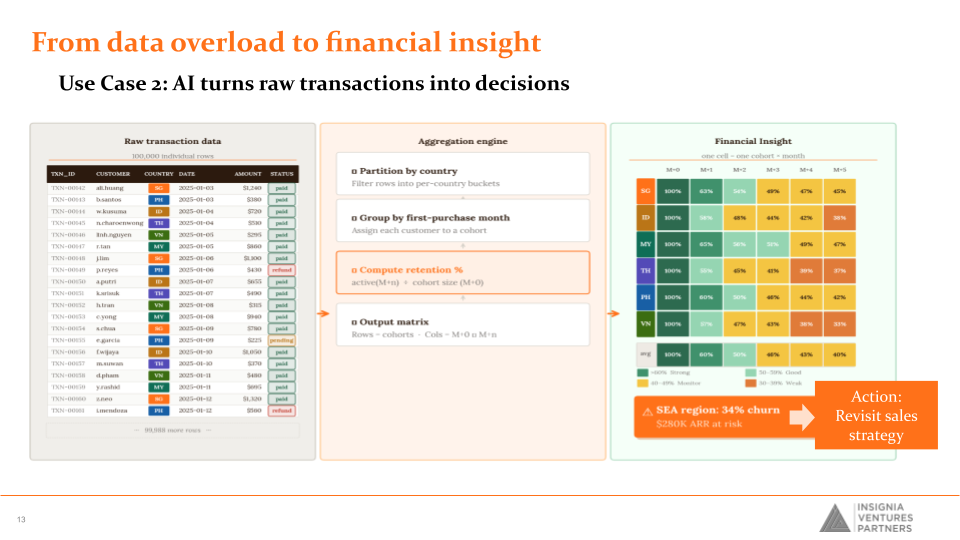
A cohort analysis built on 100,000 rows of sales data illustrates the full chain. Raw transaction records, one row per sale, flow into an aggregation engine that partitions by country, groups customers by first-purchase month, and computes retention percentages across cohorts. The output: a retention matrix, one cell per cohort-month combination, colour-coded by health. Green signals strong retention. Yellow signals monitoring. Orange signals action.
The output itself is not unusual. Finance teams have built these before. What has changed is the time required to produce it, and more importantly, what happens next. A task that previously demanded days of data cleaning and manual work can now be completed in minutes. But speed alone is not the point.
The retention matrix might surface a troubling pattern in one market — a 34% churn rate, $280,000 of ARR at risk. That number, if it arrives early enough, reshapes the conversation with the sales team before the quarter closes. A cash flow signal, surfaced and connected to the right decision-maker, changes the expansion plan. The value of the analysis is not in the matrix itself. It is in the unbroken chain from raw data, to structured intelligence, to the decision that follows.
This is where the CFO’s role earns its influence: not producing outputs, but ensuring the intelligence connects to the right action at the right time. The goal is a seamless workflow — one where data does not wait in a spreadsheet while decisions are made without it.
The Checklist, Revisited
The expanded CFO mandate does not change when AI enters the picture. The same categories apply: treasury, financial planning, risk management, stakeholder management, governance, fundraising, finance infrastructure. What changes is what the CFO has to do manually to fulfil each one.
- On treasury: a unified view of all cash balances, updated in real time. A client payment that is running slower than usual gets flagged before it affects runway. The team can act rather than react.
- On financial planning: the scenario model described above. Interactive, real-time, and ready for the investor question that arrives without warning.
- On stakeholder management: board pack templates that AI populates from source data, leaving the finance team to verify the figures and focus on the insight and narrative.
- On governance: anomaly detection that flags control exceptions as they occur, early enough for remediation rather than retrospective explanation.
The checklist stays the same. The automation reduces the workload required to fulfil it. What that unlocks is time — time that can be directed toward the judgment calls that define a CFO’s contribution: capital allocation, fundraising strategy, the decision to expand or to wait.
Closing the Gap Between Data and Intelligence
The shift happening in finance technology is not purely about capability. It is also about orientation. For a long time, treasury and financial planning tools were designed for banks and large multinationals with dedicated technology teams. The companies that needed them most — growth-stage businesses managing cross-border complexity with lean finance functions — were left to adapt systems that were not built for their reality.
A new generation of platforms is addressing that directly. The design principle is the same in each case: the data-to-intelligence-to-action chain should require minimal heavy lifting to adopt and to sustain. The goal is not to add another system the finance team has to maintain. It is to surface the right signal at the right moment, without the manual assembly work that has historically consumed the hours between data collection and decision. Real-time cash visibility, anomaly detection, AI-assisted forecasting — capabilities that were once the domain of enterprise treasury departments are increasingly accessible to finance teams operating at a fraction of that scale.
The underlying logic connects back to both use cases above: the tools should do the heavy lifting — aggregating, flagging, modelling — so the CFO can focus on what requires judgment.
The Role That Remains
AI does not remove the need for a CFO. It removes the need for a CFO to spend most of their time being a data processor.
The governance call, the investor conversation, the decision about when to raise and at what terms, the judgment about whether a retention number signals a structural problem or a seasonal one — these require a combination of contextual knowledge, institutional trust, and the kind of pattern recognition that only comes from having been in the room when things went wrong. No prompt can replicate that.
What AI can do is make sure the CFO arrives at those conversations with the right number already on the screen, the scenario already stress-tested, the anomaly already flagged. The answer, in other words, no longer has to wait for the follow-up email.
Join the Insignia Ventures Finance Team
Insignia Ventures Partners is hiring for the finance team. Open roles:
Finance Intern → career.insignia.vc/position/336
Fund Accountant → career.insignia.vc/position/299
Reach out to Iris Ho directly to apply.

Paulo Joquiño is a writer and content producer for tech companies, and co-author of the book Navigating ASEANnovation. He is currently Editor of Insignia Business Review, the official publication of Insignia Ventures Partners, and senior content strategist for the venture capital firm, where he started right after graduation. As a university student, he took up multiple work opportunities in content and marketing for startups in Asia. These included interning as an associate at G3 Partners, a Seoul-based marketing agency for tech startups, running tech community engagements at coworking space and business community, ASPACE Philippines, and interning at workspace marketplace FlySpaces. He graduated with a BS Management Engineering at Ateneo de Manila University in 2019.




 Home
Home

 Publications
 Podcasts
  Search