
Rinaldi Dharma Utama and Christian Wilfandio did not set out to build a viral food brand. They set out to close a gap that everyone else had written off as structural. Three years and 50 million meals later, Se’Indonesia is what that looks like.
In most parts of Indonesia, a fried chicken rice bowl costs between Rp 20,000 and 30,000, roughly one to two dollars. Beef, by contrast, has historically been a premium protein: Yoshinoya charges around Rp 70,000 for its gyudon. A basic steak runs Rp 100,000 or more. For more than 270 million people, quality beef was not a daily meal — it was an occasional indulgence, if at all.
Se’Indonesia looked at that gap and built a business around closing it.
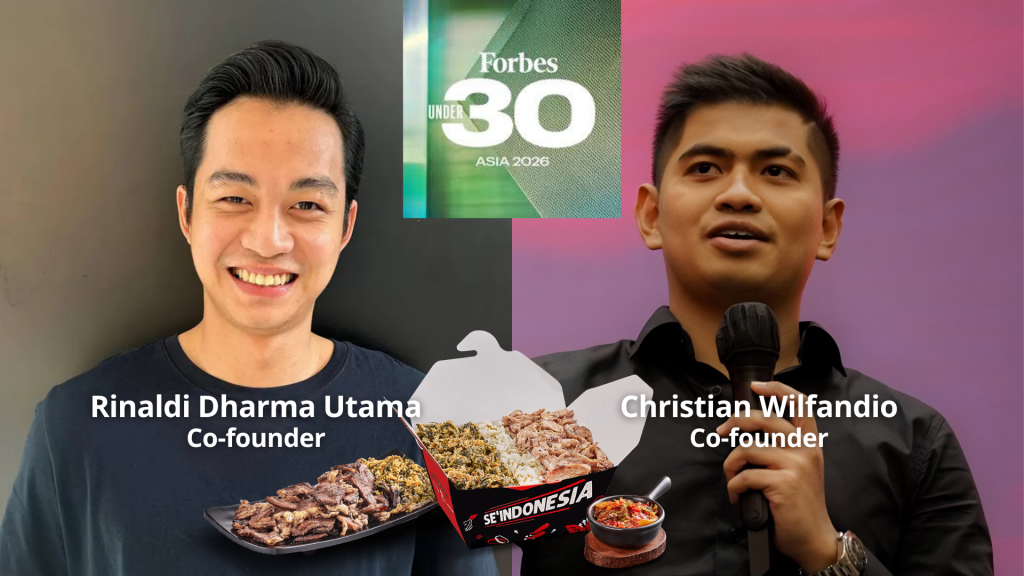
The founders Rinaldi and Christian named to the Forbes 30 Under 30 Asia 2026 list in the Retail and Ecommerce category, the latest recognition in a run that includes Forbes Asia 100 to Watch 2025 (as the only Indonesian F&B brand featured), the Shopee Super Awards for Top Growing Merchant in 2023, and a Top 10 Mitra Juara distinction from GoFood and GoPay in 2024. What those recognitions reflect is a business model that makes premium protein accessible at mass-market price points by treating food production like a factory problem, not a restaurant problem.
From Cloud Kitchen to Category Creator
Se’Indonesia’s origin story runs through two companies that shaped its founders’ understanding of scale.
Rinaldi Dharma Utama spent his early career in the legal team at Kopi Kenangan, joining in 2018 and watching the coffee chain grow from around 10 outlets to 500 before he left. [1] The lesson he took from that era was about speed: in a competitive retail market, the brand that dominates a category early sets the terms for everyone who follows. “Speed is very important,” he said on the On Call with Insignia Ventures podcast in September 2025. “The domino effect when you open more retail stores — the branding presence is very important.”
Christian Wilfandio, Se’Indonesia’s co-founder and COO, came from a different background. A law faculty graduate of Atma Jaya, he worked as an associate at HHP (Baker McKenzie’s Indonesian member firm) before joining Rinaldi to build what would eventually become Se’Indonesia. [2]
Their first company together was Lakuliner, a B2B cloud kitchen services business launched in 2021. Lakuliner helped emerging food brands expand through a shared kitchen network, and at its peak the platform worked with hundreds of brand partners. [1] That experience generated an observation that would define their next company: of all the brands running through the Lakuliner network, almost every single one was built around chicken. The protein was mass market, the margins were razor-thin, and the competition was brutal.
“Is beef actually niche,” Rinaldi recalled asking, “or because of the price, people don’t consume it more often?” [1]
The answer, it turned out, was the second one.
The Supply Chain Insight
Indonesia’s per capita beef consumption sits at roughly two to three kilograms per year, well below the global average of six kilograms and significantly behind its Southeast Asian neighbours. [3] The gap is not primarily a preference gap; it is a price gap. Beef has long been among Indonesia’s most expensive proteins for the mass market, partly due to supply chain fragmentation and partly because the local cattle industry has historically struggled to deliver consistent quality at scale.
The counterintuitive discovery that unlocked Se’Indonesia’s model was that imported beef, from Australia, Brazil, and other major producers, was often both higher quality and more competitively priced than domestically sourced alternatives. “If we import from Australia, Brazil, or anywhere in the world, it’s better even in terms of pricing compared to Indonesian local suppliers,” Rinaldi said. [1]
That insight, combined with the centralized production model they had observed running cloud kitchens, gave the founders a route to something the market had not seen before: beef rice bowls at the price point of fried chicken.
Se’Indonesia was founded at the end of 2022, built around se’i, a traditional slow-smoked meat preparation from East Nusa Tenggara (NTT) in eastern Indonesia. [4] The choice of se’i was both culturally resonant and operationally smart: the slow-smoking process is central to the product’s flavor identity, and it is a process that centralizes naturally. You cannot rush it, and you cannot do it cheaply at the outlet level. The production has to happen somewhere else.
The Factory Model
The central kitchen is the business.
At Se’Indonesia’s production facilities, beef and chicken are slow-smoked, processed, packed, and distributed to outlets before any customer places an order. The company estimates that roughly 90% of the preparation for each meal happens in the central kitchen before the food reaches the store. [4] What remains at the outlet is assembly, heating, and service — a workflow simple enough that a small team can serve hundreds of meals per hour, with an average service time of approximately 30 seconds.
This model solves two problems that have historically made affordable beef unworkable in Indonesia’s QSR space.
The first is food cost. When production is centralized at factory scale, the economics of beef procurement work differently. Volume purchasing, cold-chain optimization, and the removal of per-outlet cooking labor all compress the cost structure in ways that make a Rp 25,000 price point viable with healthy margins. “Most restaurants fail because the gross profit is too tiny or the COGS is too high,” Rinaldi said. “But actually, most restaurants fail because their opex is too high.” The insight Se’Indonesia applied was to treat outlet labor and production the way a factory treats its input costs: as part of COGS, not as a fixed overhead that scales with every new location. [1]
The second problem it solves is consistency. A distributed cooking model, where each outlet has its own kitchen crew executing complex techniques, is inherently prone to variance. Centralizing the most skilled preparation and delivering finished product via cold chain means the taste at outlet number 165 is essentially identical to the taste at outlet number one. At the scale Se’Indonesia is now operating, over 50 million meals served across dozens of Indonesian cities, that consistency is not just a quality story. It is a scalability story. [5]
Building the Network
Se’Indonesia’s expansion strategy reflected a deliberate reading of where the real market was.
The founders began by testing the model in Central Java, one of Indonesia’s most price-sensitive regions, before committing to national rollout. The hypothesis was that if the value proposition held in Semarang and Solo, where a full meal at a local warung might cost Rp 9,000, it would hold anywhere. Three pilot stores in Central Java performed at or above the Jakarta benchmark. That confirmation triggered the decision to expand across Java, Bali, and Sumatra. [1]
The outlet location strategy has been similarly disciplined. Se’Indonesia focuses on tier two and tier three areas, and deliberately opens near established competitors such as KFC. “They already spotted where the foot traffic is,” Rinaldi said. “Together we educate the market.” Rather than spending to generate footfall from scratch, the brand benefits from the traffic infrastructure that larger chains have already built, then converts customers on price and product differentiation. [1]
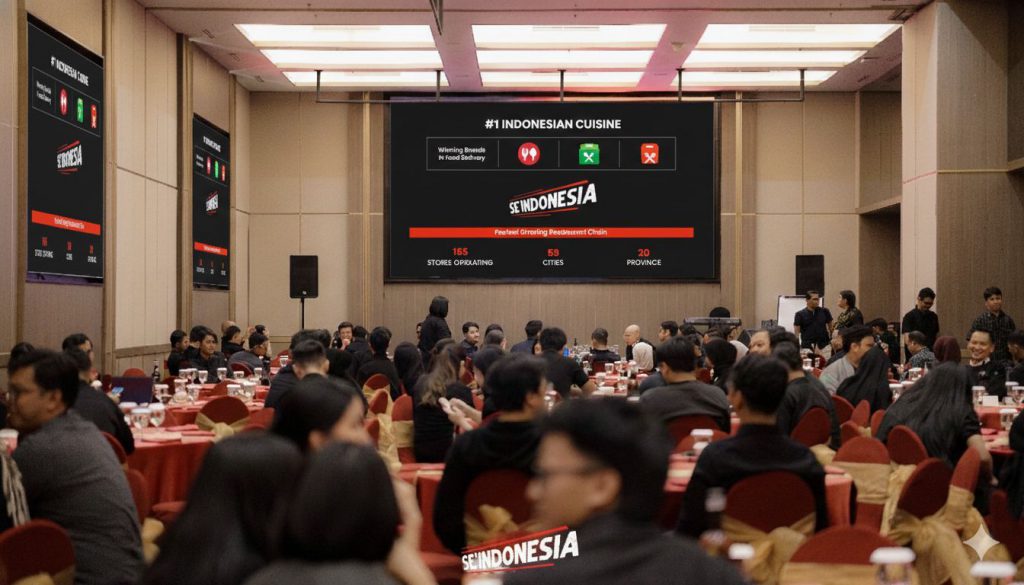
By the end of 2025, the company was operating 165 outlets across Indonesia. [4]
The online and offline businesses are treated as separate channels with distinct customer bases. Rinaldi estimates that 80 to 90% of dine-in customers are different people from delivery customers. [1] Online customers want speed and convenience; they order through apps and optimize for delivery radius. Dine-in customers want experience and location. Se’Indonesia’s marketing strategy for online follows the same logic as its production strategy: do the work where the customer already is. “Your customer is in the delivery app. Why don’t you put everything, your marketing, in the delivery app?” [1] The result was a channel optimization approach that prioritised in-app performance over brand advertising outside the platforms.
By April 2025, when Insignia Ventures Partners led a USD 9.7 million Series A round, Se’Indonesia was serving over two million meals monthly, had maintained monthly profitability for fifteen consecutive months, and was recovering its per-outlet capital in under nine months. [3]
What Se’Indonesia Has Proven
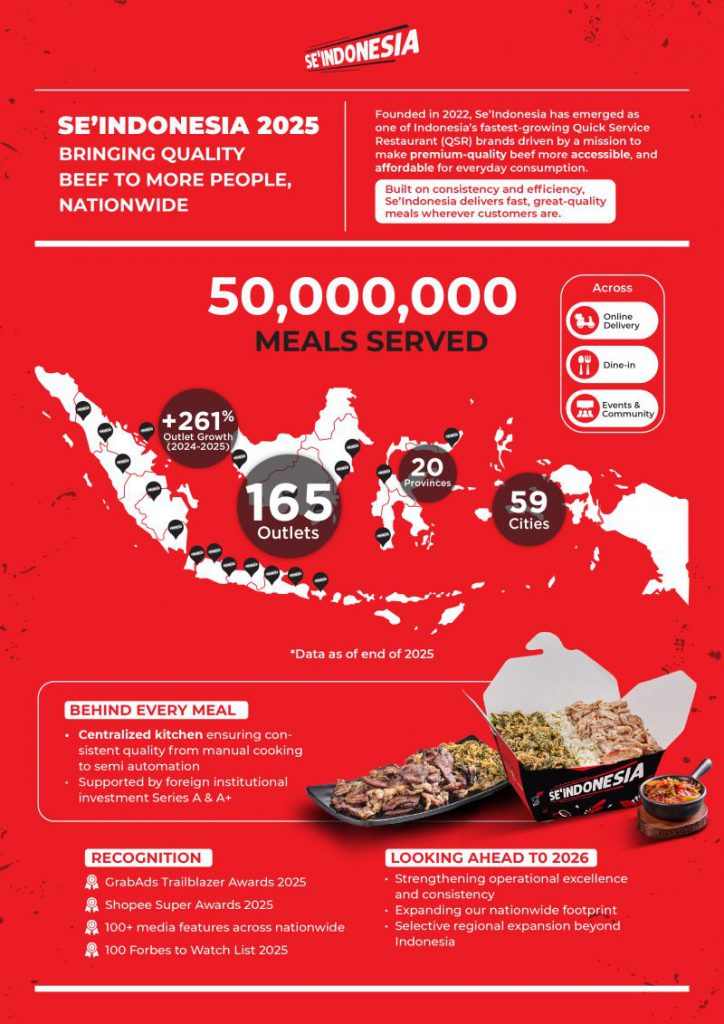
2025 numbers. Se’Indonesia LinkedIn.
The Forbes 30 Under 30 recognition lands at a particular moment in Se’Indonesia’s trajectory. The company is no longer proving that affordable beef works in Indonesia; the data settled that question. What it is now building toward is whether a QSR brand built around a centralized production model can extend that model beyond Indonesia’s borders.
The international expansion thesis Rinaldi has outlined is a franchise-and-supply model: Se’Indonesia would run the factory and the supply chain, while local franchisees would operate the outlets in new markets. The product is the logistics infrastructure as much as the rice bowls. [1]
Within Indonesia, the menu is already extending beyond the original se’i beef and chicken lineup into meatballs, cheese-based items, and new preparations, all developed against the same constraint that has governed every product decision since 2022: can the central kitchen produce it at scale? [1]
Three things account for the business Se’Indonesia has built.
The first is the supply chain insight itself. Recognizing that imported beef could be delivered to Indonesian consumers at a lower price than domestic alternatives was not obvious. It required looking at a category that everyone else had written off as inherently expensive and asking whether the price signal was a market reality or a production inefficiency.
The second is the decision to centralize production before it was operationally necessary to do so. Se’Indonesia could have launched with per-outlet cooking and centralized later. Instead, the founders built the factory model from the beginning, accepting the capital and operational complexity it required in exchange for the unit economics and consistency it delivered. That decision made expansion predictable in a way it would not have been otherwise.
The third is the discipline to define and dominate a narrow category. “Pick the niche,” Rinaldi said in September 2025. “Category leader for F&B might be an opportunity because when you have a category leader position, everything will be efficient, including the supply chain.” [1]
Se’Indonesia is the dollar beef rice bowl in Indonesia. That positioning is not accidental. It is the result of founders who understood, from years running cloud kitchens and watching Kopi Kenangan scale, that clarity of category is itself a competitive asset.
The Forbes recognition is an acknowledgment of what the numbers already show. Two young founders, neither of them trained in F&B, looked at Indonesia’s most underserved protein segment and built a factory to serve it. Fifty million meals later, the category exists because they decided it should.
References
[1] Rinaldi Utama, “Se’Indonesia CEO and co-founder Rinaldi Utama on the Big Business of Dollar Beef Rice Bowls,” Insignia Business Review, September 14, 2025. https://review.insignia.vc/2025/09/14/seindonesia-rinaldi-utama/
[2] “Kenalan dengan Pendiri Se’Indonesia, Brand Kuliner Pertama yang Tembus Forbes Asia 100 To Watch 2025,” Entrepreneur Bisnis, September 19, 2025. https://entrepreneur.bisnis.com/read/20250919/265/1912634/kenalan-dengan-pendiri-seindonesia-brand-kuliner-pertama-yang-tembus-forbes-asia-100-to-watch-2025
[3] Paulo Joquino and Shefali Dodani, “5 Reasons We Are Backing the Bold in Beef Rice Bowl F&B Se’Indonesia,” Insignia Business Review, May 6, 2025. https://review.insignia.vc/2025/05/06/seindonesia/
[4] Se’Indonesia, “Inside Se’Indonesia’s Journey as One of Indonesia’s Fastest-Growing QSR Brands,” OpenPR, November 13, 2025. https://www.openpr.com/news/4268853/inside-se-indonesia-s-journey-as-one-of-indonesia-s
[5] Paulo Joquino, “The Edge That Compounds: What Finmo, Se’Indonesia, and Carro Have Taught Us About Backing the Bold,” Insignia Business Review, April 23, 2026. https://review.insignia.vc/2026/04/23/forbes-100-to-watch/
[6] Forbes Asia, “30 Under 30 Asia 2026 — Retail & Ecommerce,” Forbes, May 2026. https://www.forbes.com/30-under-30/2026/asia/retail-ecommerce
[7] “Tiara Andini hingga Pendiri Startup Indonesia Masuk Forbes 30 Under 30 Asia 2026,” Liputan6, May 29, 2026. https://www.liputan6.com/bisnis/read/7390316/tiara-andini-hingga-pendiri-startup-indonesia-masuk-forbes-30-under-30-asia-2026

Paulo Joquiño is a writer and content producer for tech companies, and co-author of the book Navigating ASEANnovation. He is currently Editor of Insignia Business Review, the official publication of Insignia Ventures Partners, and senior content strategist for the venture capital firm, where he started right after graduation. As a university student, he took up multiple work opportunities in content and marketing for startups in Asia. These included interning as an associate at G3 Partners, a Seoul-based marketing agency for tech startups, running tech community engagements at coworking space and business community, ASPACE Philippines, and interning at workspace marketplace FlySpaces. He graduated with a BS Management Engineering at Ateneo de Manila University in 2019.




 Home
Home

 Publications
 Podcasts
  Search