
For many founders and investors, Japan represents a paradox: a high-value market that remains challenging to penetrate. It’s the world’s third-largest economy and the second-largest for enterprise software, yet its unique culture, language barriers, and business practices can feel like a locked door. But for those who find the right key, Japan offers not just revenue, but also a level of customer loyalty and long-term partnership that is rare in today’s global landscape.
So, what does it take to unlock Japan? We’ve gathered insights from the On Call with Insignia podcast, where we’ve had founders who have successfully navigated this journey, Japanese investors, as well as institutional partners like the Japan External Trade Organization (JETRO) and the Tokyo Stock Exchange (TSE), to shed light on this pathway to the country.
Is the Problem Everywhere Else a Problem in Japan?
Before even thinking about solutions, it’s crucial to understand if the problem your startup solves is a pressing issue in Japan. The country’s unique demographic and social landscape presents distinct challenges—and therefore, opportunities. Takeo Nakajima, Director General of Innovation at JETRO, points to some of these areas:
“For example, decreasing population or aging. Japan is currently facing the need to tackle those issues, but we don’t have a clear answer yet. So, it should be a collaborative effort on how we should tackle those aging societies or depopulation issues in local areas. One good example is a Singaporean mobility firm named SWAT Mobility. They are now undergoing some projects in several cities in Japan. Some areas are very local, very depopulated areas, and there are not enough traffic services, public and private. Sometimes there is just one bus a day. It’s very inconvenient, particularly for elderly people or people with disabilities. That firm is trying to provide on-demand transportation services in those local areas. It’s very challenging, of course, but we are very happy to have those global players try to solve social issues in Japan.” [1]
This highlights a key point: a solution that is a “nice-to-have” in other markets might be a “must-have” in Japan, where societal needs are evolving.
Is the Solution Everywhere Else also a Solution in Japan?
Even when a problem is universal, the solution often isn’t. The case of Intellect, a mental healthcare tech provider, offers a lesson in the importance of localization. Intellect’s former Senior VP of Partnerships and Solutions Cassandra, shares the company’s experience adopting their Intellect Dimensions feature to the market:
“Japan is at the forefront of Asia when it comes to awareness of mental well-being, specifically in the workforce… The challenge is that because there is already awareness, it’s harder to innovate within a market that is so familiar with EAPs (Employee Assistance Programs). In Japan, because they’re so familiar already, the challenge is how we can innovate within the comfort zone they have… Nuances are especially important in Japan. Intellect has its own “Intellect Dimensions,” a 26-question questionnaire that measures various metrics… But in Japan, they’re so familiar with stress checks that our 26-questionnaire, no matter how robust it is, isn’t a replacement for a stress check. Forcing our way through with our questionnaire isn’t going to work in Japan. Therefore, the product team, with inputs from the Japan team, developed a solution that meets the basic level of care expected by the Japanese population—a stress check.” [2]
This demonstrates that a one-size-fits-all approach will not succeed. Success in Japan requires a deep understanding of existing norms and a willingness to adapt your product to meet local expectations, even if it means rethinking a core part of your offering.
Lead Time Cost for Long-Term Trust
A consistent theme from those who have entered the Japanese market is the emphasis on trust and the time it takes to build it. While this can seem inefficient to startups accustomed to rapid-fire deals, the payoff is significant. As Rei Murakami, Founding Partner of Kadan Capital, explains:
“One thing is that closing deals with businesses takes much longer. It’s not as simple as having online codes. It’s a lot about building trust and meeting in person… You really have to accept that these things, which seem inefficient, need to be done for you to win bigger deals. The upside is that, because Japan is very much based on trust, once you win that trust, the stickiness is higher.” [3]
Pat Patel, Co-CEO of GFTN Forums, echoes this sentiment, advising founders to “be prepared for long lead times—but know that once trust is built, there’s long-term commitment.” [4] This long-term perspective is a fundamental shift from the often-transactional nature of business in other regions.
Shinji Asada, CEO and co-founder of One Capital, shares on our podcast back in 2023 that while the market may be hard to crack, the opportunity is significant, particularly in enterprise software:
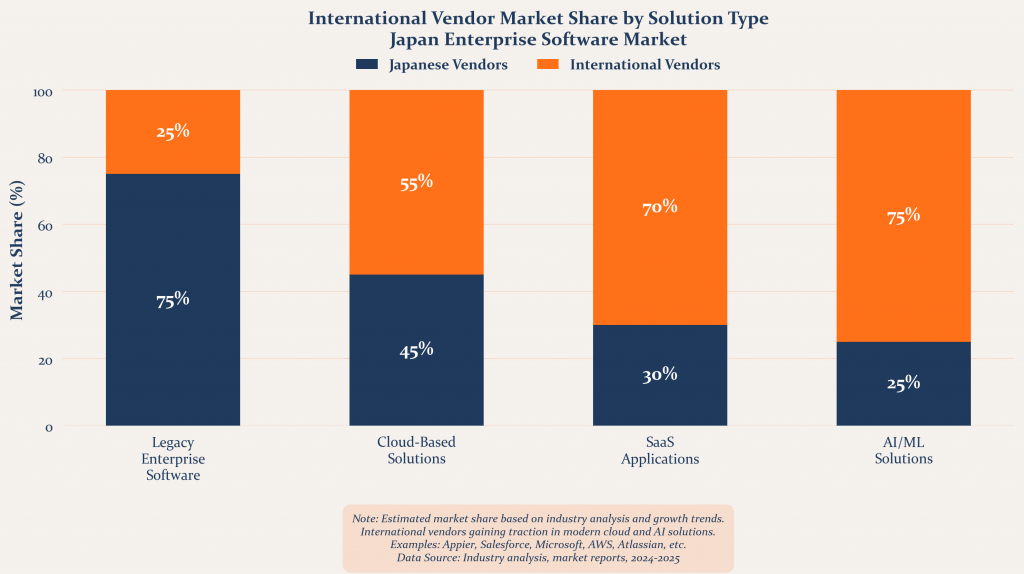
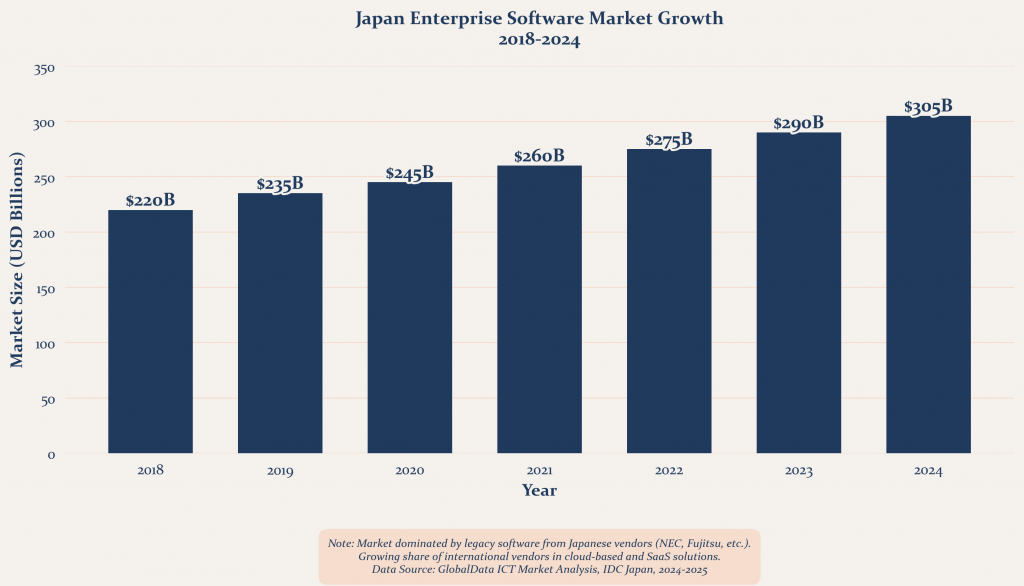
“It’s about 280 billion on an annual spend basis, and a lot of that is dominated by legacy software… So it’s a low-hanging fruit [market] if you have a great user interface experience. You can land customers. The initial leeway should start with SMBs and then move it off to mid-market and enterprise.” [5]
Local Talent Global Culture Balance
Building a team in Japan is a recurring topic. Finding the right country manager is often cited as the single most critical factor for success. But what defines the “right” leader? Rei Murakami highlights the difficulty:
“Hiring is very tough in Japan, especially as a non-Japanese person entering the Japanese market. You need to find someone who can both localize for the Japan market and speak English to communicate with your headquarters.” [3]
However, Shinji Asada offers a different perspective, prioritizing execution over perfect bilingualism:
“I think you should really hire a strong country manager that isn’t purely about his or her bilingual abilities… The guy who can execute is who I would really recommend… it’s challenging to be communicating with the local Japan head that doesn’t speak fluent English, but at the same time, we have all kinds of tools out there, like Google Translate and all that stuff.” [5]
Aaron Tan, CEO and co-founder of Carro, shares a practical approach to cultivating local leadership from a panel back in 2022:
“Oftentimes, people always say this — the moment I want to expand into the market, I always [allot] a one or two year preparation [period]. So in one or two years, I will start hiring a Japanese leader in Singapore, right? And we train them, teach them, and then we ask them to go back.” [6]
Institutional Relationships are Powerful Door-Openers
For foreign startups, navigating the Japanese business landscape can be challenging. This is where institutional partners can play a pivotal role. Beomsu Son, APAC Deputy Head at the Tokyo Stock Exchange, emphasizes the importance of credibility:
“Knocking on the door to JETRO or the Tokyo Stock Exchange is quite a good option because we will support penetrating the Japanese market or looking for business partners, of course, without charge… being invested by some Japan-related VCs or investors like Insignia Ventures Partners is quite a good option.” [7]
These institutions can provide not just practical support, but also a stamp of legitimacy that is invaluable in a market that prizes established relationships.
Where Does Japan Fit in the Bigger Picture?
For many startups, Japan is not just a market in itself, but a strategic piece of a larger puzzle. Bintang Hidayanto, CEO and co-founder of Gani.ai, illustrates how a presence in Japan can create cross-border opportunities:
“What Gani.ai allows you to do is to ask about Japanese laws in Indonesia, laws in the Middle East in UAE that are Arabic, and then be given expert excerpts and citations from the basis, the source, both in the Arabic language and translated to Japanese language.” [8]
Aaron Tan of Carro provides a clear view of Japan’s scale:
“It’s one of the largest economies in the world, with 5.86 million cars per year. It’s a much bigger market alone than surface Southeast Asia combined for myself at least… While it may not be growth for them locally, it’s still growth for us as a company.” [6]
The Key to Unlocking Japan
Entering the Japanese market requires a long-term commitment. It demands patience, a willingness to adapt, and a commitment to building long-term relationships. But for those who invest the time and effort to understand its nuances, Japan offers stability, loyalty, and scale that can be a game-changer for any startup. The door may be locked, but with the right insights and approach, it is possible to enter.
References
[1] On Call with Insignia: Takeo Nakajima
[2] On Call with Insignia: Cassandra Loh
[3] On Call with Insignia: Rei Murakami
[4] On Call with Insignia: Pat Patel
[5] On Call with Insignia: Shinji Asada
[6] On Call with Insignia: Aaron Tan
[7] On Call with Insignia: Beomsu Son
[8] On Call with Insignia: Bintang Hidayanto

Paulo Joquiño is a writer and content producer for tech companies, and co-author of the book Navigating ASEANnovation. He is currently Editor of Insignia Business Review, the official publication of Insignia Ventures Partners, and senior content strategist for the venture capital firm, where he started right after graduation. As a university student, he took up multiple work opportunities in content and marketing for startups in Asia. These included interning as an associate at G3 Partners, a Seoul-based marketing agency for tech startups, running tech community engagements at coworking space and business community, ASPACE Philippines, and interning at workspace marketplace FlySpaces. He graduated with a BS Management Engineering at Ateneo de Manila University in 2019.



 Home
Home

 Publications
 Podcasts
  Search