
For most of the internet’s commercial history, a human was always somewhere in the loop.
Someone clicked a button. Someone typed a credit card number. Someone compared prices, read a review, and decided. Even as the experience layer improved — from desktop to mobile, from search bars to recommendation engines — the underlying assumption held: commerce required a human intent at its origin and a human action at its close.
That assumption is beginning to break.
AI agents are increasingly doing the searching, comparing, and transacting on behalf of users. In some B2B workflows, one company’s procurement agent is already negotiating directly with another company’s inventory agent, with no human touching the transaction until it appears in an audit log. The volume is still small. The direction is not.
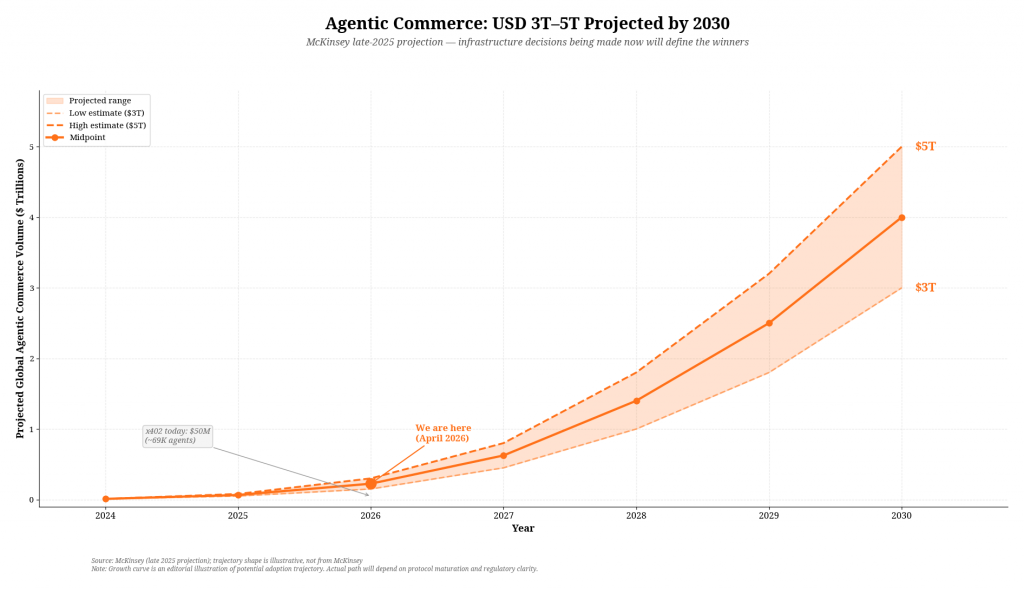
McKinsey projected in late 2025 that agentic commerce could orchestrate between $3 trillion and $5 trillion in global commerce by 2030. That is not a projection about a distant speculative future. It is a projection about infrastructure decisions being made right now — and the companies building in 2026 will have compounding advantages that late entrants cannot easily replicate.
The Stack Taking Shape
What makes agentic commerce different from prior waves of automation is that it requires agents to do something previous software could not: discover other agents, delegate tasks to them, and pay for the outputs — all without human intervention.
Three protocol layers are converging to make this possible.
MCP (Model Context Protocol), developed by Anthropic, is the universal adapter that equips individual agents with tools, data, and context. A2A (Agent-to-Agent Protocol), developed by Google, handles the layer above — how agents communicate, delegate tasks, and negotiate with each other. By April 2026, A2A had reached its one-year anniversary with more than 150 organizations in production, including deployments across Azure AI Foundry, Amazon Bedrock, and Salesforce. [1] x402, developed by Coinbase and co-governed with Cloudflare, handles payment: by reviving the dormant HTTP 402 status code, it embeds stablecoin micropayments directly into web interactions so agents can pay for resources as seamlessly as they exchange data — no accounts, no subscriptions, no API keys. [2]
MCP gives agents tools. A2A lets agents coordinate. x402 lets agents pay each other.
As of late April 2026, approximately 69,000 active agents on x402 have processed over 165 million transactions totaling $50 million in volume. [3] That is a rounding error in global commerce — but the protocol layer is no longer a whitepaper. It is working infrastructure, and Coinbase’s launch of Agent.market this week as a discovery and payment layer for autonomous agents signals that the race for platform position in this stack has already started.
Coinbase Singapore Country Director Hassan Ahmed framed the underlying logic plainly in a recent On Call with Insignia Ventures conversation: “My intuition is that this is one of those classic cases where we overestimate what can happen in the near term and vastly underestimate what it could become in the long term.” [4] And then, later in the same conversation: “There is one scenario, which I think is quite plausible, in which agentic commerce becomes larger than human-driven commerce in the future.”
The hype cycle will come. The infrastructure will outlast it.
Where Value Accrues
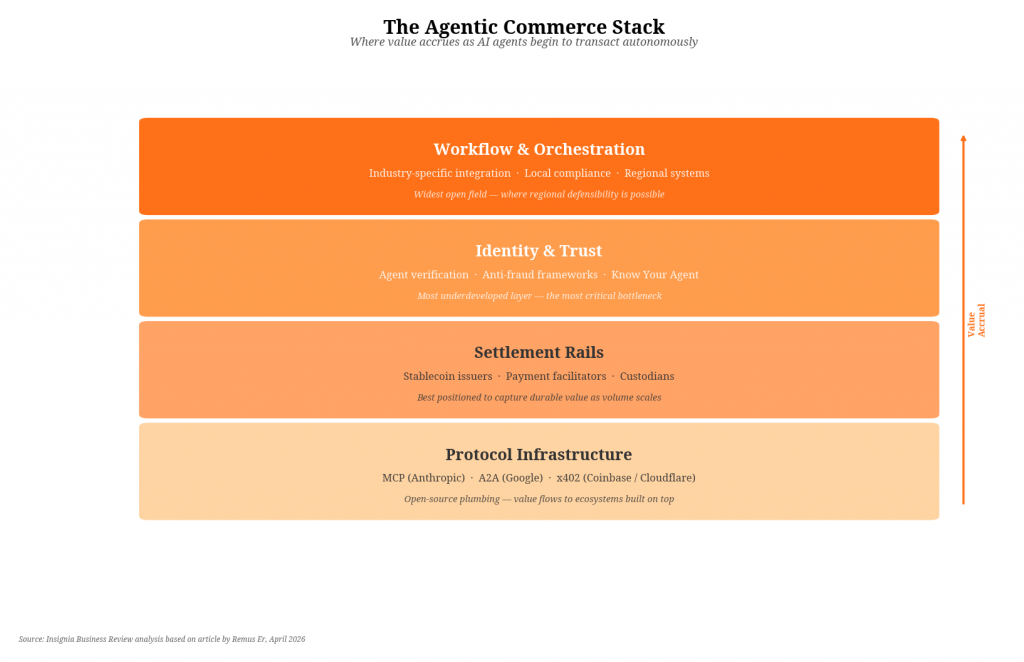
Every prior technology wave distributed value across its stack in ways that surprised early observers. In industrial automation, hardware captured most of the value. In mobile, the application layer captured far more than the device manufacturers. In cloud, managed services consistently outperformed raw compute.
Agentic commerce has its own stack, and the same pattern applies. Protocol infrastructure — MCP, A2A, x402 — is open-source plumbing. Value here flows to the ecosystems built on top, not to the protocols themselves. Settlement rails — stablecoin issuers, payment facilitators, custodians — sit above the protocol layer and are better positioned to capture durable value as volume scales. Identity and trust — agent verification, anti-fraud frameworks, Know Your Agent protocols — remains the most underdeveloped layer and the most critical bottleneck; commerce cannot scale if merchants and platforms cannot distinguish legitimate agents from malicious bots. Workflow and orchestration — companies that make agents actually work in specific industry contexts — is the widest open field, especially for regional players who understand local systems and compliance environments that global protocol teams will not prioritize.
The settlement layer is where StraitsX — Insignia’s portfolio company building stablecoin infrastructure out of Singapore — is most directly relevant. Tianwei Liu, CEO and co-founder of StraitsX, put the agentic payments thesis plainly at Singapore FinTech Festival 2025: “AI will bring about generative payments. Machines or digital agents will be able to initiate transactions under set parameters. That’s machine-to-machine and agent-to-agent finance, enabled by programmable money.” [7] In December 2025, StraitsX followed that vision with action, launching both XSGD and XUSD on Solana with native x402 support, positioning them among the first regulated stablecoins explicitly designed for agent-to-agent payment flows. [5] That move reflects a deliberate thesis: programmable money needs to be both internet-native and local-currency-aware, because an AI agent completing a transaction in Singapore still needs a settlement currency that local rails can accept and that regulators trust.
StraitsX’s advantage here is cumulative. Xfers built payment infrastructure under regulatory scrutiny from 2015, obtained an MAS e-money license in 2019, launched XSGD in 2020 after close engagement with regulators, and accumulated a full licensed operating stack — payment APIs, regulated local-currency stablecoin issuance, Major Payment Institution permissions — before stablecoins became mainstream. Standard Chartered now provides reserve management and custody for both XSGD and XUSD. That depth is not easily replicated by a protocol-native project starting from scratch.
The company’s own data shows what it looks like when that infrastructure becomes genuinely invisible. Between Q4 2024 and Q4 2025, stablecoin-backed card transaction volume across StraitsX’s global programs grew 40x, with card issuance rising 83x, spending concentrated in restaurants, groceries, and department stores — habitual daily use rather than occasional crypto off-ramps. [6] The same rails that power those card transactions are the rails that will power agent-initiated payments when agentic commerce scales. That is the flywheel: cards build liquidity and trust, which attracts institutional flows, which deepens the settlement layer, which makes it viable for agents.
The Southeast Asia Position
Southeast Asia is not where most of the protocol development is happening. But it may be one of the most consequential early deployment contexts for the reasons that matter most: cross-border complexity, manufacturing density, and the size of the gap between what legacy financial infrastructure provides and what businesses actually need.
Eleven countries, at least eight major currencies, and significant remittance flows mean that the friction cost of moving money across the region is among the highest in the world. Agent-driven B2B procurement, inventory management, and supplier coordination map directly onto how regional supply chains are structured — and settlement delays in those chains translate into real working capital costs. Singapore’s IMDA published the Model AI Governance Framework for Agentic AI in January 2026, establishing a legal vocabulary for delegation chains and multi-agent coordination that enterprise deployers need before they will commit capital.
StraitsX’s April 2026 partnership connecting KBank’s Q Wallet with GrabPay QR through XSGD-linked blockchain settlement captures the pattern well: travelers pay through familiar wallets, merchants receive local currency, and the stablecoin-enabled settlement complexity disappears from every layer anyone can see. That invisible infrastructure is what agentic commerce will need at scale — not a new consumer product, but regulated middleware moving quietly underneath whatever interface the world is already using.
For Southeast Asian builders more broadly, the regional opportunity is not to win the protocol race. It is to own the workflow and settlement layers: integrating global protocols with local payment rails, local compliance requirements, and local operational systems that global players will not prioritize. That is not a consolation prize. In a stack where protocol infrastructure is open-source and intelligence consolidates around a handful of foundation model providers, the integration and settlement layers are where durable regional defensibility is possible.
What Comes Next
The protocol layer is stabilizing faster than most expected. 2026 is the year MCP, A2A, and x402 mature from early-stage experiments into production infrastructure — and the first meaningful agent-to-agent commercial transactions outside controlled demos are already happening. The identity and trust layer will define the next bottleneck. The workflow layer remains the widest open field.
The companies that will matter in 2030 are mostly building now. The builders who treat agentic commerce as obvious — and build accordingly — are the ones who will look back on 2026 as the year it was all decided.
References
[1] byteiota. “Microsoft Agent Framework 1.0 Ships: MCP + A2A Converge.” 04/18/2026. https://byteiota.com/microsoft-agent-framework-1-0-ships-mcp-a2a-converge/
[2] Coinbase. “Coinbase and Cloudflare Will Launch the x402 Foundation.” Coinbase Blog. https://www.coinbase.com/blog/coinbase-and-cloudflare-will-launch-x402-foundation
[3] Cryptonews. “Coinbase Expands x402 With AI Agent App Store.” 04/21/2026. https://cryptonews.com/news/coinbase-x402-ai-agent-app-store-crypto-payments/
[4] On Call with Insignia Ventures. “Why venture scale builders should take stablecoins seriously with Coinbase Singapore Country Director Hassan Ahmed.” Insignia Business Review. 04/13/2026. https://review.insignia.vc/2026/04/13/coinbase-hassan-ahmed/
[5] StraitsX. “StraitsX to Launch Both XSGD and XUSD on Solana’s Public Blockchain.” 12/16/2025. https://www.straitsx.com/blog-post/straitsx-to-launch-both-xsgd-and-xusd-on-solanas-public-blockchain
[6] Rodrigues, Francisco. “Stablecoin payments go ‘invisible’ in Southeast Asia as crypto card business surges.” CoinDesk. 03/29/2026.
[7] “StraitsX builds the rails for real-world stablecoin payments.” The Asian Banker. 11/20/2025. https://www.theasianbanker.com/updates-and-articles/straitsx-builds-the-rails-for-real-world-stablecoin-payments





 Home
Home

 Publications
 Podcasts
  Search